Three Datapoints the Fed Is Likely Watching Ahead of the September FOMC Meeting
Key Takeaways:
- Investors will be watching the September Federal Reserve interest rate decision closely. We believe this is a live meeting, but the Fed will likely weigh several datapoints, including labor market data, CPI inflation, and inflation expectations.
- The U.S. labor market remains healthy, but wage pressures continue to ease. August payrolls increased by 162,000, well above expectations, while wage growth slowed to 3.1%, suggesting labor demand remains solid without signs of wage-price inflation.
- Next week's consumer price index (CPI) report could play a pivotal role in the Fed's September decision. Inflation has come in below expectations for the past two months, and another favorable reading could support keeping rates unchanged, while a reacceleration in price pressures may increase the likelihood of a rate hike.
- Long-term inflation expectations remain well anchored despite inflation running above the Fed's target. Market-based measures, such as break-even rates and forward inflation expectations, remain in the low-2% range, suggesting investors expect inflation to moderate over time rather than become entrenched at elevated levels.
Introduction
The next Federal Reserve interest rate decision and press conference is on Wednesday, September 16. For markets, this is a particularly notable Fed meeting because investors believe there is a real possibility that the Fed decides to raise interest rates – this would be the first rate hike since July 2023. In fact, the probability of a rate hike is now about 60%, according to CME FedWatch
What are the factors that the voting members of the Federal Open Market Committee (FOMC) are likely watching to help them make their decision? We highlight three key factors below:
1. The U.S. labor market and wage growth
We know that the Fed has a dual mandate: Maximum employment and price stability. The first part of this mandate refers to the labor market and specifically keeping the unemployment rate low without causing inflation. For this, the Fed uses a number of labor indicators, but perhaps one of the most important is the monthly nonfarm-jobs report.
The August nonfarm-jobs report: On Friday, the U.S. nonfarm-jobs report pointed to a healthy pickup in the labor market for the month of August. New jobs added totaled 162,000, well above forecasts of 55,000, and above last month's revised 21,000 jobs added. Notably, job gains came from a broad set of sectors including leisure and hospitality, government, and education and health services. Most of the 14 sectors showed gains, except for financial services and information (which include telecom, media, data, and internet services).
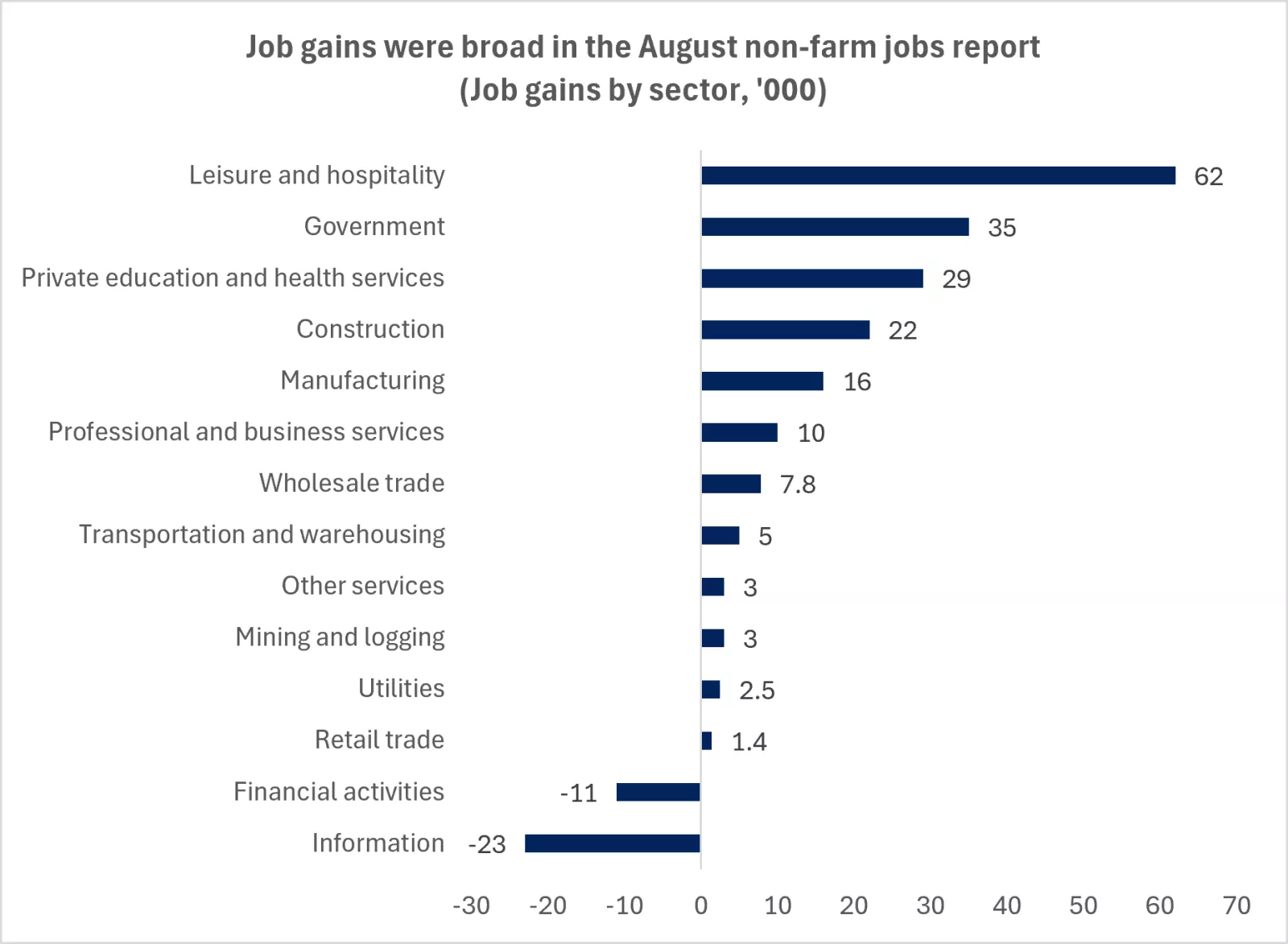
The chart shows that job gains were broad in the August U.S nonfarm jobs report.
The chart shows that job gains were broad in the August U.S nonfarm jobs report.
The unemployment rate remained steady at 4.1%, well below the long-term average U.S. unemployment rate of around 5.5%. This comes even as the labor force participation rate ticked higher, from 61.4% to 61.6%, implying that even with new entrants to the labor force, the demand for labor and supply of labor remain roughly balanced, keeping the unemployment rate steady.
Wage inflation? One of the key components of the job report that the Fed monitors is wage growth. If the labor market were running "hot," this may show up as rising wages, as employers have to increase salaries to remain competitive. These higher wages may lead to higher prices and wage-price inflation.
However, we have not seen this wage inflation play out in the current labor market. The August jobs report showed wage gains of 3.1% year-over-year, in line with forecasts and below last month's 3.2% reading. Wage growth has averaged about 3.5% this year, and the August reading was the lowest level since 2021.
Of note, wage gains have been outpacing headline inflation for much of the past three years, implying that consumers have seen positive real wages. This has shifted in the past few months, as CPI inflation has been elevated at around 3.4%, while wage gains have moved lower. However, if we expect inflation rates to gradually head back toward 2.0% levels, consumers should see positive real wage growth again too.
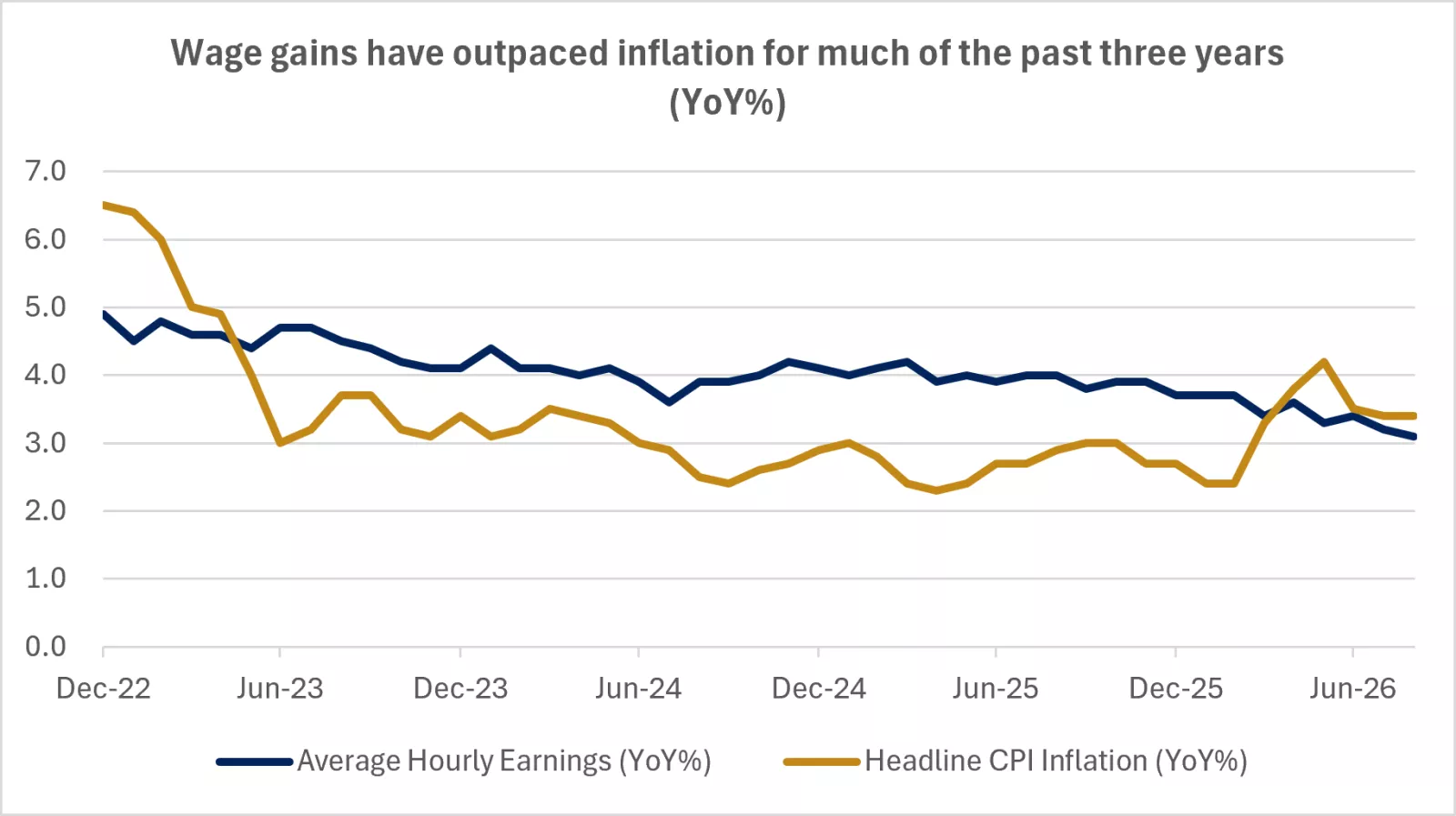
The chart shows that wage gains have outpaced inflation for much of the past three years.
The chart shows that wage gains have outpaced inflation for much of the past three years.
2. The next CPI inflation report remains front and center
The second and perhaps most critical datapoint that the Fed will likely be watching is the inflation rate. Consumer price index (CPI) and personal consumption expenditure (PCE) inflation has been stubbornly elevated, with headline and core inflation running above the Fed's 2% target for over five years now.
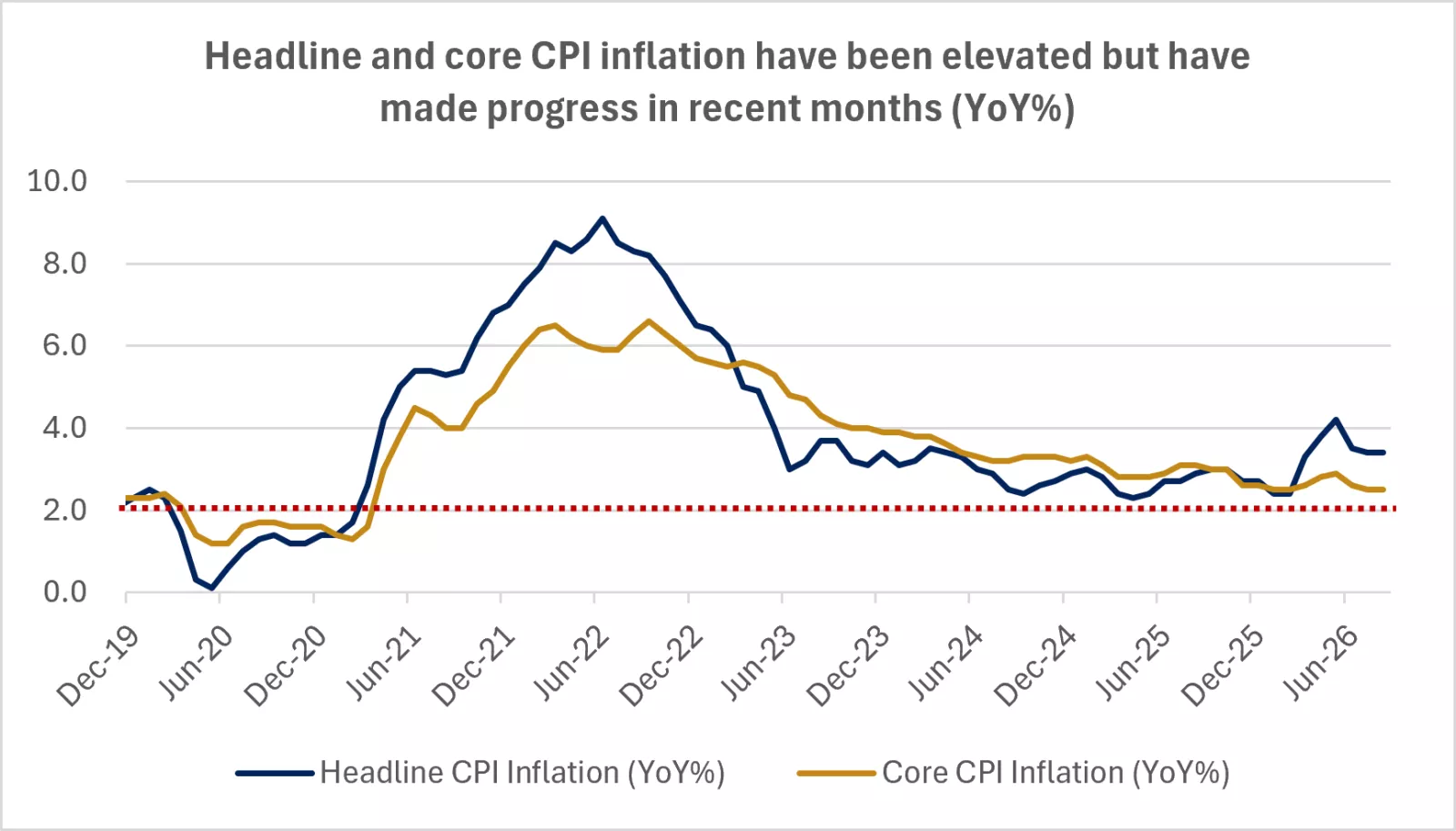
The chart shows that headline and core CPI inflation have been elevated but have made progress in recent months.
The chart shows that headline and core CPI inflation have been elevated but have made progress in recent months.
However, perhaps the silver lining more recently has been that consumer price index (CPI) inflation has been in line or below expectations for the last two months. This past week, Federal Reserve Governor Waller noted that if inflation continues to cool, he "would be inclined" to keep the fed funds rate unchanged. This was a welcome message for markets, after Fed Chair Kevin Warsh a week earlier noted that the Fed may have "more work to do" if inflation does not show improvement.
Next inflation reading is Friday, September 11: Given the scrutiny around inflation trends, investors and the Fed will be closely watching next Friday's CPI inflation report for August. This should help determine if the recent cooler inflation readings were an anomaly or perhaps the start of a trend.
Expectations are for headline CPI inflation to remain steady at 3.4% year-over-year. However, core CPI inflation is expected to tick lower, from 2.5% to 2.4% annually. We know that oil prices did climb higher toward the end of August, but averages for the month remained relatively steady, with WTI crude oil climbing from about $79 per barrel on average in July to about $82 in August.
In our view, the September rate decision is very much a live one. If inflation does come in line or lower than expectations next week, combined with wage gains that were contained in the jobs report, the Fed may be more inclined to remain on hold. If we start to see a reacceleration in inflation rates, which has not been the case in recent months, that may push the Fed to move interest rates higher.
3. Longer-term inflation expectations
The third set of data that the Fed is likely watching closely are inflation expectations. The Fed wants to keep inflation expectations anchored because these can become self-fulfilling: If households and corporations believe inflation will return to around 2.0%, their behavior and pricing models may reflect this view. Similarly, if they believe inflation will head towards 4% or 5%, they may reflect this as well.
The Fed has a number of tools to monitor inflation expectations. These include survey-based measures (like the Philadelphia Fed survey of professional forecasters), household measures (like the University of Michigan consumer sentiment survey), and market-based metrics, including the five- and 10-year breakeven rates as well as the Fed's five-year forward inflation expectation rate.
Perhaps the most objective of these and easiest to monitor are the market-based metrics, as they are timely, involve real capital and investors, and have a longer-term focus.
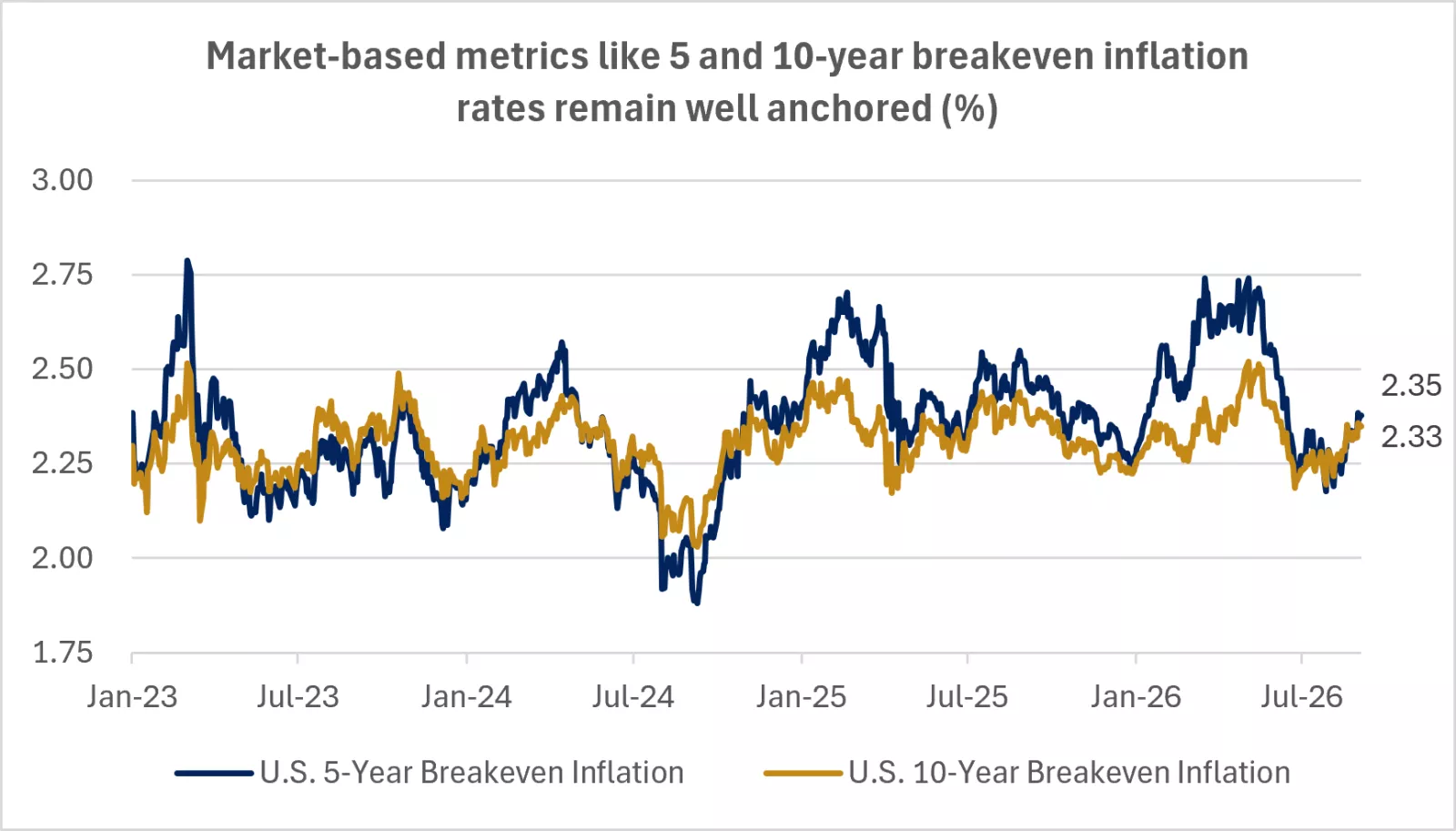
The chart shows that market-based metrics like 5 and 10-year breakeven inflation rates remain well anchored.
The chart shows that market-based metrics like 5 and 10-year breakeven inflation rates remain well anchored.
Overall, these market-based inflation expectations remain relatively well anchored and have not shown signs of meaningful re-acceleration despite inflation running above the Fed's target. Measures such as 10-year TIPS breakeven inflation and longer-term forward inflation expectations remain in the low-2% range, suggesting investors expect inflation to moderate over time rather than become entrenched at current levels. This should be encouraging for the Fed, as anchored expectations can help prevent temporary inflation shocks from becoming more persistent.
What does the Fed decision mean for portfolios?
We expect that the Federal Reserve will have a tough decision to make on September 16 on whether to raise interest rates or hold them steady. The FOMC will likely have to weigh a healthy labor market and elevated inflation rates against potentially better recent trends in inflation and well-anchored inflation expectations.
For investors, however, we know that a good defense against higher inflation is to invest in assets that can outpace inflation rates over time. In our view, a diversified portfolio across market caps, regions, and sectors can set up investors for positive after-inflation rates of return. We continue to favor U.S. large-cap and mid-cap stocks, emerging market and international value equities, as well as the industrials and communication sectors, which give exposure to both technology and AI, as well as cyclical parts of the market.
Also, keep in mind that even if the Fed decides to raise rates once or even twice, we don't believe this would derail the broader narrative. The U.S. economy is growing at or above trend levels, S&P 500 earnings growth is on pace for over 30% this year, and the labor market and consumer remain healthy. In this backdrop, we believe the economy would be able to absorb a mid-cycle adjustment in interest rates, especially if it helps bring credibility to the Fed and pushes inflation expectation lower.
Your financial advisor can help ensure that your portfolio is aligned with your personal investment goals and risk tolerances, to help ensure you are making progress toward financial fulfillment, regardless of inflation and interest rate risks.
Mona Mahajan
Investment Strategist
Source for all data in commentary: Bloomberg.
Mona Mahajan
Mona Mahajan is responsible for developing and communicating the firm's macroeconomic and financial market views. Her background includes equity and fixed income analysis, global investment strategy and portfolio management.
She regularly appears on CNBC and Bloomberg TV, and in The Wall Street Journal and Barron’s.
Mona has a master’s in business administration from Harvard Business School and bachelor's degrees in finance and computer science from the Wharton School and the School of Engineering at the University of Pennsylvania.
Previous weeks' weekly market wraps
8/28: A Clearer Path into September
8/21: A roller-coaster week for rates: Separating opportunity from risk
8/14: Cooling inflation supports the case for Fed patience
8/7: Easing headwinds clear the way to new highs
7/31: Fed and tech earnings take center stage
Important Information:
The Weekly Market Update is published every Friday, after market close.
This is for informational purposes only and should not be interpreted as specific investment advice. Investors should make investment decisions based on their unique investment objectives and financial situation. While the information is believed to be accurate, it is not guaranteed and is subject to change without notice.
Investors should understand the risks involved in owning investments, including interest rate risk, credit risk and market risk. The value of investments fluctuates and investors can lose some or all of their principal.
Past performance does not guarantee future results.
Market indexes are unmanaged and cannot be invested into directly and are not meant to depict an actual investment.
Diversification does not guarantee a profit or protect against loss in declining markets.
Systematic investing does not guarantee a profit or protect against loss. Investors should consider their willingness to keep investing when share prices are declining.
Dividends may be increased, decreased or eliminated at any time without notice.
Special risks are inherent in international investing, including those related to currency fluctuations and foreign political and economic events.
Before investing in bonds, you should understand the risks involved, including credit risk and market risk. Bond investments are also subject to interest rate risk such that when interest rates rise, the prices of bonds can decrease, and the investor can lose principal value if the investment is sold prior to maturity.