Key takeaways:
- Gold had a banner year in 2025, driven by a mix of short‑term and structural forces, including a weaker U.S. dollar, elevated geopolitical and fiscal risks, falling real rates, and strong central bank buying.
- History and today’s macro backdrop point to cooling ahead, with gold likely to consolidate after extreme momentum; shifting investor sentiment may also result in elevated volatility.
- Strategically, gold is a diversification tool, not a return driver, in our view. A small allocation can serve as “insurance” against tail risks, but over long horizons gold has generally underperformed equities.
- Silver tends to behave more like a growth‑sensitive industrial metal than a defensive store of value, making it more volatile, more correlated with equities, and ultimately a less effective portfolio diversifier than gold.
Since the start of the current bull market in 2022, a mix of U.S. and international stocks has delivered above‑average returns relative to history*. Yet, one investment has shined even brighter: gold. Precious metals had an extraordinary 2025, with gold surging 65%, and silver rising 155%, outpacing all major asset classes, including technology stocks and other equities*. The question now is: Can this rally be repeated, and how should investors view gold as an asset class going forward?
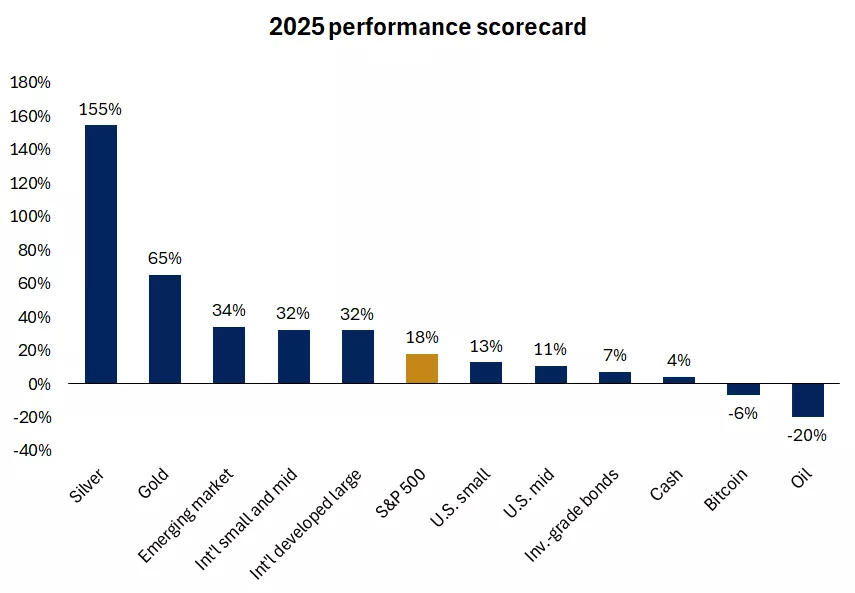
This chart shows the performance of the following assets in 2025: Gold: 65%, Silver: 155%, Emerging-markets/MSCI Emerging-markets: 34%, Int'l small- and mid/MSCI EAFE SMID: 32%, Int'l developed large/MSCI EAFE: 32%, S&P 500: 18%, U.S. Small-cap/Russell 2000: 13%, U.S. Mid-cap/Russell Mid-cap: 11%, U.S. inv.-grade bonds/ Bloomberg U.S. Aggregate: 7%, Cash/Bloomberg Treasury Bellwethers 3-month: 4%, Bitcoin: -6%, Oil: -20%.
This chart shows the performance of the following assets in 2025: Gold: 65%, Silver: 155%, Emerging-markets/MSCI Emerging-markets: 34%, Int'l small- and mid/MSCI EAFE SMID: 32%, Int'l developed large/MSCI EAFE: 32%, S&P 500: 18%, U.S. Small-cap/Russell 2000: 13%, U.S. Mid-cap/Russell Mid-cap: 11%, U.S. inv.-grade bonds/ Bloomberg U.S. Aggregate: 7%, Cash/Bloomberg Treasury Bellwethers 3-month: 4%, Bitcoin: -6%, Oil: -20%.
What has been driving the gains?
This historic rally was fueled by a mix of factors that boosted gold and precious metals' appeal to investors. Some drivers are short-term and may prove temporary, while others are more structural. Together, they created the perfect storm for gold’s surge:
- Favorable macroeconomic conditions
- U.S. dollar weakness
- Declining real interest rates
- High uncertainty and risk
- Trade uncertainty and deglobalization trends
- Rising geopolitical risks
- Fiscal concerns and debt sustainability
- Strong demand dynamics
- Robust central bank purchases
- Price momentum and increased investment flows
Because gold and precious metals broadly are assets that don’t generate cash flows or pay dividends, their appeal often depends on the opportunity cost of holding them. Real interest rates are a key driver. When they decline, gold typically benefits, and when they rise, gold tends to lag. Similarly, a weaker U.S. dollar lowers the relative cost for global investors, adding to gold’s attractiveness.
In 2025, both forces were in play. Central banks, including the Fed, shifted from restrictive to more neutral policy as inflation normalized, pushing real rates lower. At the same time, the U.S. dollar posted its worst calendar year since 2017, with the DXY down 9.5%, driven by a 12% depreciation against the euro*. Together, these dynamics alongside provided a powerful tailwind for precious metals.
But these factors alone do not explain the surge in gold and silver prices. Additional support came from elevated geopolitical uncertainty, initially sparked by Russia’s invasion of Ukraine, compounded by conflicts in the Middle East, the capture of Venezuelan leader Nicolás Maduro and protests in Iran. Concerns about Fed independence and government debt sustainability further reinforced gold’s role as a hedge against systemic risks. In an environment shaped by sanctions, trade wars, and a push toward deglobalization, gold has served as a safe-haven asset against tail risks. Some central banks have also accelerated diversification away from a dollar-centric system, stepping up gold purchases over the past three years, reinforcing demand.
Tactical lens: Is gold overextended?
Gold's move in 2025 was historic, marking the fourth strongest annual return since the end of the Bretton Woods system in 1971, which suspended the dollar convertibility into gold*. But the question now is what happens next. To explore this, we look at (1) lessons from history and (2) what current macro conditions imply.
1) Lessons from History
There have been 11 historical instances where gold surged 20% above its 200-day moving average, a sign of extreme momentum*. Forward returns after such strength have been mixed at best, with many periods showing muted or negative performance. Outside of a few standout winners (1978, 1979), upside momentum often fades*. Historically, buying gold at extremes tends to lead to cooling, consolidation, or mild corrections. Flat-to-slightly negative returns have been the norm*.
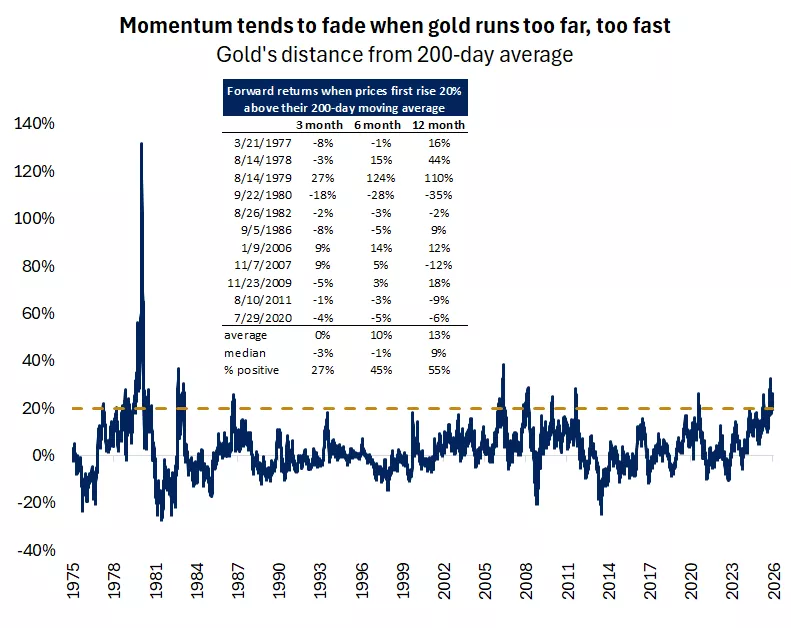
The graph shows that forward gold returns after prices rise 20% above their 200-day moving average. Historically, momentum tends to fade when gold runs too far, too fast.
The graph shows that forward gold returns after prices rise 20% above their 200-day moving average. Historically, momentum tends to fade when gold runs too far, too fast.
2) Macro Backdrop for 2026
In 2025, global trade uncertainty and tariff headwinds dominated headlines, yet growth proved resilient. For 2026, we expect another year of steady economic growth, slightly looser Fed policy alongside an ECB pause, modest fiscal stimulus tied to the new U.S. tax bill and fading tariff uncertainty. Lingering inflation pressures should limit the scope for aggressive easing, and while geopolitics remains a wild card, an oversupplied oil market reduces the risk of energy price spikes*. We also don’t anticipate another sharp U.S. dollar decline, though a modest softening is likely.
Taken together, these conditions could keep gold rangebound, with a risk of correction if growth surprises to the upside and long-term yields fail to decline further. Increased investment demand also opens the door for increased volatility as gold has become much more of an investor driven market. In 2025 Investment demand (ETFs, bars, coins) accounted for more than half of total gold demand, a sharp increase from roughly a third the prior year and up from just 15% in 2005**.
Bottom Line: After 2025’s parabolic advance, we expect gold’s momentum to cool, with historical patterns pointing toward a period of consolidation or even a corrective phase.
Strategic lens: A portfolio diversifier
With prices potentially overextended, we believe investors should avoid chasing gold higher. Gold has had three standout periods of strong performance—the 1970s, the 2000s, and the past five years*. But over longer horizons, it has delivered higher volatility and lower returns than equities, often with extended stretches of sideways action and long recovery periods*. Notably, once it peaked in 1980, it took until 1999 to make a new high. Since 1970, gold has returned 9% annualized versus 11% for the S&P 500 (including dividends)*.
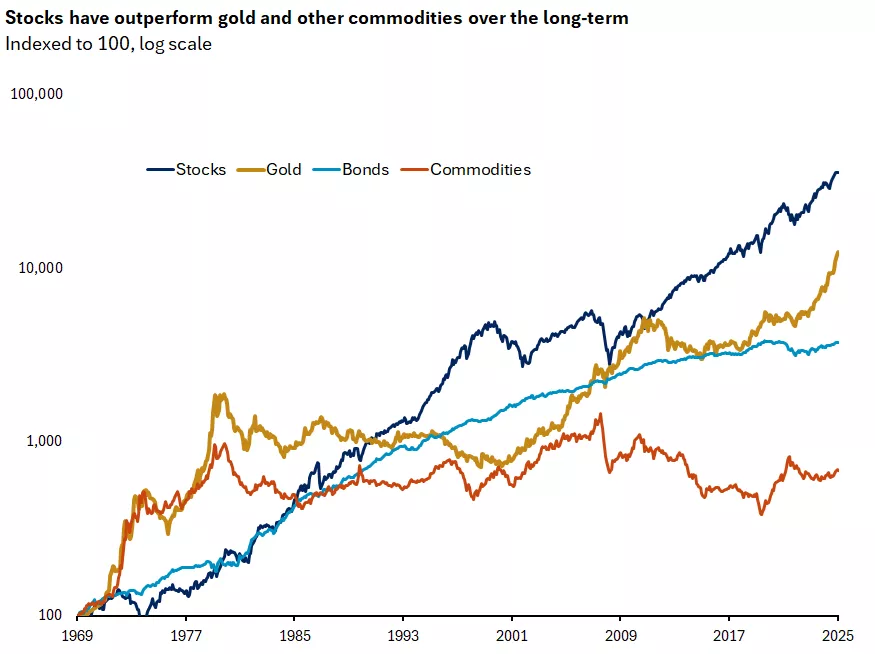
This chart shows the historical performance of stocks, gold, bonds and commodities indexed to 100 in 1969. Stocks have been the top performer, followed by gold, bonds and then a broad commodities basket. Stocks represented by the S&P 500. Bonds represented by the Bloomberg U.S. Aggregate Index. Commodities represented by the Bloomberg Commodities Index.
This chart shows the historical performance of stocks, gold, bonds and commodities indexed to 100 in 1969. Stocks have been the top performer, followed by gold, bonds and then a broad commodities basket. Stocks represented by the S&P 500. Bonds represented by the Bloomberg U.S. Aggregate Index. Commodities represented by the Bloomberg Commodities Index.
However, the case for gold is not about seeking above-average returns, but rather its diversification and stability benefits in our view. Historically, gold has shown low correlation to both stocks and bonds, meaning its returns tend to move independently of traditional assets*. This decoupling, especially during periods of market stress, makes gold a useful diversifier, helping smooth returns across cycles and improve portfolio efficiency. Looking back since 1970, a small ownership position in gold has provided less volatility in total portfolio returns as compared with a portfolio of simply stocks and bonds, but with slightly lower returns.
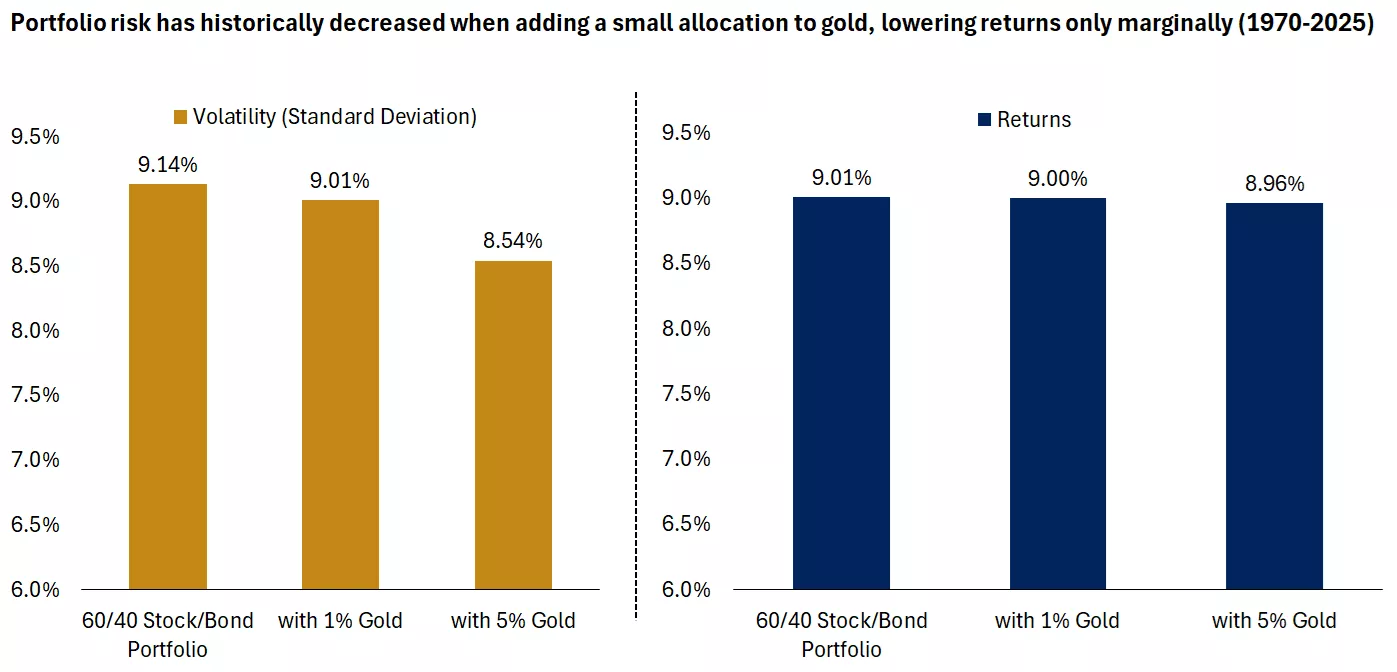
This chart shows that adding gold to a portfolio of 60% stocks / 40% bonds has historically resulted in lower volatility while achieving nearly the same returns. Stocks represented by the S&P 500 Index. Bonds represented by the Bloomberg U.S. Aggregate Index.
This chart shows that adding gold to a portfolio of 60% stocks / 40% bonds has historically resulted in lower volatility while achieving nearly the same returns. Stocks represented by the S&P 500 Index. Bonds represented by the Bloomberg U.S. Aggregate Index.
From a fundamental perspective, gold has historically acted as a hedge against large, unexpected inflation spikes, when both stocks and bonds typically struggle. However, unlike a diversified stock portfolio, it offers limited protection against smaller or gradual price increases, which explains why gold lagged inflation during the 1960s, 1980s, and 1990s. In addition, gold has also tended to provide some protection during severe geopolitical, economic, or financial shocks (e.g., 2008), but these are rare extreme events, which though have outsized impact in portfolios when they happen*.
How about silver?
While silver often moves in the same general direction as gold, its behavior in portfolios is meaningfully different. Silver is far more sensitive to economic growth because more than half of its demand is tied to industrial applications, including solar, electronics, and advanced manufacturing*. This growth‑linked demand makes silver more correlated with equities than gold and notably less defensive during periods of market stress. As a result, silver tends to amplify both upside and downside moves. Historically, its volatility has been roughly twice that of gold, yet without offering higher long‑term returns*. In our view, this makes silver a less effective diversifier.
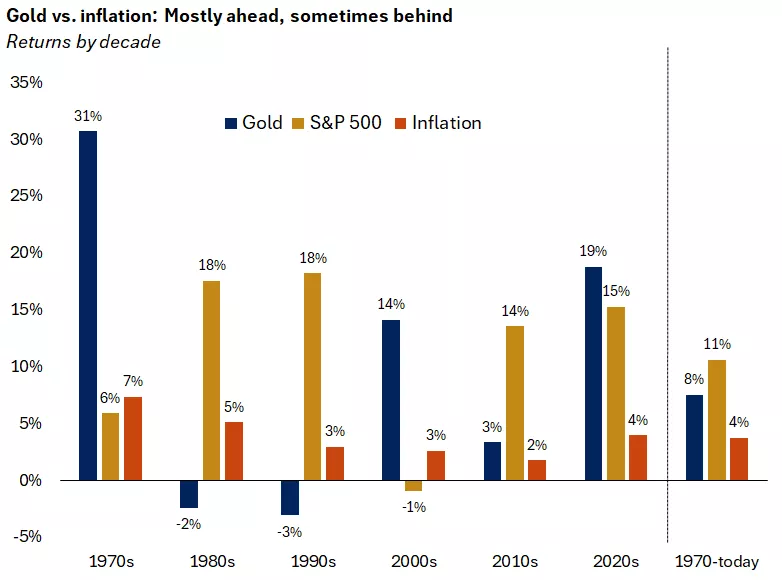
The graph shows returns for gold, stocks and inflation by decade. While gold has outpaced inflation over time that was not the case in the 1960s, 1980s and 1990s.
The graph shows returns for gold, stocks and inflation by decade. While gold has outpaced inflation over time that was not the case in the 1960s, 1980s and 1990s.
Bottom line: Stocks have more consistently protected an investor’s purchasing power over time, but gold can serve as a strategic hedge against extreme uncertainty and help smooth volatility, complementing stocks and bonds in a diversified portfolio. Although our target allocation for commodities, which includes gold, remains 0%, for investors seeking to enhance diversification with precious metals or mitigate equity market volatility amid heightened fiscal, inflationary, and geopolitical risks, we believe a gold allocation of up to approximately 5% may be appropriate within the more aggressive portion of a well-diversified portfolio.
Portfolio considerations
- We classify commodities, gold and silver included, as aggressive asset classes because historically they have exhibited higher risk and lower long-term returns than stocks and bonds. Unlike equities, gold does not produce cash flows or dividends, which makes it difficult to value with precision or confidence. As a result, its price tends to be heavily influenced by shifts in investor sentiment, contributing to elevated volatility.
- An equity-and-bond portfolio can still provide meaningful inflation protection and diversification without precious metals. However, for those seeking an additional layer of crisis resilience and inflation hedging, gold can be a complementary allocation.
- If the goal is diversification and crisis protection, we think investors consider funding the gold allocation from equities.
- If the goal is inflation protection (against large, unexpected spikes), investors may consider reallocating from bonds.
Angelo Kourkafas, CFA;
Senior Global Investment Strategist
Sources: * Bloomberg, Edward Jones, ** World Gold Council
Angelo Kourkafas
Angelo Kourkafas is responsible for analyzing market conditions, assessing economic trends and developing portfolio strategies and recommendations that help investors work toward their long-term financial goals.
He is a contributor to Edward Jones Market Insights and has been featured in The Wall Street Journal, CNBC, FORTUNE magazine, Marketwatch, U.S. News & World Report, The Observer and the Financial Post.
Angelo graduated magna cum laude with a bachelor’s degree in business administration from Athens University of Economics and Business in Greece and received an MBA with concentrations in finance and investments from Minnesota State University.
Important Information:
Investing in equities involves the risk of loss. The value of an investors shares can fluctuate, and investors can lose money. Small-and mid-cap stocks tend to be more volatile than large company stocks.
Diversification does not ensure a profit or protect against loss in a declining market.
This report is provided for intended as educational only and should not be interpreted as specific recommendations or investment advice. Investors should make investment decisions based on their unique investment objectives and financial situation. Opinions are as of the date of this report and subject to change.