Angelo Kourkafas,CFA
Mona Mahajan
After a mostly uninterrupted 15-year bull market, the U.S. dollar came under pressure in 2025. Political and fiscal uncertainty, combined with a narrowing yield advantage versus other developed markets, and increased currency hedging by foreign investors, contributed to the dollar’s decline.
The sharp decline in 2025 reignited debate over whether the dollar is at risk of losing its global status as the primary reserve currency. While its value against other currencies will fluctuate year to year, we don't believe the U.S. dollar's central role in global trade and finance will change in the foreseeable future, for three key reasons:
1. The U.S. dollar still accounts for the majority of global reserves.
The U.S. dollar dominates foreign exchange reserves, which are assets held by global central banks in foreign currencies. These reserves are often used for trade payments or to support a currency if needed.
The percentage of reserves held in U.S. dollars has moderated over the past few decades, as the U.S. economy accounts for a somewhat smaller share of global activity. However, the dollar remains the most held currency by far, comprising nearly 57% of global reserves. The euro, which is the next largest currency held in reserves, makes up about 20% of reserves.
The remaining currency reserves are relatively small in comparison. For example, the Chinese renminbi made up only 1.9% of global reserves as of 2025.
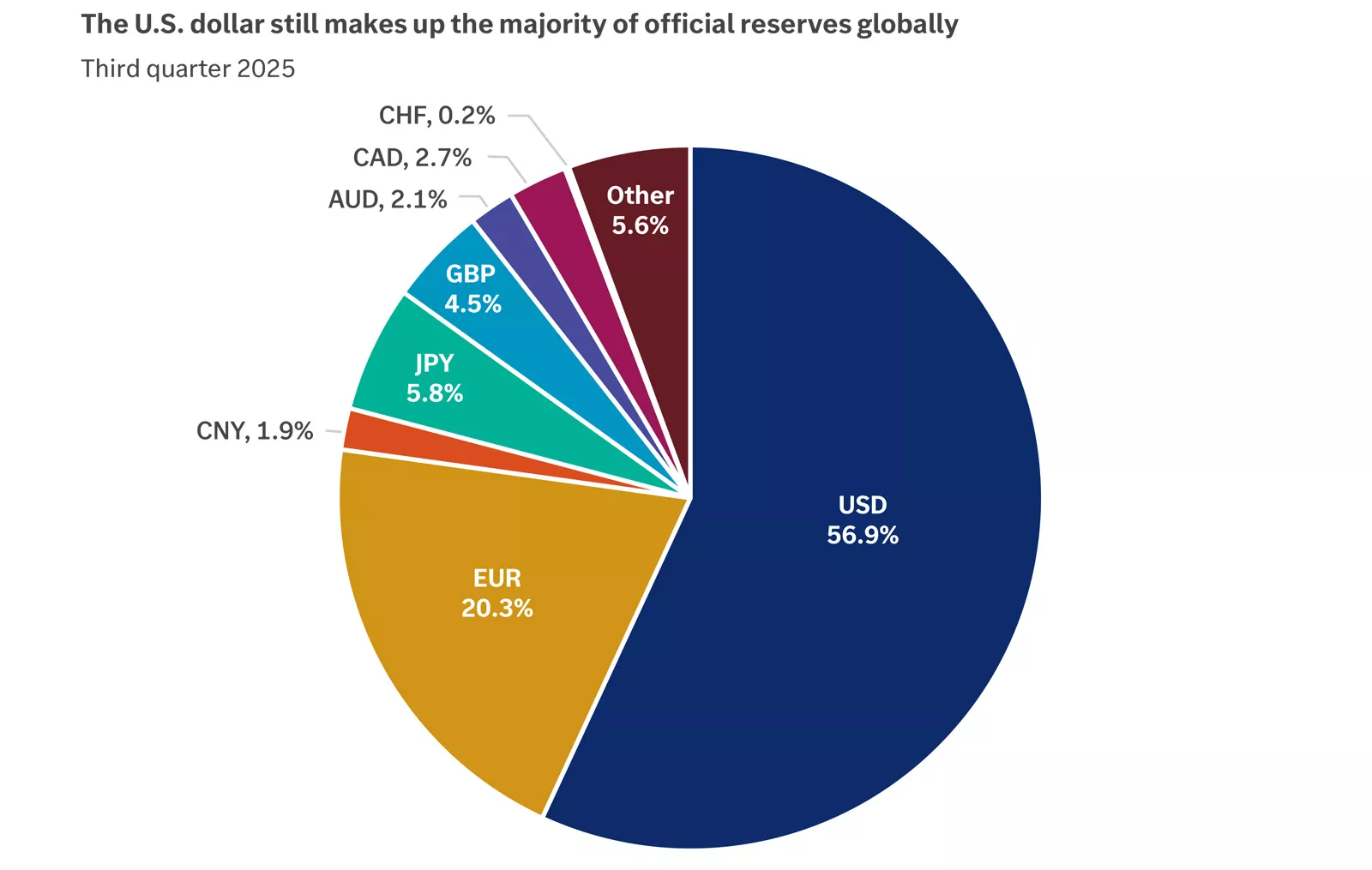
Pie chart key: USD = U.S. dollar; EUR = euro; CNY = Chinese yuan renminbi; JPY = Japanese yen; GBP = British pound; AUD = Australian dollar; CAD = Canadian dollar; CHF = Swiss franc.
This graphic highlights that the U.S. dollar is still the dominant reserve bank currency globally.
Pie chart key: USD = U.S. dollar; EUR = euro; CNY = Chinese yuan renminbi; JPY = Japanese yen; GBP = British pound; AUD = Australian dollar; CAD = Canadian dollar; CHF = Swiss franc.
This graphic highlights that the U.S. dollar is still the dominant reserve bank currency globally.
2. Global trade, including oil trade, is still largely conducted in dollars.
The Federal Reserve estimates that between 1999 and 2019, the dollar accounted for 96% of trades in North America, 74% in the Asia-Pacific region, and 79% for the rest of the world. The only region where trade was not dominated by the U.S. dollar was Europe, where the euro remained the preferred trade currency.
In addition, global oil trade, which accounts for about 10% of overall trade, is still largely conducted in U.S. dollars. While the dollar may become less of a force in this sector, oil remains a relatively small part of overall trade and may still use the U.S. dollar in some transactions.
3. The U.S. dollar is backed by deep, liquid and regulated financial markets.
Perhaps a key reason the U.S. dollar has been the dominant currency globally is the strength and stability of the U.S. economy, as well as the deep and liquid financial markets the U.S. offers.
The U.S. has by far the largest bond and stock markets globally. Importantly, the financial markets are highly regulated and offer borrowers and lenders access to a large set of counterparties. Overall, the U.S. is still the world’s largest economy with the deepest capital markets.
There are no realistic alternatives to replace the dollar anytime soon. The euro has faced political risk in the past, and the renminbi has significant capital flow restrictions from the Chinese government.
These factors have allowed the U.S. dollar to maintain its dominant position in international trade and finance. In our view, the dollar will continue to do so for the foreseeable future.
The bottom line
While headlines around the U.S. dollar may raise questions or concerns for investors, we don’t see a credible threat to its leadership position globally. The dollar’s value may fluctuate relative to those of other currencies, driven by factors such as central bank interest rate policy, inflation regime and economic growth. But these are within the normal range of financial market volatility.
Historically, the U.S. dollar has risen during periods of turbulence, such as the global financial crisis or the 2022 rise in inflation. In our view, this points to investor confidence in the stability of the dollar.
Action for investors
We would not recommend any portfolio shifts based on fears about the U.S. dollar. But we continue to recommend investors consider diversifying their portfolios with exposure to markets and currencies outside the U.S. In our view, including exposure to international stocks and bonds can help broaden investor opportunity and manage risk.
Historically, international equities tend to perform well when the dollar is weaker against other currencies. Conversely, U.S. investments typically outperform when the dollar is stronger, as the following chart illustrates. The U.S. dollar has weakened in three of the four years that international stocks have outperformed U.S. stocks since 2010, with 2022 being the only year in which international stocks outperformed despite a stronger U.S. dollar.
While we expect the U.S. dollar to retain its dominant role in global trade and financial markets, its sharp decline relative to other developed-market currencies in 2025 highlighted the benefits of maintaining a globally diversified portfolio.
We recommend you work with your financial advisor to help ensure your portfolio is adequately diversified across markets and currencies, according to your personal financial goals and risk tolerance.
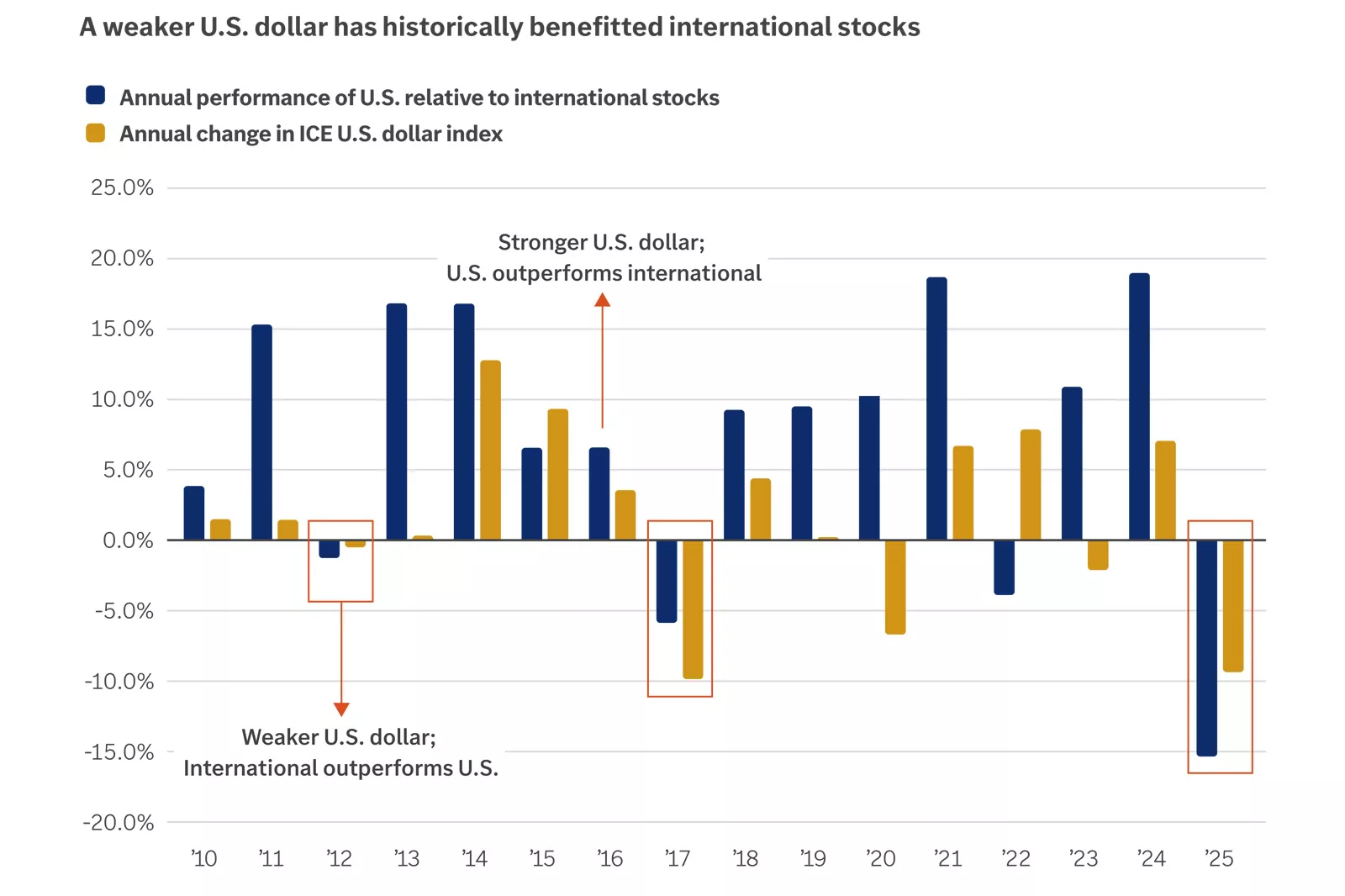
This chart shows that over time, a stronger U.S. dollar has served as a headwind for international stock performance.
This chart shows that over time, a stronger U.S. dollar has served as a headwind for international stock performance.
This report is provided for informational purposes only. This report is not directed toward any specific investor or potential investor and should not be interpreted as a specific recommendation or investment advice. Investors should make investment decisions based on their unique investment objectives and financial situation. While the information is believed to be accurate, it is not guaranteed and is subject to change without notice.
Opinions expressed are as of the date of this report and are subject to change.