Three key trends to watch, beyond geopolitical headlines

Key takeaways

  • While geopolitics continue to dominate headlines, markets have increasingly refocused on underlying economic and earnings fundamentals, pushing equities to new record highs.
  • This optimism is supported by signs that the economy remains on solid footing, with last week’s labor market data pointing to improving hiring momentum despite ongoing geopolitical uncertainty.
  • Corporate earnings have also continued to surprise to the upside, underscoring strong profitability across sectors, particularly among AI‑related companies that have led the recent rally.
  • In contrast, bonds have lagged the equity rebound, as renewed inflation pressures and resilient growth pose another obstacle to near‑term interest rate cuts.
  • Sustaining equity-market momentum at its recent pace may prove challenging, but we believe the economic and earnings outlook remains constructive, offering opportunities for disciplined, diversified investors.

Hopes building over an Iran peace deal

The conflict in the Middle East continues to dominate headlines.

The big story last week centered on a U.S. proposal to effectively end the war. Details around the one-page document are slim, but Axios reported that the 14-point deal includes a moratorium on Iranian nuclear enrichment, a lift of U.S. sanctions and an end to restrictions on traffic through the Strait of Hormuz. Sources suggest that this is the closest both sides have come to an agreement since the war started.

 This chart shows a large spike in the number of articles on the war in Iran from February onwards.
Source: Bloomberg.

Markets responded positively to the news, with major U.S. equity benchmarks hitting new record highs last week. At the time of this writing, we have yet to hear Iran's response, and tensions around the Persian Gulf remain elevated. However, signs of progress in talks supports our expectation that a diplomatic solution to the Iran conflict can be reached.

While geopolitics remains front-and-center in the news cycle, markets have increasingly shifted focus away from day-to-day oil price swings and back toward the underlying economic and corporate fundamentals. In this week's wrap we will look at three trends you may have missed amid the outbreak of war in the Middle East.

1. An improving labor market

There were concerns around the health of the labor market coming into 2026.

Private payrolls growth averaged just 25,000 per month in 2025 as hiring slowed to a crawl, and the unemployment rate drifted higher, from 4.1% at the end of 2024 to 4.5% in late 2025. There were few signs of outright distress, but anemic hiring was flagged by the Fed as a potential threat to the economy.

The latest labor market data look brighter, despite the oil shock. Payrolls delivered back-to-back increases for the first time in a year through March and April, lifting the average gain in private employment to near 90,000 per month so far this year. Meanwhile, the unemployment rate has fallen from its 2025 peak and was unchanged in the latest April reading at 4.3%.

 This chart shows that private job gains so far in 2026 have rebounded from the very weak 2025 readings
Source: Bloomberg.

Scratching beneath the surface, there has been a broadening in sectors adding headcount. The payrolls diffusion index, which compares the number of sectors adding, as opposed to cutting, jobs, has clearly improved in the past six months. This indicates that better hiring has been driven by a wider group of companies and sectors, providing some encouragement over the durability of this trend.

Importantly, this trend is consistent with other labor market data. Initial unemployment insurance claims remain low, households are saying that it is slightly easier (or less difficult) to find work, and the Chicago Fed is tracking an improvement in the hiring rate for unemployed workers.

Overall, the labor market is looking solid, even in the early innings of an energy price shock. We can't take this resilience for granted should we see a larger or more prolonged spike in oil prices. However, these data also chime with other indicators, such as upbeat retail spending, which suggest the economy is comfortably weathering higher oil prices for now.

2. An earnings frenzy

The big story from the corporate sector in recent months has not been centered on the effect of higher oil prices. Instead, the picture is one of robust corporate earnings across sectors, particularly around technology and AI companies. 

 This chart shows how the Magnificent 7—Apple, Microsoft, Alphabet, Amazon, Nvidia, Meta Platforms, and Tesla—have outperformed the rest of the stocks in the S&P 500, though they're not far behind.
Source: Factset. Past performance does not guarantee future results. An index is unmanaged, cannot be invested into directly and is not meant to depict an actual investment.
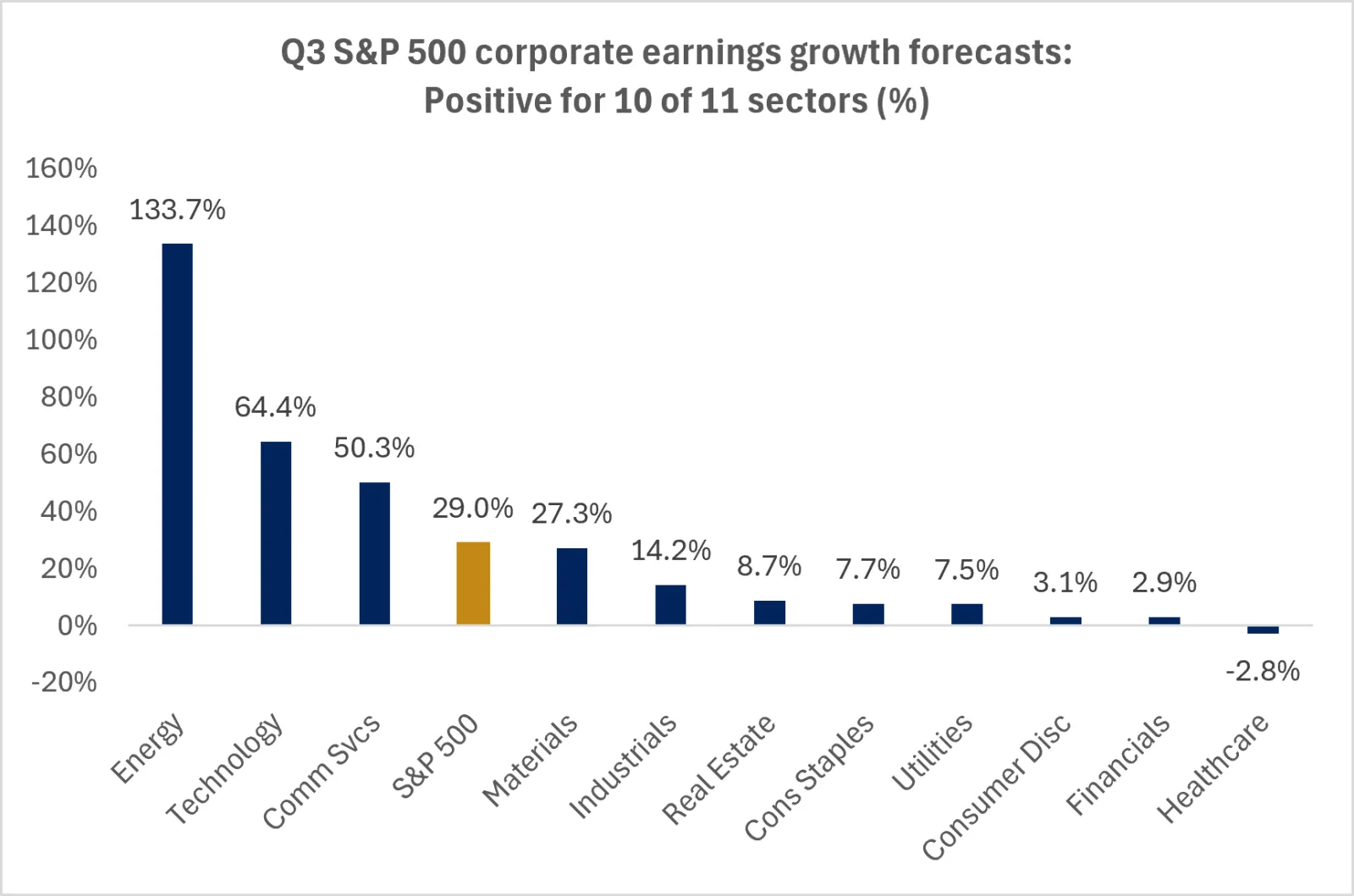
Let's look at the Q1 earnings season as it draws to a close. With 89% of S&P 500 companies having now reported, a full 84% have had better-than-expected earnings per share, comfortably above the typical beat rate over the past five years. The blended earnings growth rate for the index is tracking nearly 28% in Q1, which, if maintained, would be the strongest delivered since 2021. Ten of eleven sectors are reporting positive year-over-year earnings growth, with seven of these in double digits.

Admittedly, the oil price shock will only be partly reflected in these reports, with prices spiking late in the first quarter. However, these data help highlight the underlying strength of corporate profitability coming into this shock, and the likely resilience of this trend barring a much worse spike in oil prices.

The reports also underline the strength in the tech sector, with an extraordinary investment cycle around AI helping power the sector. The strength of these numbers has helped drive a huge rally in semiconductors in recent weeks, with the Philadelphia semiconductor index up more than 10% last week alone and now 65% year-to-date.

3. A reset in Fed easing expectations

While equity markets have more than recovered from the Middle East shock, bonds have not.

At the time of this writing the yield on the 10-year U.S. Treasury note is trading at 4.36%, up around 40 basis points from a low in late February. This reflects a durable decline in expectations for Fed interest rate cuts. Markets were pricing at least two 25 basis point (0.25%) cuts by the end of this year before the Iran shock but now think the central bank will be on hold this year.

 This chart shows how oil prices have risen, which has driven expectations for additional Fed rate cuts lower.
Source: Bloomberg.

We think there are a few reasons for this shift.

  • First, and most obviously, higher oil prices have pushed inflation to 3.3%, and a further acceleration is likely in April's report this week. This jump will most likely prove transitory, and we currently expect inflation to peak between 3.5%-4% over Q2, before starting to ease in late 2026. Still, above target inflation makes it harder for the Fed to cut.
  • Second, the improved labor market backdrop, and signs of broader economic resilience, lessen the urgency to lower interest rates. Amid robust corporate profits there are few signs that policy is especially restrictive right now.
  • Finally, and related, the FOMC itself appears to have shifted in a slightly more hawkish direction, illustrated by recent dissents over its guidance that the next move in interest rates will be lower. These divisions will make it hard for incoming Chair Warsh to build consensus for rate cuts in the near-term at least.

All in, the Fed looks likely to sit on the sidelines for at least the next few meetings. We still think it is possible that we could see a rate cut by the end of the year, should oil prices and inflation moderate, but it would not be a surprise to see the Fed stay on hold. The upshot is that bonds might struggle to recover, and we continue to expect the 10-year Treasury yield to remain stuck in the 4.0%-4.5% range. 

What does this mean for investors?

Markets are forward looking, and the move to new record highs reflects the (seemingly) waning risks around the Iran conflict and an improving economic and earnings backdrop.

Importantly, with much of this positive news now priced in, it might be hard to maintain the recent momentum in stocks. In our view, it would not be a surprise to see a period of market consolidation, characterized by slower and bumpier gains in the coming months.

However, looking through these fits and starts, we think the latest economic signals remain supportive of this ongoing bull market, and we continue to recommend remaining invested in a diversified allocation to equities.

 This chart shows that year-to-date returns have been strong across domestic and international stock markets, despite leadership shifting throughout the year.
Source: Bloomberg. International developed-market stocks represented by the MSCI EAFE index. Emerging-market equity represented by the MSCI EM index. Past performance does not guarantee future results. An index is unmanaged, cannot be invested into directly and is not meant to depict an actual investment.
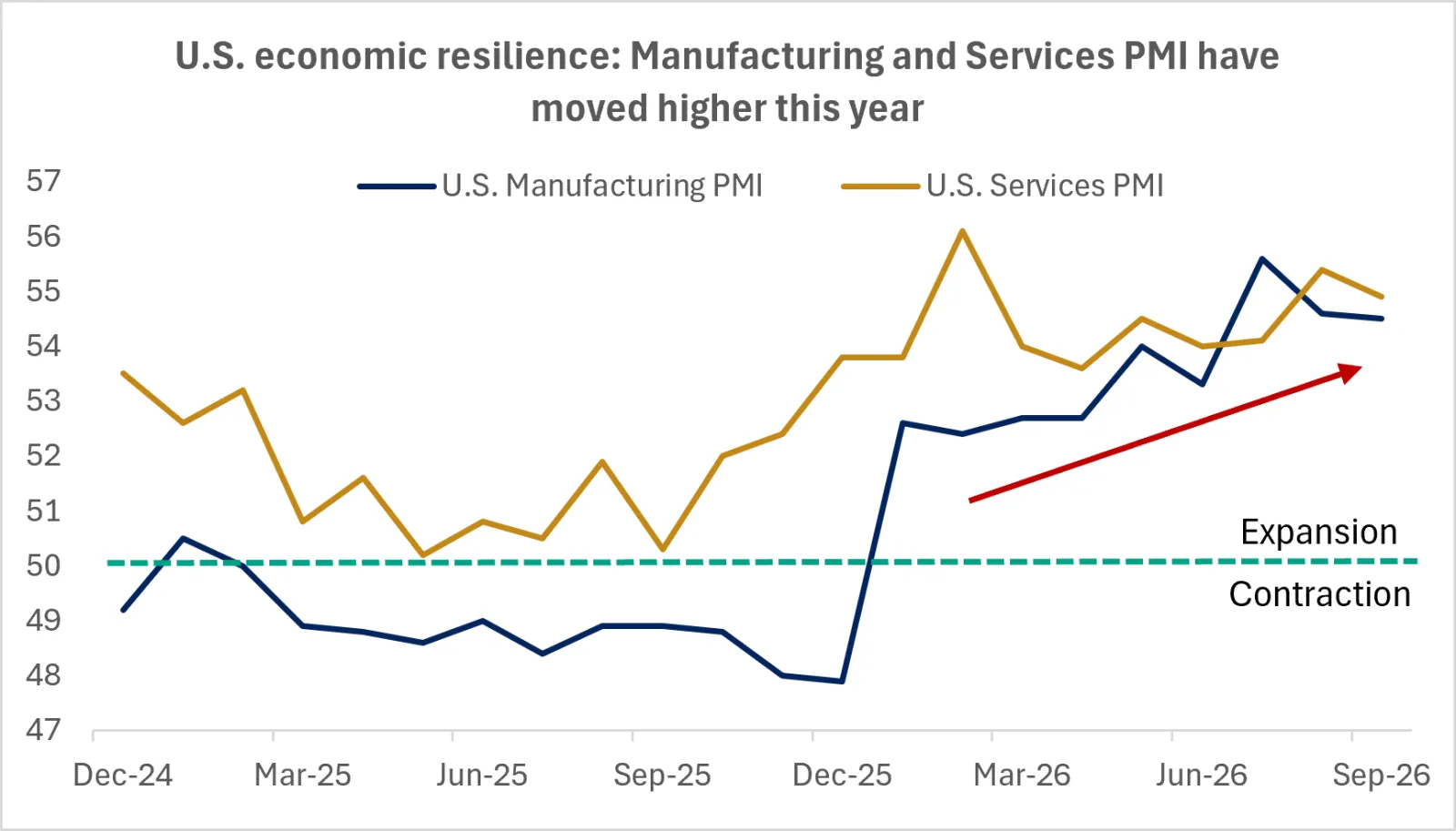
The recent rally in tech stocks provide a timely reminder of the potent earnings and investment cycle supporting large cap U.S. equities, while broadening earnings growth across sectors in 2026 has helped propel small and mid-cap benchmarks to new record highs. International equities have been volatile but continue to offer relatively attractive valuations and improving earnings potential, with emerging market stocks also offering exposure to the AI investment cycle.

Overall, the last few months highlight the importance of not becoming too focused on the short-term news cycle. While geopolitical uncertainty remains front-and-center markets have already started to move on from the Iran shock. Investors should make sure that they are not losing sight of the underlying fundamentals amid this noisy backdrop.

James McCann
Investment Strategy

Sources: All data referenced in text from Bloomberg or Factset

The Week Ahead

Important economic data and events for the week ahead include PPI and CPI inflation and retail sales data.

 James McCann Profile Pic

James McCann

Senior Economist

Thought Leader In:

  • Economic issues impacting the lives of everyday Americans.
  • The effects of government spending, taxes and regulation changes on our clients.  
  • Building diversified portfolios to help investors reach their long-term financial goals.

“The economic, political and policy landscape is shifting dramatically, making it ever more challenging for our clients to navigate their personal finances. In this environment, it's our deep, research-driven insights that can help clients stay on track to reach their financial goals."

James McCann
Senior Economist

Read Bio

Important Information:

The Weekly Market Update is published every Friday, after market close. 

This is for informational purposes only and should not be interpreted as specific investment advice. Investors should make investment decisions based on their unique investment objectives and financial situation. While the information is believed to be accurate, it is not guaranteed and is subject to change without notice.

Investors should understand the risks involved in owning investments, including interest rate risk, credit risk and market risk. The value of investments fluctuates and investors can lose some or all of their principal.

Past performance does not guarantee future results.

Market indexes are unmanaged and cannot be invested into directly and are not meant to depict an actual investment.

Diversification does not guarantee a profit or protect against loss in declining markets.

Systematic investing does not guarantee a profit or protect against loss. Investors should consider their willingness to keep investing when share prices are declining.

Dividends may be increased, decreased or eliminated at any time without notice.

Special risks are inherent in international investing, including those related to currency fluctuations and foreign political and economic events.

Before investing in bonds, you should understand the risks involved, including credit risk and market risk. Bond investments are also subject to interest rate risk such that when interest rates rise, the prices of bonds can decrease, and the investor can lose principal value if the investment is sold prior to maturity.