Transitioning from saving to spending in retirement is one of the most significant financial shifts you’ll make. A clear retirement spending strategy, built around your goals, your income sources and your timeline, can help ensure your money lasts as long as you need it. Here are five practical steps your Edward Jones financial advisor may recommend helping guide that transition.
1. Know your retirement budget
Your retirement plan likely assumes a certain annual spending amount with increases each year to account for inflation. All else equal, the lower those initial withdrawals, the longer your money will last. So work with your financial advisor to set up a budget that's personalized to your goals and situation, and then give yourself permission to spend those amounts knowing there's intention behind them.
2. Separate your spending assets
Separating your spending assets from your other investments can make it easier to track your retirement cash flow and determine how much you have available for day-to-day spending. While the accounts and investments you use to source your retirement income and "refill" your spending account may vary from year to year, as a general guide, we recommend the following sequence:
- Nonportfolio sources such as Social Security (if already claiming) and pensions/lifetime annuities (if applicable)
- Required minimum distributions (RMDs) from retirement accounts (if applicable)
- Dividends and interest from taxable accounts (including municipal bond interest)
- Sales from your investments, starting with taxable accounts, followed by traditional retirement accounts and, finally, Roth retirement accounts
3. Maintain your cash reserves
We generally recommend retirees maintain 12 months' worth of portfolio withdrawals in cash in their separate spending account and another three to five years of portfolio withdrawals in a short-term, fixed-income ladder. Maintaining appropriate cash reserves can help ensure your retirement spending needs are met, while allowing your stocks more time to recover following a market decline. Keep in mind, though, that holding too much cash and short-term fixed income also comes with risks, and that is that your portfolio doesn't earn enough to keep up with inflation. We believe a more balanced portfolio allocation between equities and fixed income is key. So, while some cash is good, you'll want to remain invested in assets with more growth potential to help your portfolio last through retirement.
4. Consider an annuity for guaranteed retirement income
With an annuity*, you exchange a portion of your portfolio for a guaranteed retirement income stream, regardless of market performance or how long you live. This can help provide a baseline income level to cover fixed retirement expenses. However, annuity payments typically don't adjust for inflation and offer less liquidity, so it's important to understand their tradeoffs. Depending on your situation, annuities can still be a valuable tool to provide retirement income and help increase confidence in your strategy.
5. Review your strategy regularly and be flexible
Your retirement could be 25 years or longer, and as much as you've prepared, a lot can change along the way. That's why it's important to review your strategy, including your preparedness for potential risks, at least annually or sooner if you experience a life event.
You may also have to be flexible with your strategy in retirement to help ensure your money lasts. Even minor adjustments can have a dramatic effect on your portfolio's longevity. The following chart compares two different spending patterns: one increases withdrawals by 3% every year for inflation regardless of portfolio performance, while the other only increases spending by 3% in years following a portfolio increase and takes no raises in years following a portfolio decline.
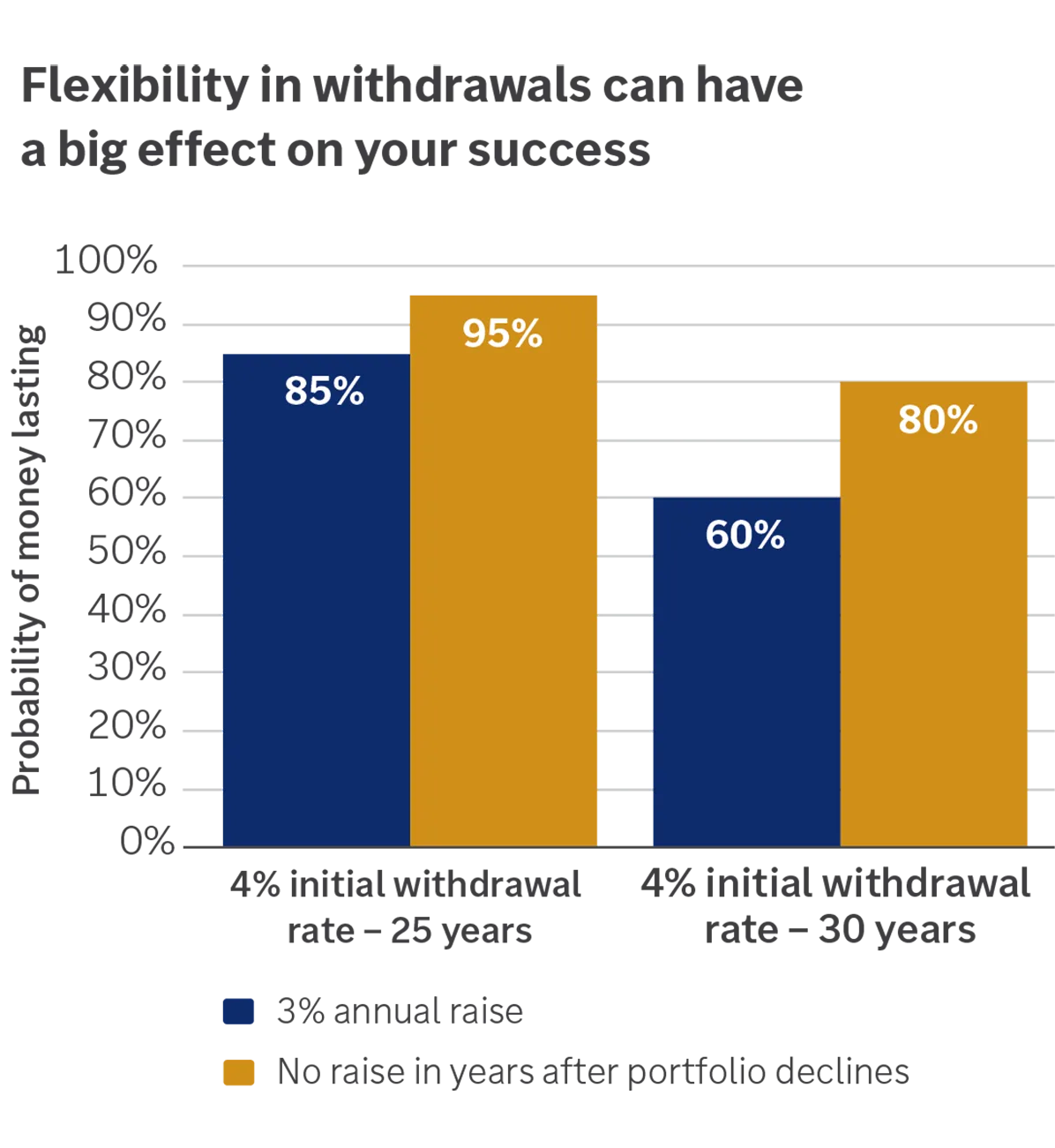
The bar farthest to the left shows the probability of your money lasting for 25 years is 85% if you take a 4% initial withdrawal and increase your withdrawal by 3% each year. The next bar shows the probability of your money lasting 25 years increases to 95% if you take the same starting withdrawal but do not increase the withdrawal amount in years after the portfolio declines. The third bar from the left shows the probability of your money lasting 30 years is 60% if you take a 4% initial withdrawal and increase your withdrawal by 3% each year. The last bar shows the probability of your money lasting 30 years increases to 80% if you take the same starting withdrawal but do not increase the withdrawal amount in years after the portfolio declines.
The bar farthest to the left shows the probability of your money lasting for 25 years is 85% if you take a 4% initial withdrawal and increase your withdrawal by 3% each year. The next bar shows the probability of your money lasting 25 years increases to 95% if you take the same starting withdrawal but do not increase the withdrawal amount in years after the portfolio declines. The third bar from the left shows the probability of your money lasting 30 years is 60% if you take a 4% initial withdrawal and increase your withdrawal by 3% each year. The last bar shows the probability of your money lasting 30 years increases to 80% if you take the same starting withdrawal but do not increase the withdrawal amount in years after the portfolio declines.
Not yet retired?
If you're not yet retired, here are some additional strategies to help ensure your savings last you through retirement.
How we can help
Talk to your Edward Jones financial advisor today about ways to help make your money last as you make the switch from saving to spending.
Important information:
*Annuities are long-term investments designed to provide tax-deferred savings for and during
retirement. Annuity guarantees are subject to the claims paying ability of the issuing life insurance company.
This content is provided as educational only and should not be interpreted as specific investment advice.
Investors should make investment decisions based on their unique investment objectives and financial
situation.