Understand how much you may need to save for retirement with Edward Jones
Key Takeaways
- Retirement savings generally increase with age, with average retirement balances rising from $49,130 for people under 35 to $609,230 for those ages 65 to 74, before declining among those 75 and older.
- Benchmarks like Edward Jones goalposts can provide a useful starting point, offering age- and income-based savings ranges, giving investors a way to gauge their progress toward retirement.
- Your retirement target is personal. Average balances and generalized benchmarks can't account for factors such as your spending, retirement age, lifestyle, other income sources and goals. A personalized savings target can give you a clearer picture of whether you're on track.
How much should I save for retirement?
The bottom-line goal of retirement planning is deceptively simple: accumulate enough money to live the life you want once your career no longer occupies most of your time or generates a regular paycheck.
Achieving that goal requires asking questions that have no easy answers: How can you measure your progress toward a target decades in the future?
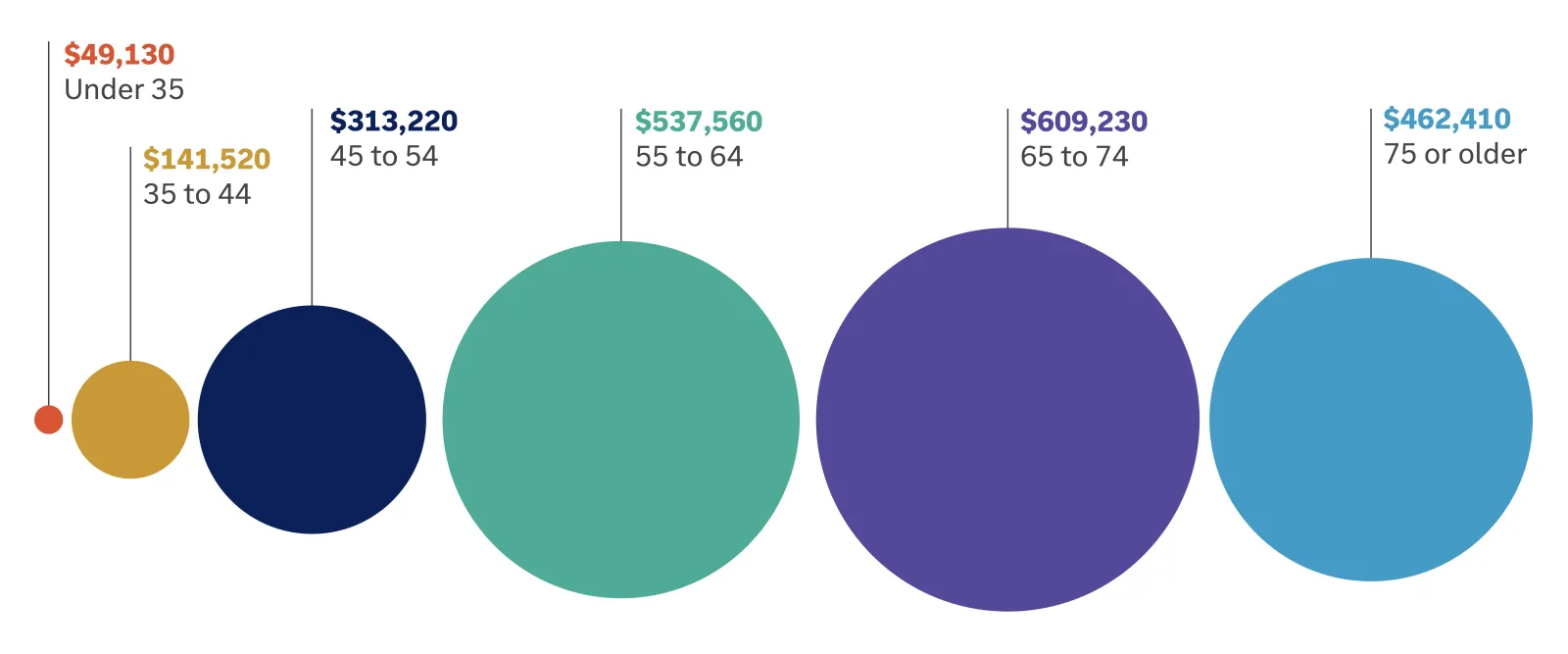
Often, people trying to figure out how well they’re doing begin by comparing their own savings with those of others in the same age bracket. If you’re curious how you stack up, data collected by the Federal Reserve in its 2022 Survey of Consumer Finances, shown below, can tell you.
What is the average retirement savings by age?
www.federalreserve.gov/econres/scfindex.htm
The above chart shows that U.S. residents under 35 have an average of $49,130 in retirement savings; those 35 to 44 have an average $141,520; those 45 to 54 have an average $313,220; those 55 to 64 have an average $537,560; those 65 to 74 have an average $609,230; and those 75 or older have an average $462,410.
www.federalreserve.gov/econres/scfindex.htm
The above chart shows that U.S. residents under 35 have an average of $49,130 in retirement savings; those 35 to 44 have an average $141,520; those 45 to 54 have an average $313,220; those 55 to 64 have an average $537,560; those 65 to 74 have an average $609,230; and those 75 or older have an average $462,410.
What average balances can – and can’t – tell you?
What those numbers can't tell you, though, is how close you are to your goal. The relevant data point isn’t what others your age have saved but how much money you need yourself. The answer depends almost entirely on you, your habits now and your plans for later.
For example, what’s your average monthly spending today and do you expect to maintain it after retirement? Do you expect to relocate? If so, will you live in a region where the cost of living is higher or lower than where you are now? How do you plan to spend your time — traveling the world in style or volunteering in your neighborhood and working in your garden?
To help you begin evaluating your progress, Edward Jones has developed generalized benchmarks for someone retiring at age 65, below, that are more useful and more detailed than average savings levels.
What are retirement savings goalposts by age?
Below you'll find generalized retirement savings benchmarks by age and current salary that might let you retire comfortably, using broad assumptions about factors including taxes and spending preferences. For example, if you are 29, making $100,000, you would want savings of $35,000 - $90,000 to maintain your current lifestyle. (The higher and lower ends of the range reflect differing assumptions about market volatility.)
Source: Edward Jones calculations, values rounded to the nearest $5,000. Assumptions: You want to maintain your current level of spending in retirement (calculated as current income minus savings contributions and taxes); you expect to retire at 65 and live until 92; retirement contributions are pretax and equal 15% of gross income; pre-retirement income and postretirement spending adjust annually for inflation of 3%; portfolio earns annual return of 6% pre-retirement and 5% postretirement; Social Security benefits begin at 65 and equal the lesser of 35% of gross income and $41,112 (the maximum annual benefit at 65 in 2024); no portfolio withdrawals until retirement; effective tax rate of 25%; lower boundary assumes no market volatility and portfolio is entirely depleted at death; upper boundary incorporates market volatility expectations with 80% to 90% probability of portfolio lasting until death.
If your retirement savings aren’t within range, there may be a good reason for that – your specific goal and strategy may differ from our assumptions. For example, you may be planning to retire later or expect your spending to decrease in retirement. A financial advisor can help you develop a more precise goal, review your progress and, if needed, help you explore ways to ramp up your retirement savings.
How Edward Jones can help
Average balances and generalized goalposts are useful reference points, but they can’t account for your spending, retirement timeline and other income sources. An Edward Jones financial advisor can help you build a personal savings target, compare it with what you’ve already saved and identify steps that could help close any gap.
Katherine Tierney
Katherine Tierney is a senior retirement strategist on the Client Needs Research team at Edward Jones. The Client Needs Research team develops and communicates advice and guidance for client needs, including retirement, education, preparing for the unexpected and leaving a legacy. Katherine has more than 20 years of financial services and retirement experience. She is a contributor to the Edward Jones Perspective newsletter and has been quoted in various publications.
Frequently Asked Questions
How much do I need to retire and where can I get a personalized retirement gap analysis and age-specific plans for people in their 40s and 50s?
The amount you need depends on your spending, retirement age, expected longevity, income sources and goals. The savings goalposts above offer age- and salary-based reference points. An Edward Jones financial advisor can review your current savings, estimate a personal target and help you identify any gaps.
How much do I need to retire comfortably at age 65 with moderate expenses?
There is no single amount that applies to everyone. These goalposts assume retirement at age 65, a lifespan to age 92 and spending that reflects current income after savings contributions and taxes. Under those assumptions, someone earning $100,000 would have a goalpost of $1,055,000 - $1,205,000 at age 65.
How much should I have in my retirement account by age and income level?
The tables above provide generalized savings ranges for ages 20 through 65 at salaries of $50,000, $100,000, $150,000 and $200,000. They can help you compare your progress, but your personal target may differ based on your plans and financial situation.
How much do I need to retire given my spending and goals?
Start by estimating your expected spending in retirement and how long your savings may need to last. Then account for Social Security, pensions and other income. An Edward Jones financial advisor can help you estimate a personal savings target based on your goals, risk tolerance and timeline.
How much money should I have in my retirement account by age 50?
At age 50, the Edward Jones goalposts range from $250,000 - $300,000 for a $50,000 salary; $500,000 - $600,000 for a $100,000 salary; $920,000 - $1,090,000 for a $150,000 salary; and $1,430,000 - $1,690,000 for a $200,000 salary. Note that these are generalized ranges rather than personal recommendations.