Looking back, moving forward
As we look back on 2025, it is remarkable to think about the highs and lows we experienced, particularly as investors and observers of financial markets. We began with optimism around the possibilities for the Fed and a new administration —only to face uncertainty from global trade and tariff policies. By mid-year, markets settled into a rhythm, buoyed by strong earnings— especially in AI and mega-cap tech.
As we enter 2026, the bull market begins its fourth year. The question for investors is whether the momentum will continue. We think this can be a year of positive returns, but earnings growth in tech and non-tech parts of the market will do most of the heavy lifting, with limited scope for valuation expansion.
Our base case calls for:
- Steady economic growth
- Continued rate cuts by the Fed
- Double-digit corporate earnings growth across many sectors
However, risks remain, including potential AI disappointment and stubborn inflation trends. In our view, the most compelling action investors can take this year is to double down on diversification.
10 key views for the year ahead

Private market alternatives: strategic allocations in a shifting landscape
As private markets continue to evolve, their role in long-term portfolio construction is becoming increasingly central. In 2025, Edward Jones introduced evergreen private market funds to expand access to institutional-quality private equity, credit, real estate and infrastructure. This section focuses on the structural dynamics and strategic considerations shaping private market alternatives in 2026 and beyond.
Private equity: middle market resilience amid evolving exit dynamics
Private equity firms are facing challenges when it comes to selling their investments. While initial public offerings activity showed signs of recovery in 2025 — with listings backed by private equity managers on U.S. exchanges up 50% year-over-year — volumes remain well below pre-2021 levels, and market windows are narrow due to regulatory and macro headwinds. Corporate buyers have been cautious, so managers are finding other ways to return cash to investors — such as extending ownership of assets through new funds, borrowing against portfolio value, or selling to other private equity firms.
Middle market managers are structurally advantaged in this environment. Beyond the usual ways of selling, mid-sized firms can also sell bigger businesses to large private equity firms — a common practice that gives them more options for exiting investments. Additionally, more corporate buyers are in a position to buy middle market companies. These dynamics provide more selling options for middle market private equity managers.
On the company acquisition side, middle market firms are supported by a powerful demographic shift: the retirement of baby boomer business owners. According to the U.S. Census Bureau, 51% of U.S. employer businesses are owned by individuals age 55 and older, highlighting the demographic transition underway and the potential for increased private equity deal flow as succession needs rise.
Strategic takeaway: Even though selling investments is harder right now, the middle market is well-positioned. It provides many chances to buy companies and several ways to sell them later, which makes it appealing for long-term investors.
Private credit: credit selection and structural maturity take center stage
Private credit continues to evolve as a core financing tool for private equity-backed companies, but the importance of credit selection is rising. While recent defaults such as First Brands and Tricolor have drawn headlines, these were largely public market bank loan exposures and didn't represent the private direct lending market. Nonetheless, defaults will eventually emerge in private credit portfolios, and when they do, the quality of underwriting and documentation will be critical. Top managers are pushing for stronger loan protections to safeguard investments and improve recovery if things go wrong. Additionally, while declining interest rates reduce absolute returns for private credit at the margin, because it is a floating rate asset class, it also helps to relieve the interest burden on borrowers. This could help reduce the peak defaults at the end of the cycle, all else equal.
Over the past decade, private credit has steadily gained share from high-yield bonds and syndicated bank loans, becoming the preferred financing channel for many private equity-backed companies. This trend is now stabilizing, with borrowers increasingly dual-tracking both public and private options depending on pricing, flexibility and execution certainty.
While the spread premium for private credit has narrowed, especially for larger deals, borrowers continue to value its ability to act quickly, commit capital with certainty and tailor structures to specific needs. Importantly, demand for leveraged credit remains strong, particularly from private equity sponsors seeking flexible capital solutions. This sustained borrower demand helps mitigate concerns about excess capital supply into private credit and supports the asset class’s continued growth.
Strategic takeaway: As the market matures, manager selection and underwriting discipline will be key differentiators. Private credit’s role as a flexible, scalable and increasingly institutional asset class remains intact but investors must be selective and forward-looking in their allocations.
Private real estate: Stabilization and structural evolution
Private real estate is showing signs of stabilization following a period of significant repricing. Capitalization rates (cap rates) — a key valuation metric calculated as net operating income divided by property value — rose sharply in 2022 in response to higher interest rates and pandemic driven structural shifts, particularly in office and retail. As of mid-2025, cap rates have begun to stabilize and, in some sectors, modestly compress, signaling a more balanced market.
Among the four primary sectors — office, industrial, apartments and retail — cap rates have declined for industrial, multifamily and office, while retail continues to see upward pressure. Office cap rates remain the highest, reflecting persistent vacancy rates near 20%, a legacy of hybrid work and corporate space rationalization.
This repricing is part of a broader structural transformation in the real estate landscape. Over the past decade, industrial real estate has grown from 14% of the institutional index in 2017 to nearly 34% as of Q2 2025, driven by sustained demand from e-commerce and logistics. Simultaneously, expanded sectors — including data centers, student and senior housing, self-storage and single-family rentals — now represent approximately 8% of the institutional private real estate market, as measured by the National Council of Real Estate Investment Fiduciaries (NCREIF).
Despite headwinds in office, stabilized valuations have begun to unlock transaction activity. In Q2 2025, office assets accounted for over 40% of sales in the NCREIF Property Index, suggesting that investors are selectively re-engaging where pricing reflects risk.
For long-term investors, these conditions may present attractive entry points but require careful asset and sector selection to navigate secular risks, placing greater emphasis on manager quality.
Additionally, private real estate funds offer preferential tax treatment, with a majority of distributions often classified as return of capital, helping defer taxable gains and potentially improving after-tax outcomes — especially for investors in higher tax brackets.
Strategic takeaway: Private real estate is transitioning from repricing to reallocation. As the asset class stabilizes, investors could use this as an opportunity to initiate an allocation or increase their allocation toward their strategic target if they are underweight.
Private infrastructure: Scaling to meet global transformation
Private infrastructure continues to benefit from powerful secular tailwinds, driven by its critical role in enabling both the energy transition and the digital transformation. From renewable energy generation to the rapid build-out of AI-driven data centers, infrastructure assets are increasingly central to the functioning and modernization of the global economy.
Electricity demand from AI data centers is projected to quadruple by 2030, accelerating investment in digital infrastructure, including fiber, towers and hyperscale data centers, often paired with renewable energy sources to meet sustainability mandates. At the same time, aging essential services, particularly in the U.S., require significant reinvestment. Public-private partnerships remain a vital mechanism to address funding gaps and unlock development across transportation, water and energy systems.
To meet the growing size and complexity of these projects, leading managers are raising record levels of capital. Several recent large fundraisings reflect the scale of institutional commitment to the sector. Yet there remains ample room for specialized and midmarket players to develop and optimize smaller-scale infrastructure assets, from regional energy storage to niche data center components.
While the influx of capital warrants monitoring, the supply demand backdrop appears to be favorable still. The scale of infrastructure needs, both in the U.S. and globally, continues to outpace available capital, creating a wide range of opportunities across sectors and geographies.
Interest rates are a risk factor, given that most projects include debt. However, most of the risk factors for infrastructure are specific to the asset class, such as construction and/or permitting delays and regulatory/policy risks specific to infrastructure. In addition to providing exposure to unique risk factors, infrastructure assets can benefit from structural advantages: long-duration contracted cash flows, inflation-linked pricing escalators and essential service characteristics that support portfolio stability.
Strategic takeaway: Infrastructure is a growing asset class that warrants consideration for inclusion in long-term portfolios. As the sector scales to meet global transformation, manager selection and strategy specialization will be key to capturing durable value.
Planning and portfolio strategies for 2026
As we enter 2026, now is the time to review your financial strategy. The volatility of 2025 — marked by tariffs, concentrated tech-sector growth, the longest government shutdown in history and the passage of the One Big Beautiful Bill Act (OBBBA) — may have impacted your plan. Assessing your situation now can help you capitalize on new tax legislation and position yourself for success.
A proactive review helps prepare you for evolving markets, respond to regulatory changes and track progress toward your financial goals. Work with your financial advisor and professional team to determine which of the above items make sense for your situation. Having a plan and solid commitment to execute can help better position you to achieve your goals.
Portfolio roadmap: 4 steps to stay ahead in 2026
Build purpose into your portfolio, strengthened by a global strategy
2026 will likely deliver its share of attention-grabbing headlines, particularly as markets grapple with ongoing AI dynamics and evolving economic policies. But resilient portfolios aren’t built on reaction. They’re built on strategy. In a year offering a broad set of opportunities, global diversification should remain the cornerstone of that strategy, enabling your purpose to lead you through 2026 with clarity and discipline.
Therefore, revisit your comfort with risk, time horizon and financial goals. These factors should guide the creation of globally diversified asset allocation targets for your investment strategy — beginning with an appropriate mix of stocks and bonds aligned with your risk and return objectives. When supported by disciplined rebalancing, your strategic targets can help keep your portfolio goal focused and your emotions in check, no matter the surprises 2026 may bring.
Past performance of the markets is not a guarantee of what will happen in the future.
Investors should understand the risks involved in owning investments, including interest rate risk, credit risk and market risk.
The value of investments fluctuates, and investors can lose some or all of their principal.
Diversification does not ensure a profit or protect against loss in a declining market.
This material is for general information purposes only and is not intended to predict or guarantee the future performance of individual securities, market sectors or the markets generally. Opinions expressed are as of the date of this report and are subject to change. This material should not be interpreted as specific recommendations or investment advice for any particular investor or potential investor. Investors should make investment decisions based on their unique financial situation.
Opportunistic portfolio guidance
Opportunistic asset allocation guidance — Our opportunistic asset allocation guidance represents how we recommend positioning your portfolio across asset classes based on current market conditions and our global outlook, while helping you stay appropriately diversified and within your comfort with risk. A neutral position indicates we recommend aligning your portfolio with your long-term strategic target allocations.
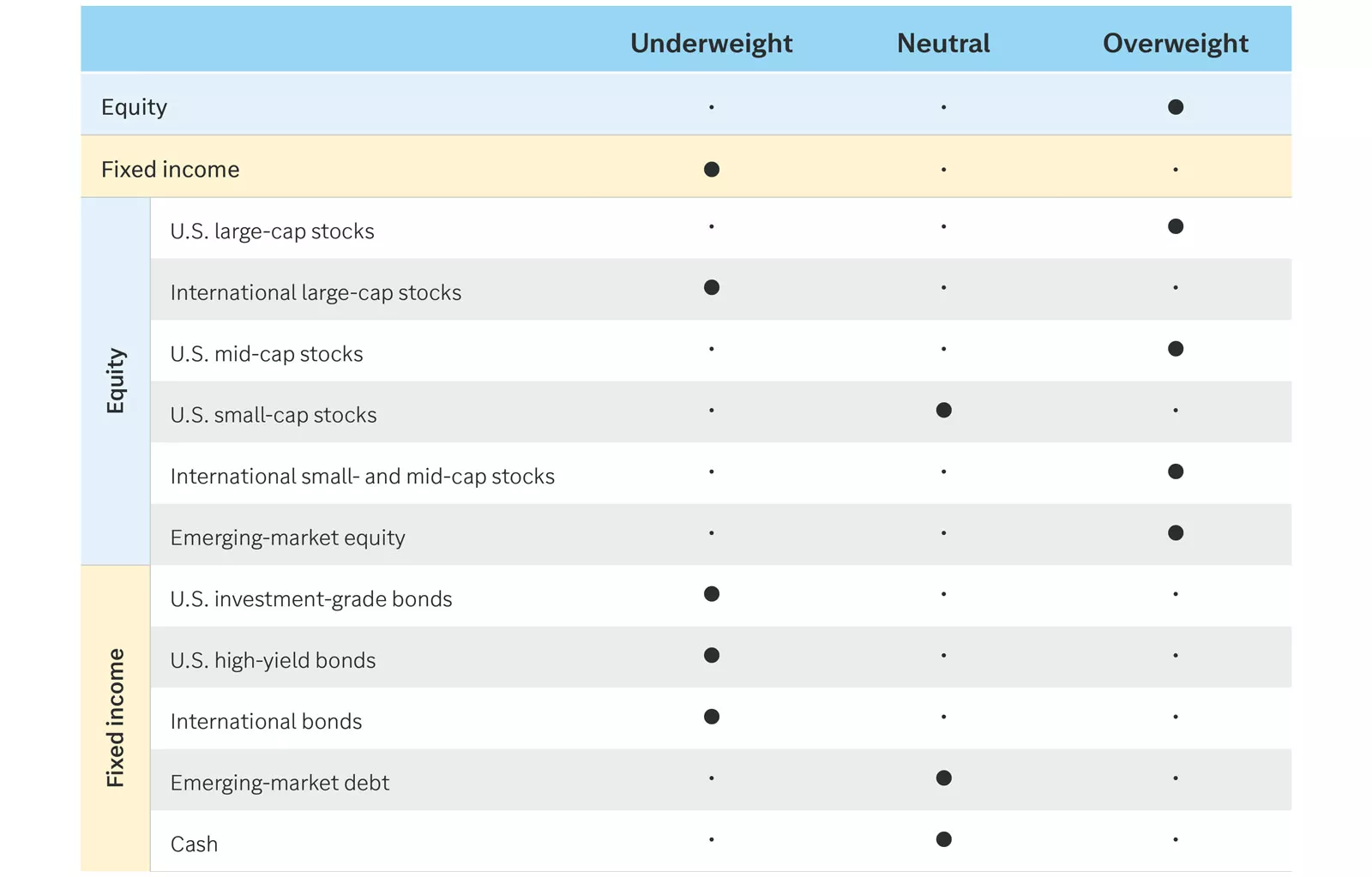
Asset allocation guidance table indicating overweight positions in U.S. small-cap stocks and high-yield bonds, neutral positions in large-cap equities and investment-grade bonds, and underweight positions in international bonds and emerging-market debt.
Asset allocation guidance table indicating overweight positions in U.S. small-cap stocks and high-yield bonds, neutral positions in large-cap equities and investment-grade bonds, and underweight positions in international bonds and emerging-market debt.
Opportunistic equity style guidance — Our opportunistic equity style guidance represents how we recommend positioning between value- and growth-style equity within U.S. stock asset classes and the international large-cap stock asset class based on current market conditions and our global outlook.

Equity style allocation table indicating neutral positioning for both value and growth strategies, suggesting balanced exposure across styles.
Equity style allocation table indicating neutral positioning for both value and growth strategies, suggesting balanced exposure across styles.
Opportunistic equity sector guidance — Our opportunistic equity sector guidance represents how we recommend positioning across sectors within the U.S. equity allocations of your portfolio based on current market conditions and our global outlook over the next six to 12 months. The guidance is relative to the sector weights of the S&P 500.
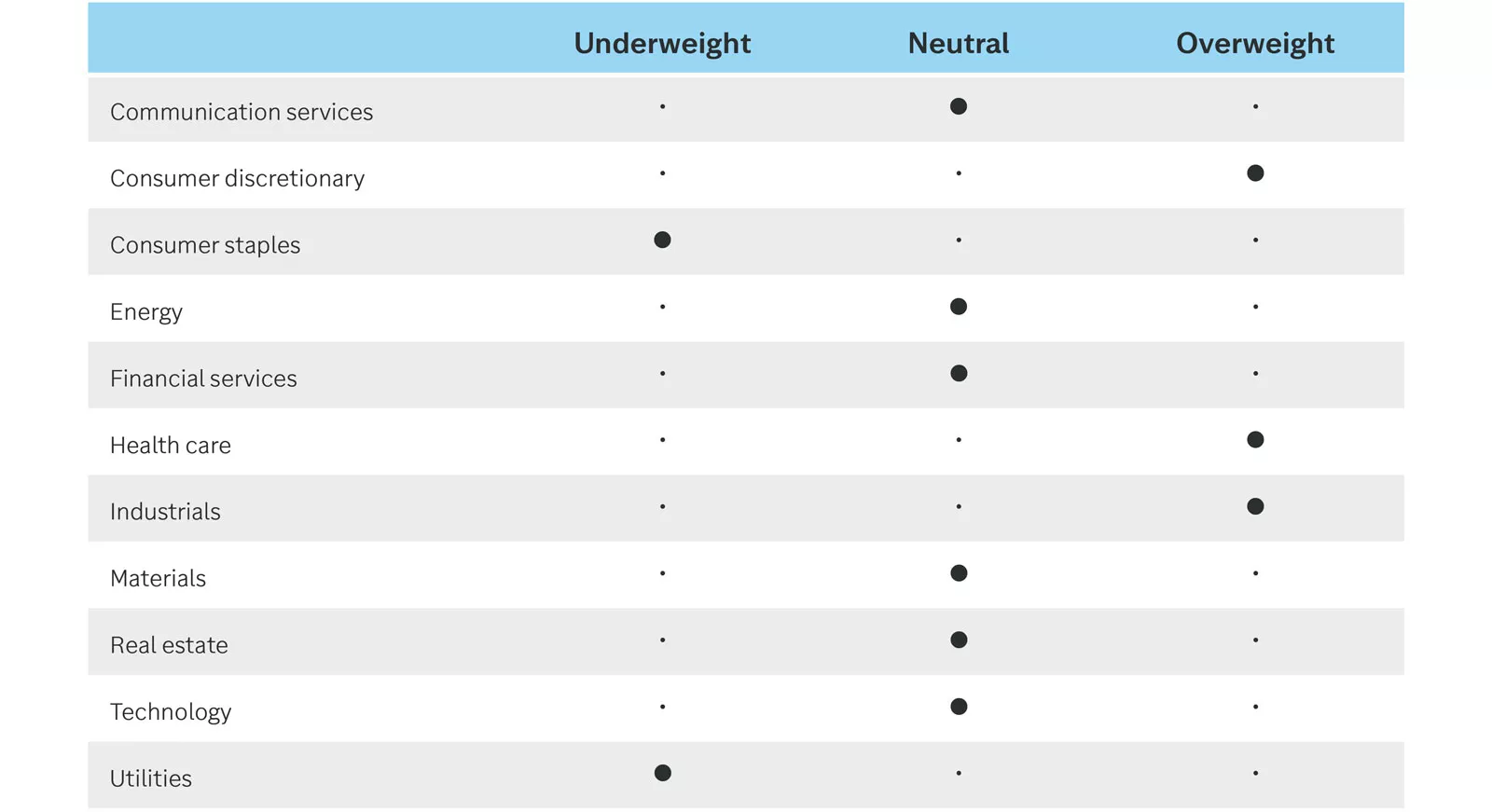
Sector allocation guidance table highlighting overweight recommendations for financial services, health care, and technology, while consumer staples and utilities are underweight, and energy and real estate remain neutral.
Sector allocation guidance table highlighting overweight recommendations for financial services, health care, and technology, while consumer staples and utilities are underweight, and energy and real estate remain neutral.
Opportunistic U.S. investment-grade bond guidance — Our opportunistic U.S. investment-grade bond guidance represents how we recommend positioning across maturities and sectors within your higher-quality bond allocations, relative to the Bloomberg U.S. Aggregate Bond Index. Longer-term bonds generally carry more interest rate risk than shorter-term bonds. Corporate bonds have more credit risk than U.S. government bonds.

Risk allocation table indicating neutral stance on both interest rate risk and credit risk, reflecting a balanced approach to fixed income exposure.
Risk allocation table indicating neutral stance on both interest rate risk and credit risk, reflecting a balanced approach to fixed income exposure.
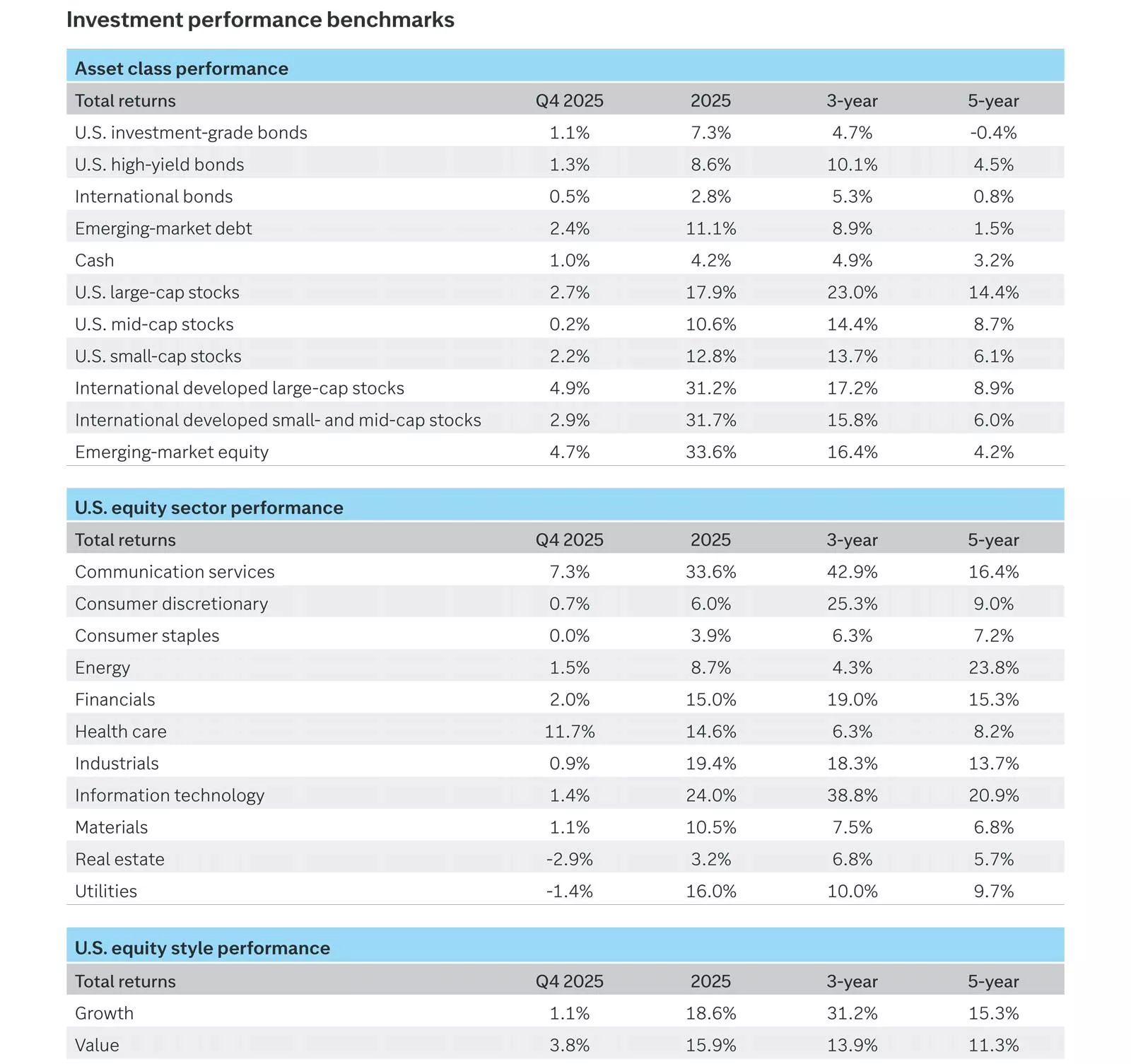
The asset class return chart shows the total return for eleven different asset classes for Q4 2025, year-to-date, 3-year annualized, and 5-year annualized time horizons.
The sector return chart shows the total returns for the eleven U.S. large-cap sectors for Q4 2025, year-to-date, 3-year annualized, and 5-year annualized time horizons.
The asset class return chart shows the total return for eleven different asset classes for Q4 2025, year-to-date, 3-year annualized, and 5-year annualized time horizons.
The sector return chart shows the total returns for the eleven U.S. large-cap sectors for Q4 2025, year-to-date, 3-year annualized, and 5-year annualized time horizons.
*Returns through 12/31/2025.
Important Information:
Past performance of the markets is not a guarantee of what will happen in the future.
Investors should understand the risks involved in owning investments, including interest rate risk, credit risk and market risk.
The value of investments fluctuates and investors can lose some or all of their principal.
Diversification does not ensure a profit or protect against loss in a declining market.
This material is for general informational purposes only and is not intended to predict of guarantee the future performance of individual securities, market sectors or the markets generally. Opinions expressed are as of the date of this report and are subject to changes. This materials should not be interpreted as specific recommendations or investment advice for any particular investor or potential investor. Investors should make investment decisions pase on their unique financial situation.