Did you know your retirement strategy could be at risk regardless of your life stage? In fact, many of the risks you face earlier in life don’t go away — they change or new ones surface.
The good news is that addressing these risks is typically within your control. Here are some of the biggest risks as you near retirement and ways to help insulate yourself from them.
Life stage: Nearing retirement
Risk: Unexpected expense or emergency
Unexpected expenses can occur at any time. These can impact your retirement savings if you need to pause contributing to your retirement account or, worse, withdraw money from it.
You’ll want to create an emergency fund of three to six months’ worth of living expenses to cover unexpected events and provide a buffer.
Risk: Premature death or disability
Some risks can be upsetting just to think about. The emotional toll of an untimely loss or injury is hard enough without the financial toll to exacerbate it. These risks are rare, but they can be severe financially.
Consider a life insurance policy with enough coverage to pay off liabilities, replace lost income, provide for caregiving and cover final expenses.
Risk: Unplanned retirement
According to a survey, almost one in three retirees retired earlier than anticipated. The most common reasons were to care for a loved one, layoffs and injuries.1 Regardless of the reason, the result can leave you with more time to live on less savings and potentially more expenses you’ll need to cover.
Instead of worrying about an early retirement, plan for it. In addition to an emergency fund and disability insurance, develop a backup plan where you identify expenses you can live without to help offset the effects of an early retirement.
Risk: Sequence of returns
A bad scenario is one in which you experience a bout of market volatility as you’re beginning to withdraw from your portfolio. In the following hypothetical scenario, the portfolio returns are the same, but the order in which they’re experienced is reversed. The early down-market years for portfolio B translated to more than 10% less than portfolio A after just six years.
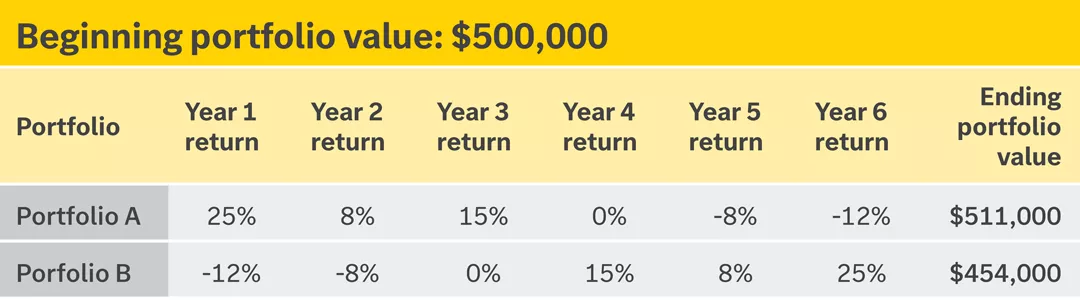
This chart compares how two portfolios—each starting with a value of $500,000—perform over six years under different sequences of annual returns. Portfolio A begins with several strong positive years before encountering negative returns, while Portfolio B experiences early losses before later gains. After six years, Portfolio A grows to $511,000, while Portfolio B ends at $454,000.
This chart compares how two portfolios—each starting with a value of $500,000—perform over six years under different sequences of annual returns. Portfolio A begins with several strong positive years before encountering negative returns, while Portfolio B experiences early losses before later gains. After six years, Portfolio A grows to $511,000, while Portfolio B ends at $454,000.
You can’t control the markets, of course, but you can structure your portfolio to account for a potential downturn close to your retirement. As you’re shifting your investments to a more conservative mix for retirement, consider a CD ladder to provide the first few years of income in retirement. This can also help act as a buffer for your portfolio to recover.2
Risk: Longevity
Living longer than expected can be an enviable yet complex problem. Not only does it increase the chance you’ll outlive your portfolio, but you’ll also likely need to plan for more long-term care expenses.
You can help your retirement income endure by getting more of it from guaranteed sources. Delaying taking Social Security can bump up its payment. Additionally, an annuity with guaranteed lifetime benefits might also help.3 For long-term care expenses, consider purchasing insurance,4 setting aside savings or using a combination of the two.
Life stage: Living in retirement
Risk: Inflation
Long-term inflation is an important factor to consider. At just 3%, inflation can increase a grocery bill from $150 to over $350 in 30 years.
You can’t control inflation, but you can lower your personal inflation rate by choosing generic over name brands, for example. You can also fight inflation with your portfolio.
Although you’ll likely be investing more conservatively during retirement, you should generally still incorporate some growth investments in your portfolio. Growth investments can help retirees keep pace with inflation over time.
Risk: Incapacity and estate planning
According to retirees, the most common challenge they’ve faced is the loss of a loved one.5 Make sure your loved ones know your desire for care and final wishes through your estate and incapacity plans.
Review and update your wills, trusts, powers of attorney, health care directives and beneficiary designations on a regular basis, and appoint willing and able fiduciaries you trust to carry out your wishes if you’re not able to.
Risk: Declining investment values
When you’re withdrawing from your portfolio, investment losses can feel especially bad. Here’s what to do if markets become volatile:
- Pause before changing investments — Ask yourself, what’s changed? If your goals and risk tolerance haven’t changed, then making a big change to your investments could make matters worse.
- Adjust your spending — In years when the market is down, not increasing your withdrawals for inflation can improve the likelihood your portfolio lasts through retirement by 20%. Pairing that with a one-time spending cut of 10% can improve your portfolio’s odds of success by 40%.
- Spend from your cash — Withdrawing cash and redeeming CDs for your near-term income can give your growth investments more time to recover.
Your financial advisor can help
Many risks are unavoidable, but changes to address them are often within your control. Talk with your financial advisor about your biggest risks. Together, you can put a strategy in place to address them so you can focus on the opportunities ahead.
Important information:
1 Edward Jones/Age Wave, Resilient Choices, 2023.
2 CD ladders aren’t for everyone, so work with your financial advisor to see if one aligns with your investment objectives, risk tolerance and financial circumstances.
3 Annuity guarantees are made by the issuing life insurance company, so it’s important to talk with your financial advisor to decide if they are suitable for you.
4 Edward Jones is a licensed insurance producer in all states and Washington, D.C., through Edward D. Jones & Co., L.P., and in California, New Mexico and Massachusetts through Edward Jones Insurance Agency of California, L.L.C.; Edward Jones Insurance Agency of New Mexico, L.L.C.; and Edward Jones Insurance Agency of Massachusetts, L.L.C. California Insurance License OC24309.
5 Edward Jones/Age Wave, Resilient Choices, 2023.