Four Years In: What Makes This Bull Market Different?
Key takeaways
- Four years in, this bull market is not an outlier in terms of either strength or longevity. It is defined by investor skepticism, higher rates, AI-driven growth, and concentrated leadership.
- Despite persistent recession fears, the U.S. economy remained resilient. The key question may no longer be when rates return to 2010s-era levels, but whether those unusually low rates were the exception rather than the norm.
- AI has transformed market leadership, with a handful of mega-cap companies driving an outsized share of returns and market value. That concentration is both a strength and a potential vulnerability.
- While correction risks are rising as the cycle matures, growing profits and a Fed that may be looking to tap the brakes rather than slam on them suggest the bull market may still have room to run.
Anniversaries are often a time to reflect on how far we've come. This week marks the fourth anniversary of the current bull market, which began on October 12, 2022. At that time, the S&P 500 had fallen roughly 25% from its peak, inflation was running above 8%, and the Federal Reserve was in the midst of one of its most aggressive rate-hiking campaigns in decades.
Fast forward four years, and the market has staged an impressive recovery. The S&P 500 has recorded 124 all-time highs, including 28 this year alone, while navigating a series of shocks that many thought could derail the advance: the 2023 regional banking stress, the 2024 yen carry trade unwind, the 2025 tariff-driven correction, and this year, heightened geopolitical tensions and oil price volatility.
Yet despite the gains, investors continue to grapple with many of the same questions that existed at the outset of this bull market: Will inflation remain contained? Where will interest rates ultimately settle? Can economic growth continue to exceed expectations?
With that in mind, let's look at how this bull market stacks up historically, the four defining characteristics that make it unique, and what its next chapter may look like.
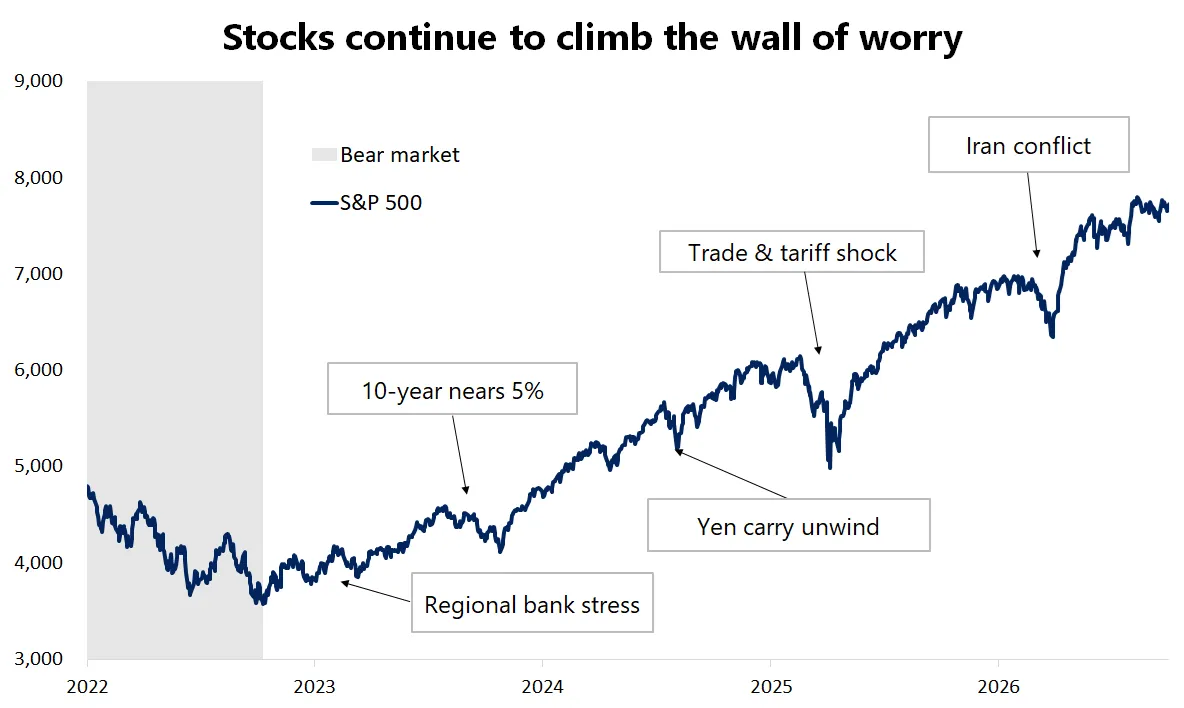
The graph shows that the S&P 500 has more than doubled from its 2022 bear market low while overcoming multiple economic, policy, and geopolitical shocks.
The graph shows that the S&P 500 has more than doubled from its 2022 bear market low while overcoming multiple economic, policy, and geopolitical shocks.
How This Bull Market Stacks Up
Since the October 2022 low, the S&P 500 has gained 117%, or 130% including dividends. No doubt it has been an impressive run, but this bull market is not an outlier in terms of either strength or longevity. Looking back over the past 70 years, the 11 bull markets that preceded it generated an average price return of roughly 150% and lasted about five years. Notably, more than half (6 of 11) made it beyond the four-year mark, with the longest, from 2009 to 2020, extending for nearly 11 years.
At four years old, the current bull market is no longer in its early stages, but neither is it particularly old by historical standards. What makes it unusual is not its age or performance, but the backdrop against which those gains have been achieved.
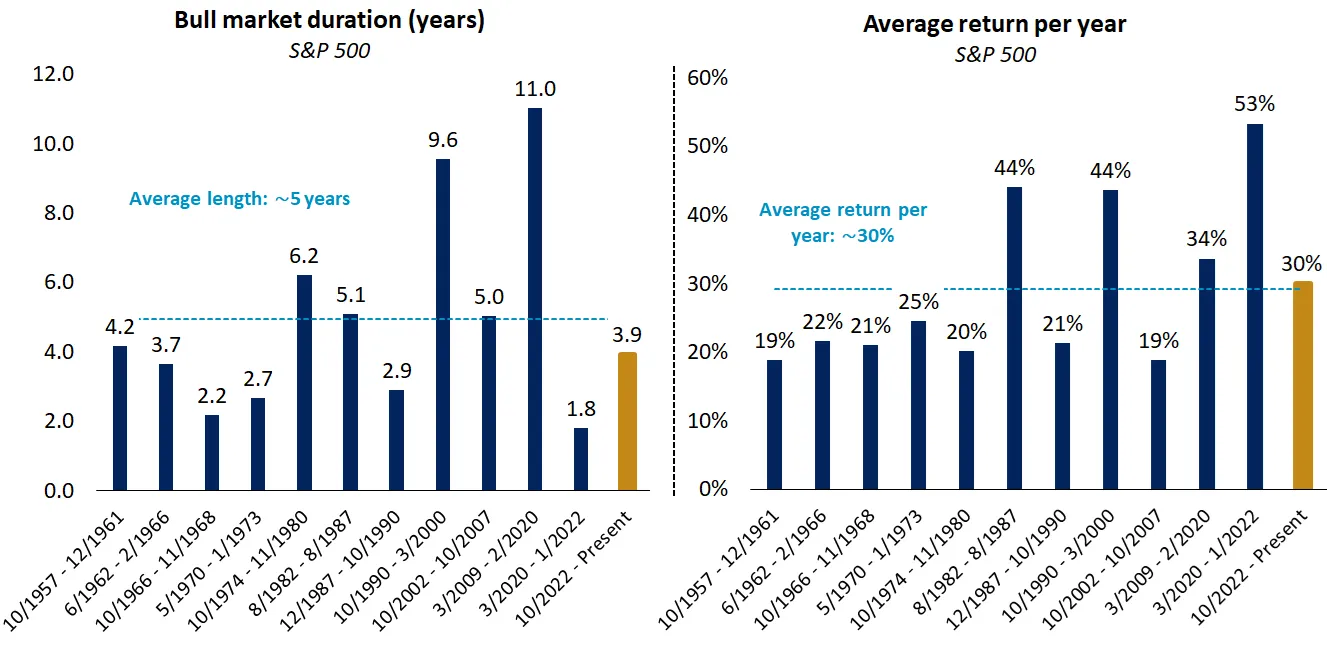
The bar charts show the current bull market is relatively average in both duration and average return compared with previous S&P 500 bull markets since 1957.
The bar charts show the current bull market is relatively average in both duration and average return compared with previous S&P 500 bull markets since 1957.
Four Defining Features of This Cycle
1. Investors Never Fully Embraced It
Unlike many previous bull markets that were driven by enthusiasm and speculation, this one has spent much of its life climbing a near-constant wall of worry. The first half of this bull market was dominated by widespread recession forecasts that never materialized. The inverted yield curve reinforced those fears, with the spread between 10- and 2-year Treasury yields remaining negative through most of 2022, 2023, and 2024. While the yield curve has historically been a useful recession indicator, this cycle appears poised to join a relatively short list of false signals.
Instead, the economy proved far more resilient than expected. Real GDP growth exceeded the often-cited 2% long-term trend in each of the past three years, supported by strong consumer spending, a healthy labor market, fiscal stimulus, and a surge in business investment. While interest-rate-sensitive sectors such as housing have struggled under the weight of higher borrowing costs, strength elsewhere in the economy has more than offset that drag.
One of the most striking examples has been the rapid growth in AI-related spending. Investment tied to AI has grown so large that it now exceeds total residential fixed investment, including both new home construction and home renovations.
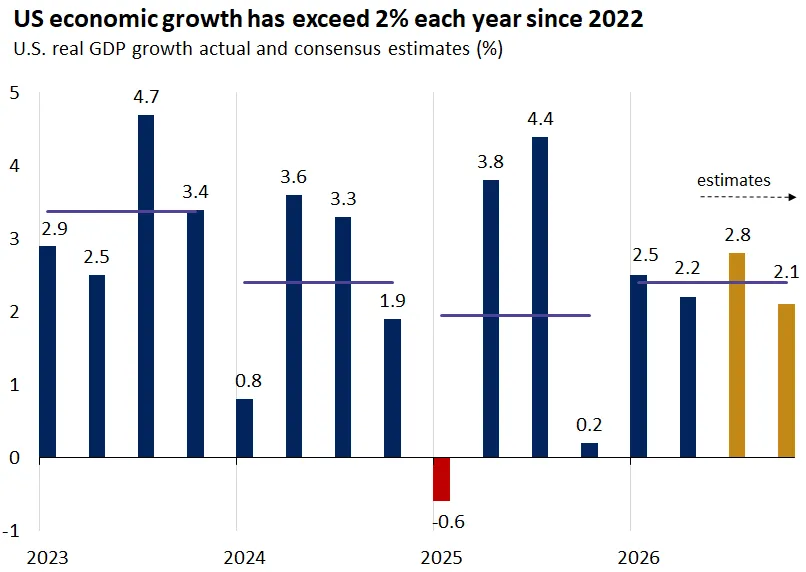
The graph shows U.S. economic growth exceeding 2% annually since 2022.
The graph shows U.S. economic growth exceeding 2% annually since 2022.
2. Learning to Live with Higher Rates
Perhaps the most surprising aspect of this cycle is that it has thrived despite the highest interest rate environment in more than two decades. Historically, rapidly rising bond yields have often been viewed as kryptonite for equities. Yet since this bull market began, stocks have continued to reach fresh highs even as Treasury yields have climbed to new cycle highs.
While a series of external shocks, including the war in Ukraine, tariffs, conflict in the Middle East, and AI-related supply constraints, have contributed to persistent inflation pressures and uncertainty around the path of Fed policy, strong economic growth may be the common thread linking both higher rates and higher stock prices. After all, interest rates tend to rise when investors expect stronger growth, firmer inflation, or both.
Investors spent much of the past four years asking when interest rates would return to the past decade's levels. Increasingly, the more important question may be whether those levels were ever normal in the first place. In a world of elevated government borrowing, growing capital investment needs, and potentially higher productivity growth, interest rates may ultimately settle at levels above what investors became accustomed to during the 2010s.
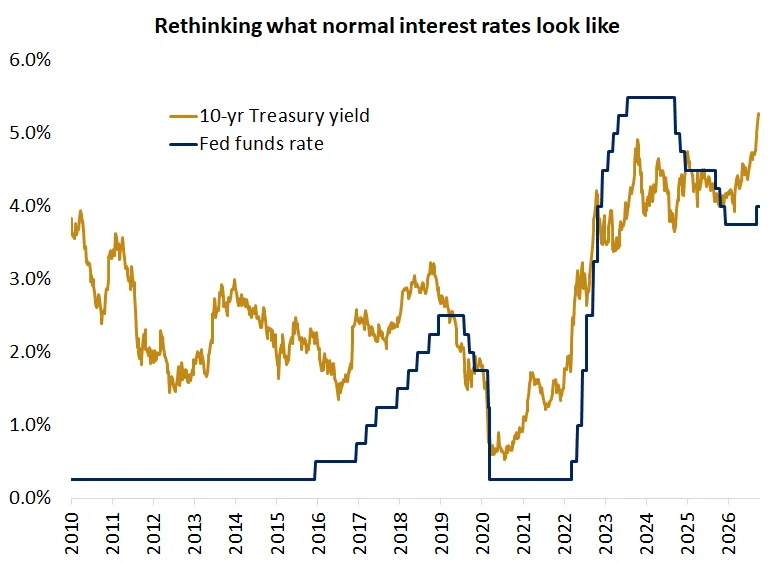
The graph shows Treasury yields and the federal funds rate rising well above 2010s levels, illustrating a shift toward a higher-rate environment.
The graph shows Treasury yields and the federal funds rate rising well above 2010s levels, illustrating a shift toward a higher-rate environment.
3. AI Powers Growth While Leadership Remains Concentrated
Since the launch of ChatGPT in 2022, advances in AI have occurred at a remarkable pace. The resulting surge in investment across the AI supply chain has not only provided a meaningful boost to U.S. economic growth but has also reshaped market leadership.
A small group of mega-cap technology companies has driven a disproportionate share of stock market returns, leaving both the S&P 500 and the broader U.S. equity market increasingly concentrated. Unlike some past episodes, however, this concentration has largely been supported by strong earnings growth. In that sense, concentration may be a feature, not a bug, of this cycle. Nevertheless, reliance on a handful of companies can amplify volatility and create risks if growth expectations fail to live up to lofty expectations.
To put today's concentration into perspective, roughly 40 cents of every dollar invested in the S&P 500 is allocated to the index's ten largest companies, while approximately 8 cents is invested in NVIDIA alone. NVIDIA's market value now exceeds that of five entire S&P 500 sectors: Energy, Utilities, Real Estate, Consumer Staples, and Materials. It is also worth more than the entire U.S. small-cap market.
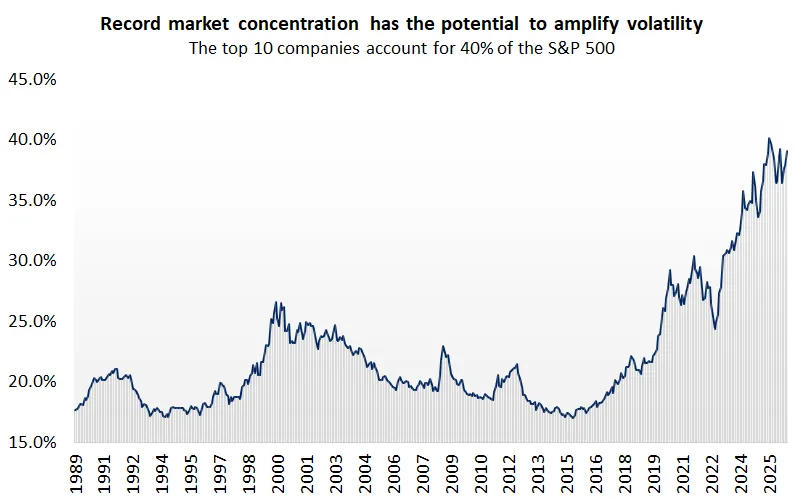
The graph shows that the top 10 companies of the S&P 500 by market capitalization now account for 40% of the index, a record concentration.
The graph shows that the top 10 companies of the S&P 500 by market capitalization now account for 40% of the index, a record concentration.
4. Earnings Continue to Do the Heavy Lifting
While valuation expansion played an important role in the early stages of the recovery, earnings growth has increasingly become the primary driver of this bull market. The composition of returns highlights this shift. Since the October 2022 low, the S&P 500 has gained roughly 117%, with approximately 70% of that advance attributable to higher earnings and the remaining 30% to valuation expansion. More importantly, the balance has evolved over time. Valuation expansion helped fuel the early stages of the rally, but earnings growth took over the baton this year as valuations declined and earnings are on track for their strongest growth in more than four decades outside of post-recession recoveries.
Strong earnings growth has also helped explain concentrated market leadership. Looking ahead to third-quarter earnings season, analysts expect another quarter of robust results, with technology and semiconductor-related companies once again accounting for a significant share of overall earnings growth, even as contributions from other parts of the market increase.
The key takeaway is that while valuations helped launch this bull market, earnings have sustained it. History suggests bull markets driven by profit growth tend to be more durable than those relying primarily on investors paying ever higher prices for the same stream of earnings.
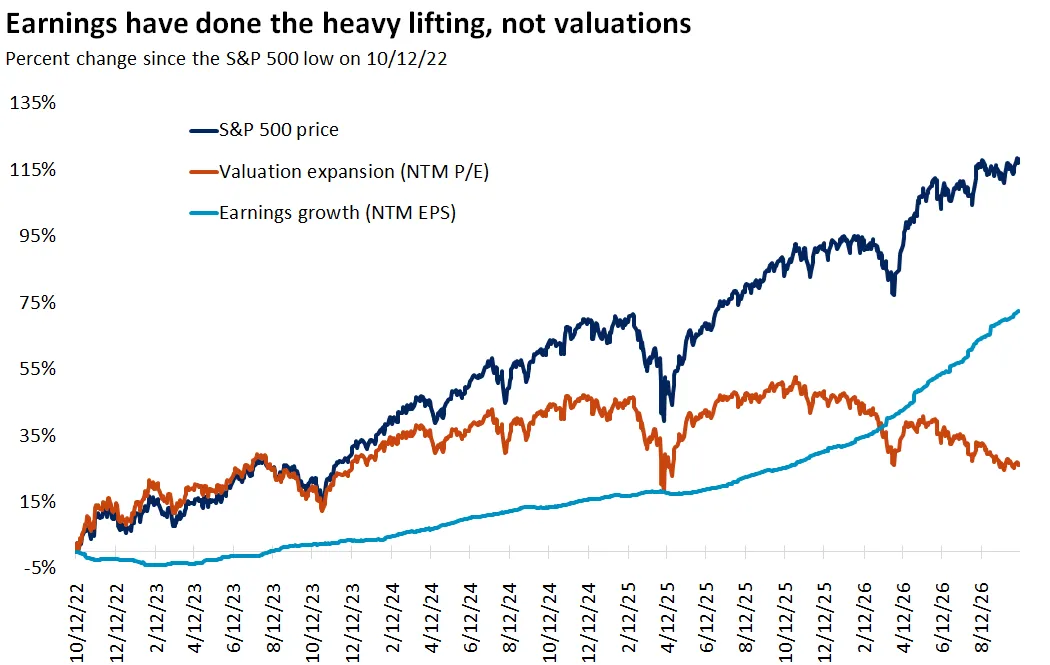
The chart shows the S&P 500 returns since October 2022 alongside earnings growth and valuation expansion. Earnings have accounted for most of the market's gains.
The chart shows the S&P 500 returns since October 2022 alongside earnings growth and valuation expansion. Earnings have accounted for most of the market's gains.
The Next Chapter
Investors spent much of this bull market waiting for a better entry point. As money market yields climbed, cash balances remained elevated and many investors stayed on the sidelines despite rising equity prices. Participation has improved over the last two years, though without the euphoria that often accompanies major market peaks.
As we look ahead, the Fed is likely to be a lead actor in the next chapter. History suggests bull markets do not die of old age. More often, they end when the Fed tightens policy aggressively and/or the economy enters a recession. While no single indicator provides all the answers, we are closely monitoring credit spreads, market breadth, leadership trends, and investor sentiment for signs that risks are building.
And even if a bear market does not emerge, the odds of a correction may be rising. Earnings growth is unlikely to maintain its current pace, and the market is approaching a full year without a 10% pullback despite such corrections occurring regularly throughout history. Investors should maintain realistic expectations for both returns and volatility. A healthier market would ultimately benefit from broader participation beyond today's leaders. Managing concentration risk, including within AI-related investments, may become increasingly important as this cycle matures.
In our view, a growing economy, rising corporate profits, and a Fed that may be looking to tap the brakes rather than slam on them suggest this bull market still has room to run. Earnings do not need to continue growing at today's exceptional pace for stocks to move higher. Continued profit growth, coupled with stable or modestly improving valuations if inflation and interest-rate pressures ease, could support further gains. If so, we may very well be celebrating another anniversary next year.
Angelo Kourkafas, CFA
Senior Global Investment Strategist
Sources for all data in commentary: Bloomberg, FactSet
Previous weeks' weekly market wraps
10/2: Rising rates, resilient economy: What history suggests for markets
9/25: Navigating a Higher Interest Rate World
9/18: What the Fed's first hike in three years means for investors
9/11: Oil Raised the Question, CPI Delivered the Answer
9/4: Three Datapoints the Fed Is Likely Watching Ahead of the September FOMC Meeting
8/28: A Clearer Path into September
8/21: A roller-coaster week for rates: Separating opportunity from risk
Important Information:
The Weekly Market Update is published every Friday, after market close.
This is for informational purposes only and should not be interpreted as specific investment advice. Investors should make investment decisions based on their unique investment objectives and financial situation. While the information is believed to be accurate, it is not guaranteed and is subject to change without notice.
Investors should understand the risks involved in owning investments, including interest rate risk, credit risk and market risk. The value of investments fluctuates and investors can lose some or all of their principal.
Past performance does not guarantee future results.
Market indexes are unmanaged and cannot be invested into directly and are not meant to depict an actual investment.
Diversification does not guarantee a profit or protect against loss in declining markets.
Systematic investing does not guarantee a profit or protect against loss. Investors should consider their willingness to keep investing when share prices are declining.
Dividends may be increased, decreased or eliminated at any time without notice.
Special risks are inherent in international investing, including those related to currency fluctuations and foreign political and economic events.
Before investing in bonds, you should understand the risks involved, including credit risk and market risk. Bond investments are also subject to interest rate risk such that when interest rates rise, the prices of bonds can decrease, and the investor can lose principal value if the investment is sold prior to maturity.