
The graphic above reads: A timeout can help you review your goals and objectives, recognize behaviors that could cause trouble, and avoid making emotional investment decisions.
The graphic above reads: A timeout can help you review your goals and objectives, recognize behaviors that could cause trouble, and avoid making emotional investment decisions.
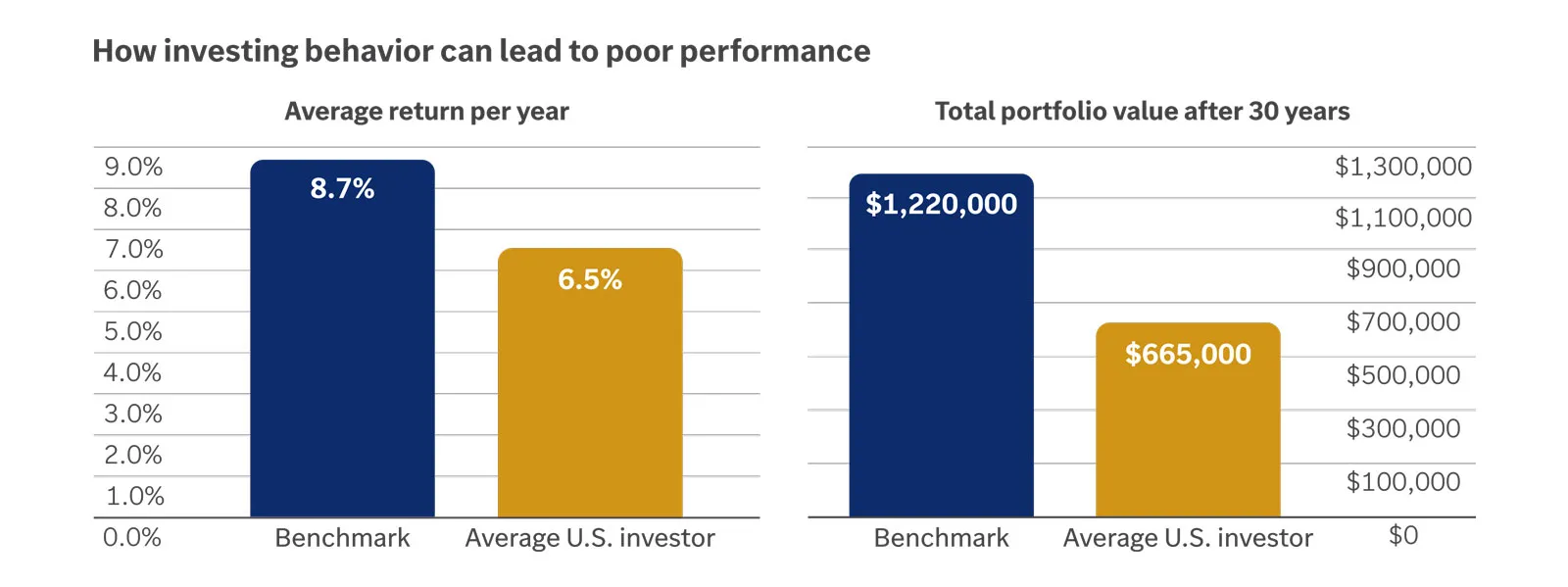
The chart shows how the average equity and bond investor in the U.S. underperforms benchmarks. It models a portfolio of 65% stocks and 35% bonds over a 30-year period ending in 2024. The two bars on the left compare average annual returns, with the benchmark portfolio returning 8.7% and the average investor returning 6.5%. The two bars on the right show that this means an initial investment of $100,000 would grow to $1,220,000 based on the benchmark portfolio return, but to only $665,000 for the average investor return.
The chart shows how the average equity and bond investor in the U.S. underperforms benchmarks. It models a portfolio of 65% stocks and 35% bonds over a 30-year period ending in 2024. The two bars on the left compare average annual returns, with the benchmark portfolio returning 8.7% and the average investor returning 6.5%. The two bars on the right show that this means an initial investment of $100,000 would grow to $1,220,000 based on the benchmark portfolio return, but to only $665,000 for the average investor return.
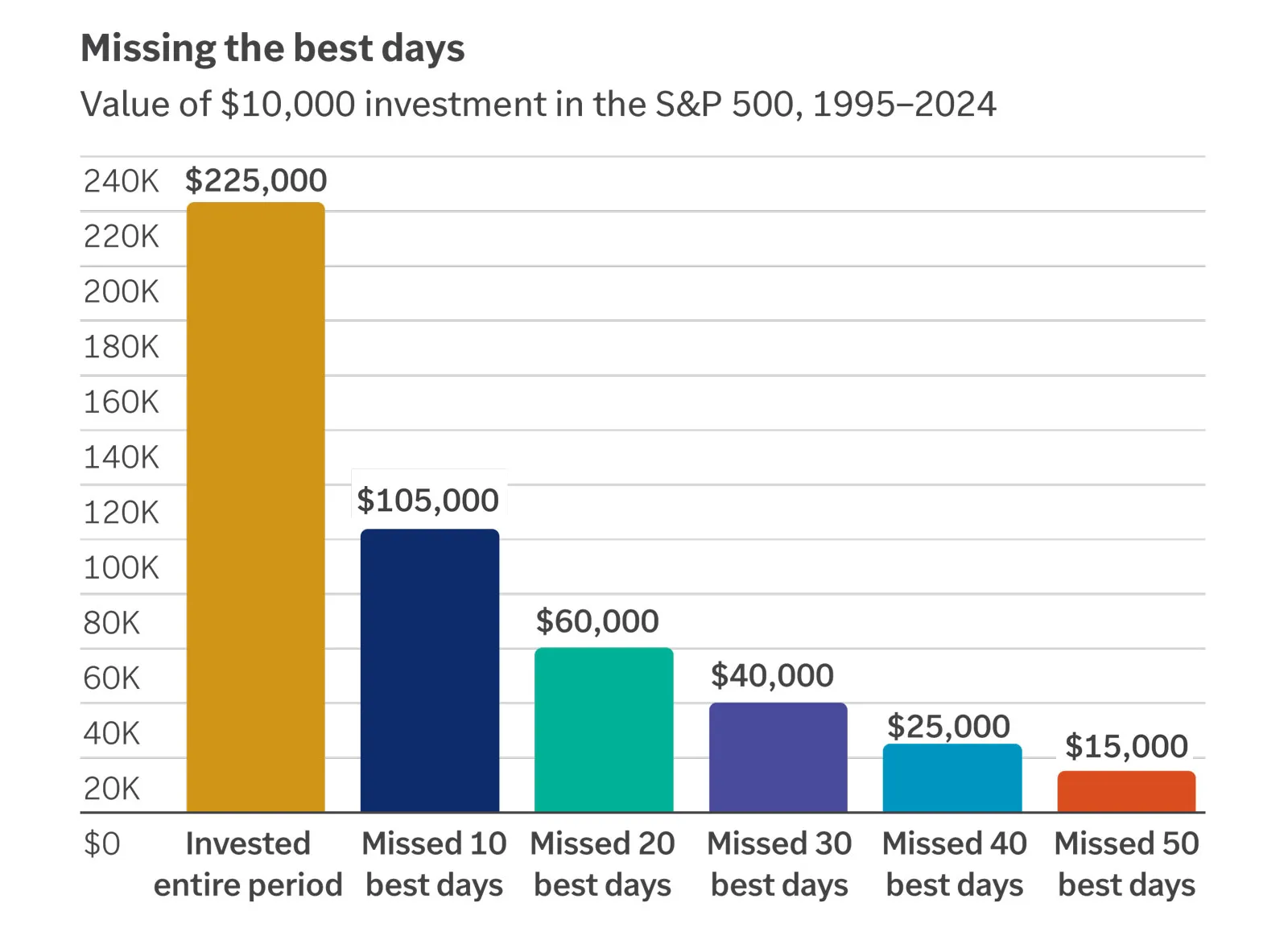
This chart illustrates the cost of missing the best days in the market. It shows that the ending value of a $10,000 investment in the S&P 500 from 1995 to 2024 for an investor remaining fully invested for the entire period would have been $225,000. By comparison, the same investment would have grown to just $105,000 for those who missed the market’s 10 best days, $60,000 for those who missed the 20 best days, $40,000 for those who missed the 30 best days, $25,000 for those who missed the 40 best days, and $15,000 for those who missed the 50 best days.
This chart illustrates the cost of missing the best days in the market. It shows that the ending value of a $10,000 investment in the S&P 500 from 1995 to 2024 for an investor remaining fully invested for the entire period would have been $225,000. By comparison, the same investment would have grown to just $105,000 for those who missed the market’s 10 best days, $60,000 for those who missed the 20 best days, $40,000 for those who missed the 30 best days, $25,000 for those who missed the 40 best days, and $15,000 for those who missed the 50 best days.
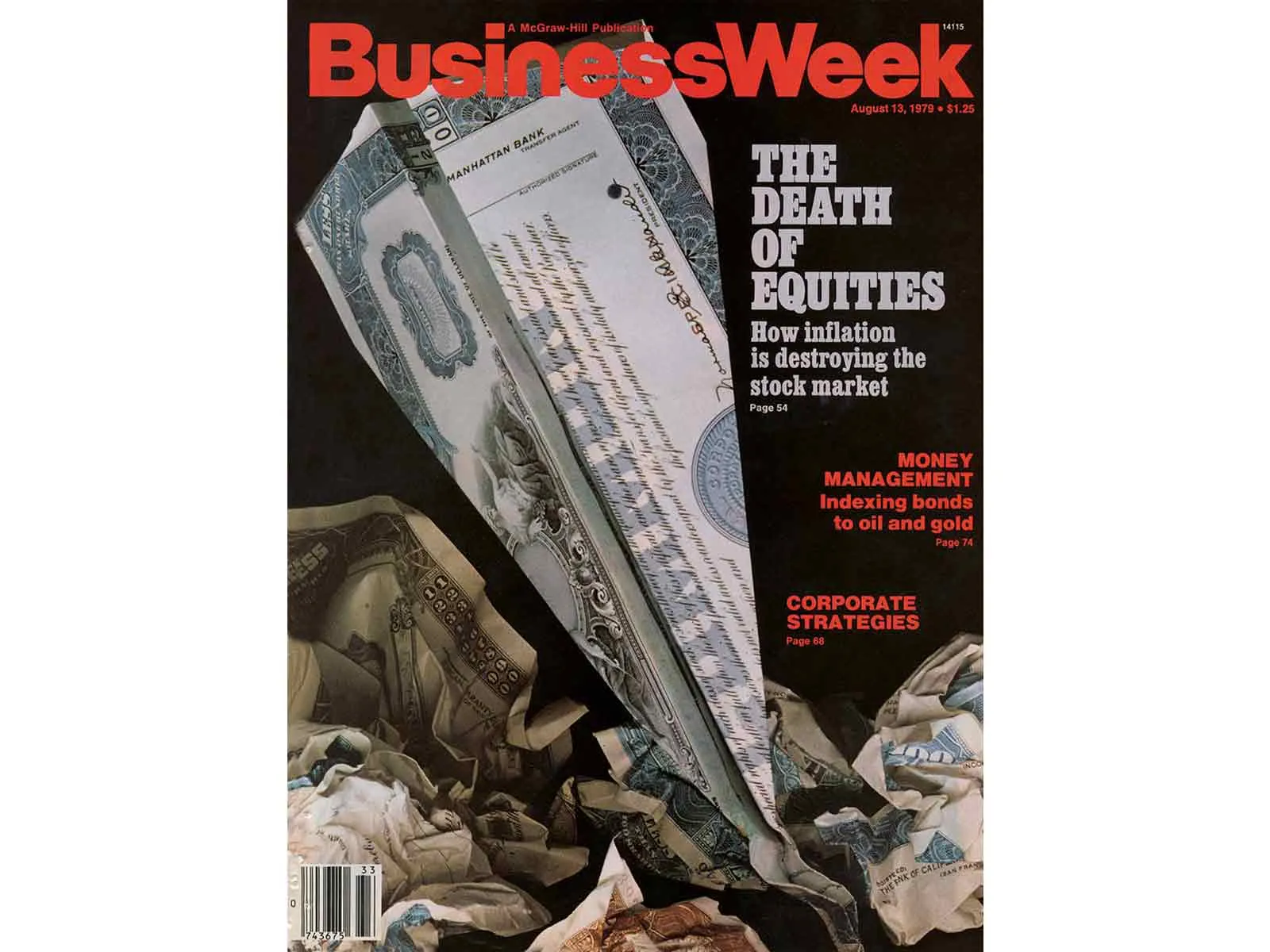
This photo shows a cover of BusinessWeek magazine focused on negative market news. It touts an article headlined “The Death of Equities: How inflation is destroying the stock market.”
This photo shows a cover of BusinessWeek magazine focused on negative market news. It touts an article headlined “The Death of Equities: How inflation is destroying the stock market.”
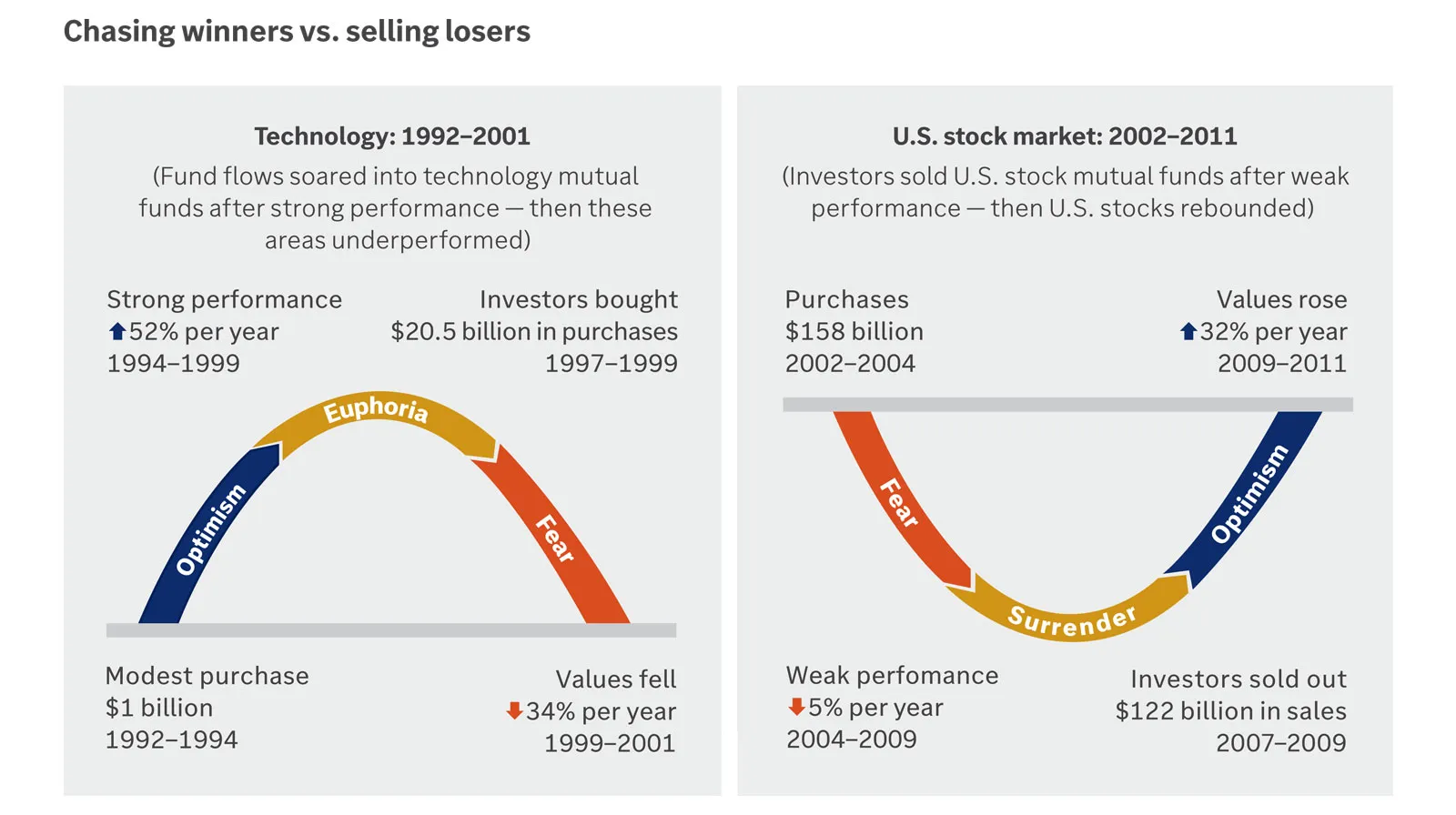
This graphic illustrates how investors crowd into and out of investments.
The chart on the left shows that fund flows soared into technology mutual funds after strong performance, but then they underperformed.
• In the two years prior to December 1994, $1 billion flowed into technology mutual funds.
• Over the next five years (December 1994 to December 1999), optimism caused tech stocks to generate an average return of 52% per year. This led to a period of euphoria, with investors pouring $20.5 billion into tech funds from December 1997 to December 1999 because of their strong performance.
• But over the following two years (December 1999 to December 2001), these stocks underperformed, falling 34% in value per year.
The chart on the right shows how investors sold U.S. stock mutual funds after weak performance, only to have those stocks rebound.
• In the two years prior to March 2004, investors bought $158 billion in U.S. stock mutual funds.
• At the bottom of the financial crisis, U.S. stocks suffered an average annual drop of 5% for the prior five years (March 2004 to March 2009). As markets faltered, investors sold $122 billion in U.S. stock funds from March 2007 to March 2009
• But markets turned optimistic in March 2009, climbing an average of 32% per year over the next two years (March 2009 to March 2011).
This graphic illustrates how investors crowd into and out of investments.
The chart on the left shows that fund flows soared into technology mutual funds after strong performance, but then they underperformed.
• In the two years prior to December 1994, $1 billion flowed into technology mutual funds.
• Over the next five years (December 1994 to December 1999), optimism caused tech stocks to generate an average return of 52% per year. This led to a period of euphoria, with investors pouring $20.5 billion into tech funds from December 1997 to December 1999 because of their strong performance.
• But over the following two years (December 1999 to December 2001), these stocks underperformed, falling 34% in value per year.
The chart on the right shows how investors sold U.S. stock mutual funds after weak performance, only to have those stocks rebound.
• In the two years prior to March 2004, investors bought $158 billion in U.S. stock mutual funds.
• At the bottom of the financial crisis, U.S. stocks suffered an average annual drop of 5% for the prior five years (March 2004 to March 2009). As markets faltered, investors sold $122 billion in U.S. stock funds from March 2007 to March 2009
• But markets turned optimistic in March 2009, climbing an average of 32% per year over the next two years (March 2009 to March 2011).
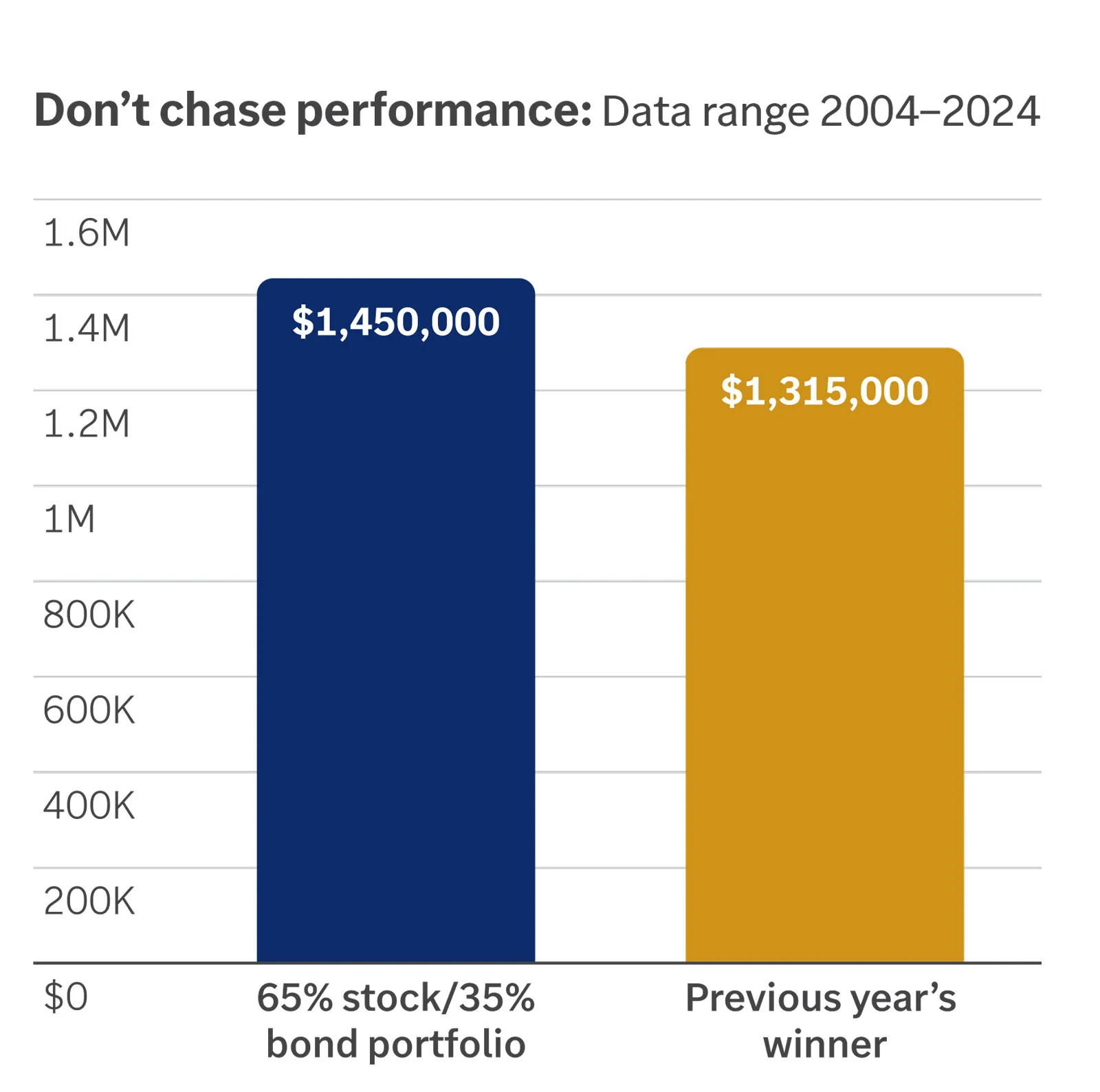
This bar chart shows that from 2004–2024, the consistent stock/bond portfolio would have grown to $1,450,000, whereas chasing the best-performing asset class would have increased to just $1,315,000.
This bar chart shows that from 2004–2024, the consistent stock/bond portfolio would have grown to $1,450,000, whereas chasing the best-performing asset class would have increased to just $1,315,000.
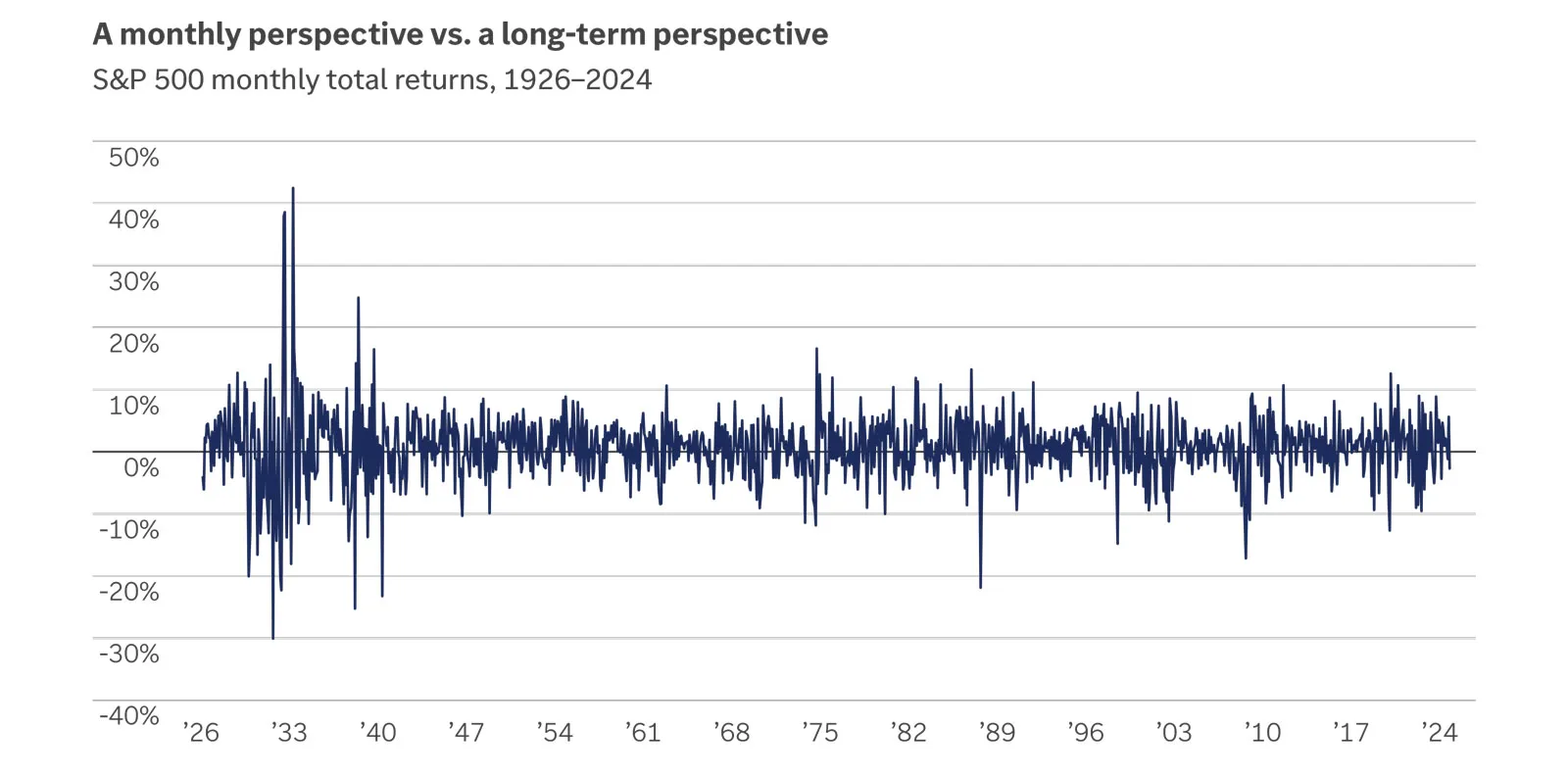
The first chart shows monthly returns in the S&P 500 from 1926 to 2024. Monthly performance ranged from a maximum loss of nearly 30% to a maximum gain of more than 40%. There are no clear patterns, highlighting short-term volatility.
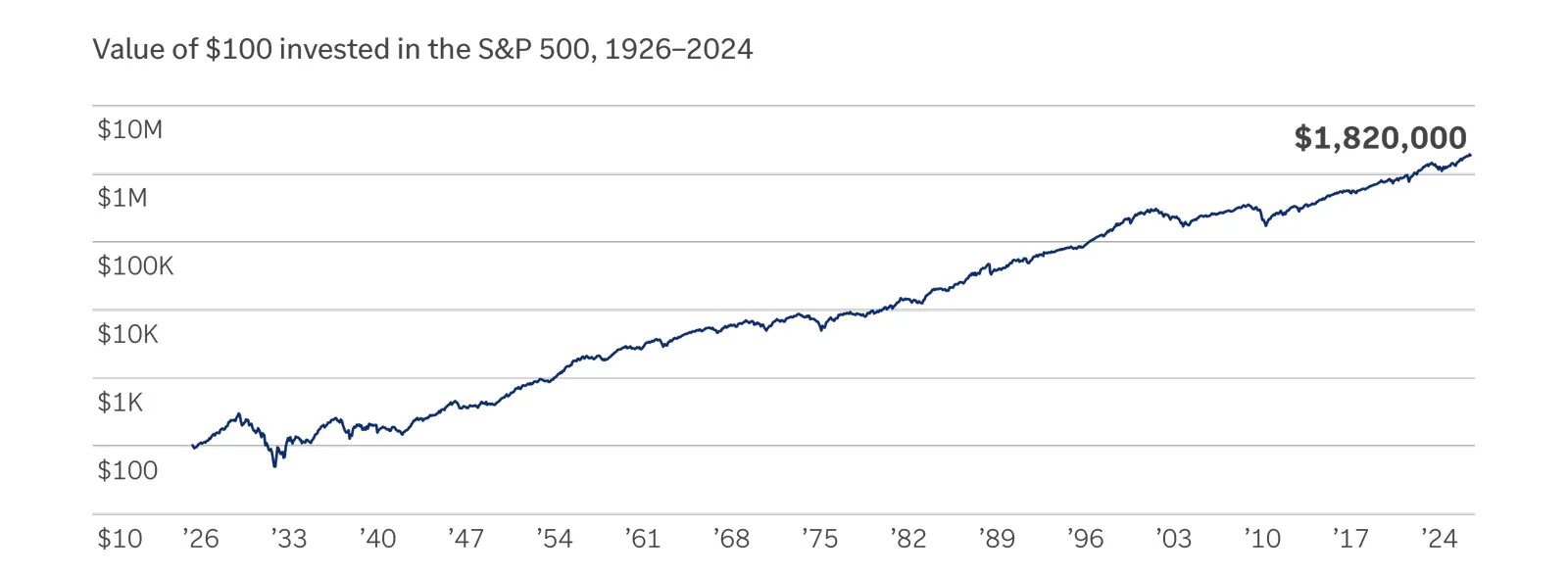
The second chart showcases the long-term growth of a $100 investment in the S&P 500 over the same period. The initial investment generally expands steadily to $1,820,000 in 2024.
The first chart shows monthly returns in the S&P 500 from 1926 to 2024. Monthly performance ranged from a maximum loss of nearly 30% to a maximum gain of more than 40%. There are no clear patterns, highlighting short-term volatility.
The second chart showcases the long-term growth of a $100 investment in the S&P 500 over the same period. The initial investment generally expands steadily to $1,820,000 in 2024.
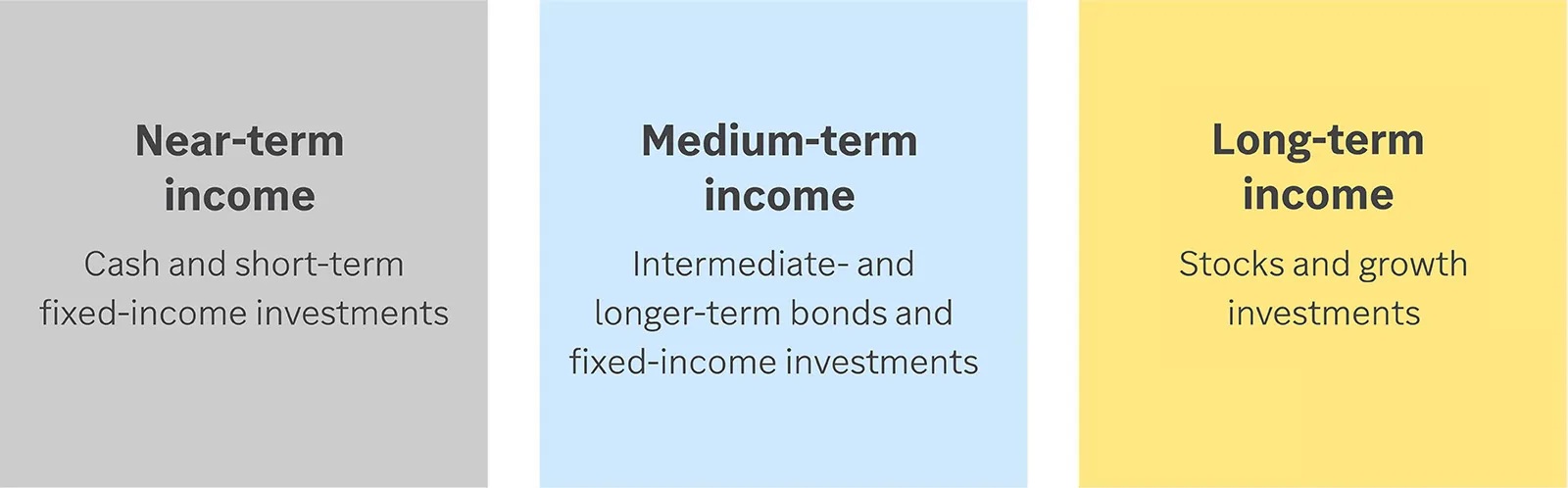
The graphic above illustrates the roles of different investments:
• Cash and short-term fixed-income investments can be thought of for near-term income needs.
• Intermediate- and longer-term bonds and fixed-income investments can be thought of for medium-term income needs.
• Stocks and growth investments can be thought of for long-term income needs.
The graphic above illustrates the roles of different investments:
• Cash and short-term fixed-income investments can be thought of for near-term income needs.
• Intermediate- and longer-term bonds and fixed-income investments can be thought of for medium-term income needs.
• Stocks and growth investments can be thought of for long-term income needs.
Important Information:
* Investing in equities involves risk. The value of your shares will fluctuate, and you may lose principal.
This information is for educational and illustrative purposes only and should not be interpreted as specific investment advice. Investors should make investment decisions based on their unique investment objectives and financial situation.
Investors should understand the risks involved in owning investments, including interest rate risk, credit risk and market risk. The value of investments fluctuates, and investors can lose some or all of their money.