Investment Policy Committee
Initial public offerings (IPOs) tend to attract a lot of investor interest, especially when the company is large and well-known. The excitement can be tempting, but it doesn’t always lead to strong investment results. We encourage investors to look beyond the headlines and focus on whether the share price is supported by fundamentals, the company’s progress toward sustainable profitability, and whether the potential volatility aligns with their goals and risk tolerance.
IPO excitement fades fast
News coverage typically ramps up and drives excitement as the offering date approaches. The stock price of an IPO often rises on the day it begins trading relative to the publicized IPO price set by the security underwriters (known as the offer price). However, most individual investors don’t receive share allocations at the offer price, as these shares are generally reserved for institutional investors.
Instead, shares are bought in the secondary market after trading begins, frequently at prices that already reflect heightened demand. When compared to the secondary market’s opening price, performance is often less impressive and returns can be negative for the days and weeks that follow.
Historical context for IPOs
On average, stocks from the 30 of the largest IPOs included in the Russell 3000 Index over the past 20 years experienced a 24% price increase on the first day of trading compared to the offer price, helping to support the excitement around high-profile IPOs. However, the stock price declined by an average of 1.4% on the first day when compared to the day's opening price as shown in the bar graph. This reflects what individual investors could experience on the first day.
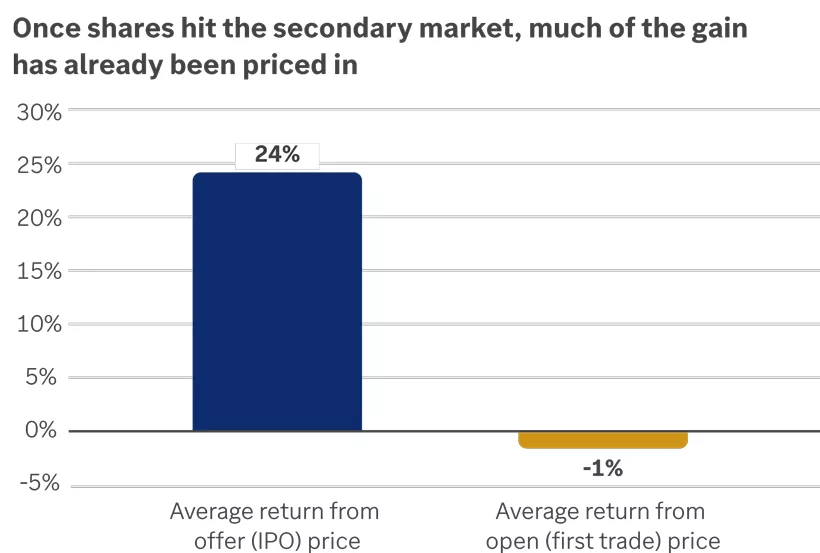
Source: FactSet, Edward Jones. Past performance does not guarantee future results.
On average, these stocks underperformed the S&P 500 over the subsequent three-month period, as the IPO companies declined 2.8% on average while the S&P 500 increased 3%. This underperformance persisted over the first year of trading, as shown in the line graph, suggesting that the short-term IPO enthusiasm does not necessarily translate into longer-term outperformance.
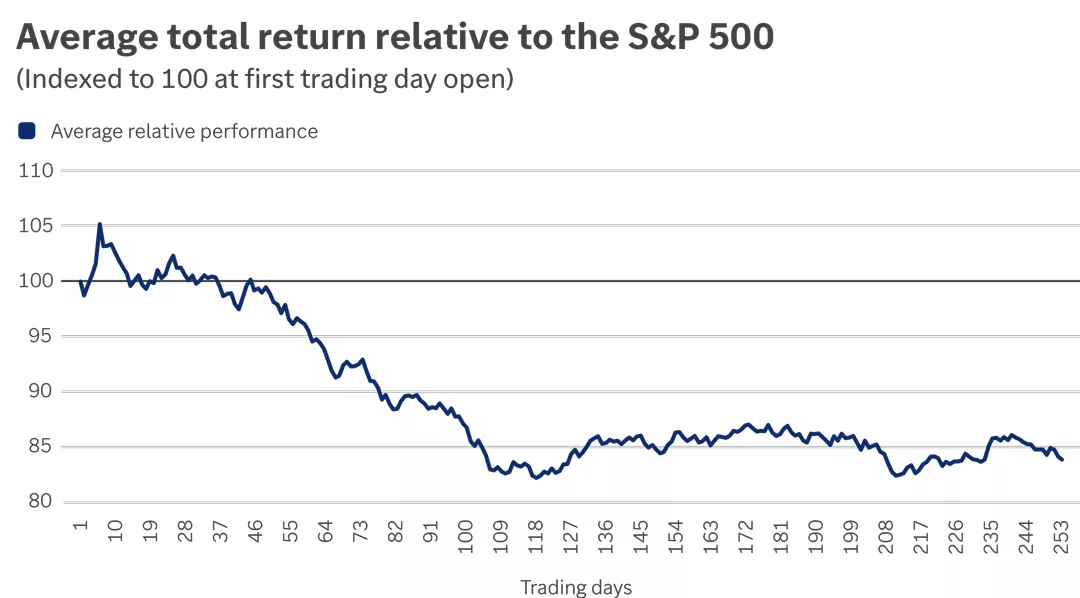
Source: FactSet, Edward Jones. Past performance does not guarantee future results. Indexes are unmanaged, cannot be invested into directly and are not meant to depict an actual investment.
Higher volatility potential
IPO stock prices can be extremely volatile and are often impacted by structural characteristics such as a small float, lockup periods and limited operating histories.
- The headline market capitalization is simply the share price multiplied by total shares outstanding, while the float-adjusted market capitalization reflects only the shares actually available to public investors after excluding founder, insider, and other strategic or control holdings (such as private equity, venture investors or sovereign wealth funds). That distinction matters because price movements are driven by the tradable supply of shares.
- Pre-IPO investors, such as private equity and venture capital firms, often have lockup periods and are restricted from selling shares for a period of time. However, when the lockup expires, early investors may exit positions to get a return on their investments, putting pressure on the stock price.
- IPO companies have limited public operating histories, which makes it more difficult for investors to assess long-term financial performance. As a result, shares can react strongly to earnings reports and shifts in broader market outlooks.
Key considerations: first days of trading
If, after considering the price risks above, you decide to still purchase the stock, it's important to understand pricing and trading mechanics.
- Opening price may be very different from the official IPO price. New issues can experience extreme volatility in the first few hours and days of trading in the secondary market. When the company’s stock opens for secondary trading, price swings can be large.
- Market orders are not accepted for an IPO; limit orders must be used. Edward Jones typically does not accept orders until after the IPO has been priced.
Investing versus speculating
Large IPOs can come with a lot of fanfare. But in the early days of public trading, it can be difficult to separate long-term fundamentals from short-term momentum. Before purchasing shares, consider the company’s business prospects, competitive position and valuation, and focus on investments that align with your objectives and risk tolerance.
Money and Meaning: Understanding Financial Fulfillment
What do Americans really think about their finances today? Discover what our 2026 Gallup research reveals about how values and emotions shape our relationship with money.