How to prepare for the unexpected
Preparing for the unexpected is about creating guardrails to help minimize the impact of unexpected challenges to your goals and ultimately create better financial stability for yourself and your family.
Why preparing for unexpected financial events matters
Having a plan to save for your goals is important, but life doesn’t always go to plan. When it comes to unexpected events, it’s common to think, “This won’t happen to me.”
The truth is that emergencies occur more often than you might realize:1
- 45% of homes face the risk of suffering severe or extreme climate events.
- 20% of individuals visit a hospital’s emergency room each year.
- One in four workers experience a disability lasting longer than 90 days during their working years.
- 55% of older adults need long-term care support over their lifetime.
Once they occur, these financial emergencies can come with a hefty price tag, whether that’s experiencing large expenses, losing your income or both.
| The cost of unexpected events2 | |
| Event | Cost |
| Replacement water heater | $1,300 |
| Storm damage to home | $14,000 |
| Unemployment | Six months’ worth of income |
| Hospital stay if uninsured | $70,000 |
| Long-term care | $150,000 |
If an unexpected event occurs and you’re unprepared, you might struggle to cover your basic expenses and stop saving or backtrack any progress you’ve made toward your long-term financial goals.
Building your financial protection plan
Which protection strategies do you need?
Preparing for the unexpected includes:
- Buying insurance
- Building dedicated savings
- Drafting legal documents stating your wishes
Some protection strategies, such as health insurance or an emergency fund, apply to everyone all the time. But others are specific to your life stage. For example, disability insurance may be important while you’re working but not so much if you’re retired. Conversely, having a plan to cover long-term care costs may not be your priority in your 20s but becomes more important as you reach retirement.
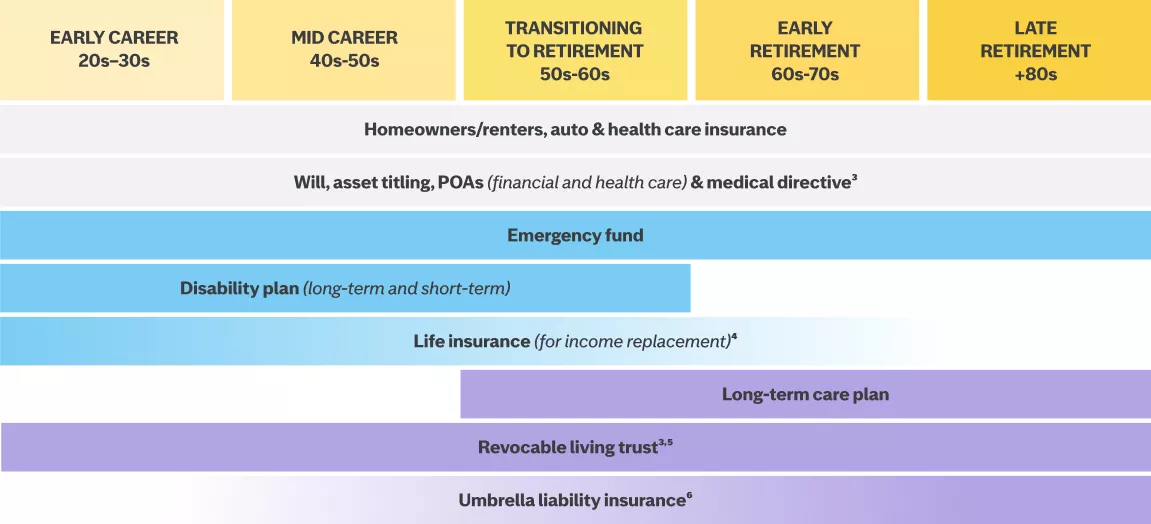
The following chart shows how protection needs can evolve over time. Keep in mind, this is just an example — not everyone’s situation looks the same.
Protection strategies by life stage
Notes:
3 In some cases, a revocable living trust might be prioritized along with other estate documents (e.g., you have a dependent with special needs). An attorney can help draft your estate documents, advise whether a trust is appropriate and provide guidance on how to title assets and designate beneficiaries.
4 Considers only the use of life insurance to cover your family’s needs in case of untimely death of you or your partner (for example, to replace lost income or pay off debts). It doesn’t include using life insurance for legacy or wealth transfer purposes.
5 The importance of a revocable living trust depends on your family situation. A revocable living trust is more relevant if you have large or complex assets, special family concerns (e.g., minor child or dependent with special needs) or a blended or nontraditional family.
6 The importance of umbrella liability insurance depends on your overall assets. The more assets you have, the more relevant this insurance is for you.
This chart shows different protection strategies and how they’re relevant at different life stages: early career (20s–30s), mid-career (40s–50s), transitioning to retirement (50s–60s), early retirement (60s–70s) and late retirement (80s and older).
Strategies that protect your home, health and family are listed first and are relevant across all life stages. These include homeowners/renters, auto and health insurance, as well as components of an estate plan including a will, asset titling, POAs (financial and health care powers of attorney) and a medical directive.
Strategies that protect your income are next, starting with an emergency fund, which is relevant during all life stages. Next is a short- or long-term disability plan, which is relevant during working years (roughly between your 20s and 60s). And finally, life insurance, which when used for income replacement is most important during your working years, becoming less important as you age and have fewer working years.
Strategies that protect your assets appear last. These start with a long-term care plan, which is most relevant in your 50s and later. The next is a revocable living trust, which could be relevant during all life stages. The final strategy is umbrella insurance, which becomes more important as you age and, presumably, accumulate more assets.
Notes:
3 In some cases, a revocable living trust might be prioritized along with other estate documents (e.g., you have a dependent with special needs). An attorney can help draft your estate documents, advise whether a trust is appropriate and provide guidance on how to title assets and designate beneficiaries.
4 Considers only the use of life insurance to cover your family’s needs in case of untimely death of you or your partner (for example, to replace lost income or pay off debts). It doesn’t include using life insurance for legacy or wealth transfer purposes.
5 The importance of a revocable living trust depends on your family situation. A revocable living trust is more relevant if you have large or complex assets, special family concerns (e.g., minor child or dependent with special needs) or a blended or nontraditional family.
6 The importance of umbrella liability insurance depends on your overall assets. The more assets you have, the more relevant this insurance is for you.
This chart shows different protection strategies and how they’re relevant at different life stages: early career (20s–30s), mid-career (40s–50s), transitioning to retirement (50s–60s), early retirement (60s–70s) and late retirement (80s and older).
Strategies that protect your home, health and family are listed first and are relevant across all life stages. These include homeowners/renters, auto and health insurance, as well as components of an estate plan including a will, asset titling, POAs (financial and health care powers of attorney) and a medical directive.
Strategies that protect your income are next, starting with an emergency fund, which is relevant during all life stages. Next is a short- or long-term disability plan, which is relevant during working years (roughly between your 20s and 60s). And finally, life insurance, which when used for income replacement is most important during your working years, becoming less important as you age and have fewer working years.
Strategies that protect your assets appear last. These start with a long-term care plan, which is most relevant in your 50s and later. The next is a revocable living trust, which could be relevant during all life stages. The final strategy is umbrella insurance, which becomes more important as you age and, presumably, accumulate more assets.
Do you have gaps in your financial coverage?
In some cases, you may be missing a protection strategy, such as not having anything saved in an emergency fund. In others, your strategy might not adequately meet your needs. For example, let’s say you created an emergency fund but haven’t reviewed it in some time. If your family has grown, you’ve changed jobs or your expenses have risen, the amount you’ve saved might not be adequate anymore.
Which gaps should you tackle first?
With many potential strategies, you may have more than one gap in coverage. If so, it’s easy to feel overwhelmed and not know where to begin. Also, enhancing your protection strategies costs money, so you might not have the resources to address all your gaps at once.
We recommend focusing on strategies in this order:
- Start with protecting your home, health and family with homeowners/renters, auto and health insurance, as well as estate documents.
- Protect your income by building an emergency fund, having a plan to address a short- or long-term disability and purchasing life insurance.
- Focus on protecting your assets with a long-term care plan and, if applicable, a revocable living trust and umbrella liability insurance.
How a financial advisor can help
Many of us prefer not to think about the things that can throw us off track. But preparing for the unexpected can help provide comfort that you’ve done everything you can in the event something goes wrong.
A financial advisor can help you assess your protection strategies and provide guidance on what to prioritize. Together, you can work to build a comprehensive protection plan that fits your needs and those of your family.
1 Source: Centers for Disease Control and Prevention (2019), Department of Health and Human Services (2022), Realtor.com (2024) and Society of Actuaries (2013).
2 Source: Angi (2025), Bureau of Labor Statistics (2000-2024), Department of Health and Human Services (2022), Genworth (2024) and Insurance Information Institute (2018–2022). Costs are averages, except for long-term care cost. Long-term care cost is based on receiving two to three years of care with increasing levels of care support.