Navigating a Higher Interest Rate World
Key takeaways
- Global interest rates continue to rise, with a sharp sell-off in U.S. Treasuries last week lifting bond yields to new 20-year highs.
- In part this sell-off is an inflation story, with a deadlock in the Middle East adding to concerns over global energy prices, and domestic inflationary price pressures proving frustratingly sticky.
- However, signs of a nascent acceleration in growth are also weighing on bonds, as households continue to spend freely, AI investment booms, and corporate profits surge.
- Central banks are pushing back against these trends, with the Fed's recent interest rate hike likely to be followed by further hikes this year and next.
- Markets do not expect this to be a short-term increase in the fed funds rate, with rising long-term policy expectations potentially signaling a higher neutral, or equilibrium, interest rate.
- A higher interest rate environment is creating new opportunities across fixed income, in our view, while also driving a rotation in equity market leadership toward large-cap stocks.
Global interest rates continue to push higher in the face of inflation risks, robust growth and hawkish central banks. These forces pushed U.S. Treasury yields to new multi-decade highs last week, with the 10-year U.S. Treasury note briefly touching 5.20% while the 30-year closed just shy of 5.5%.
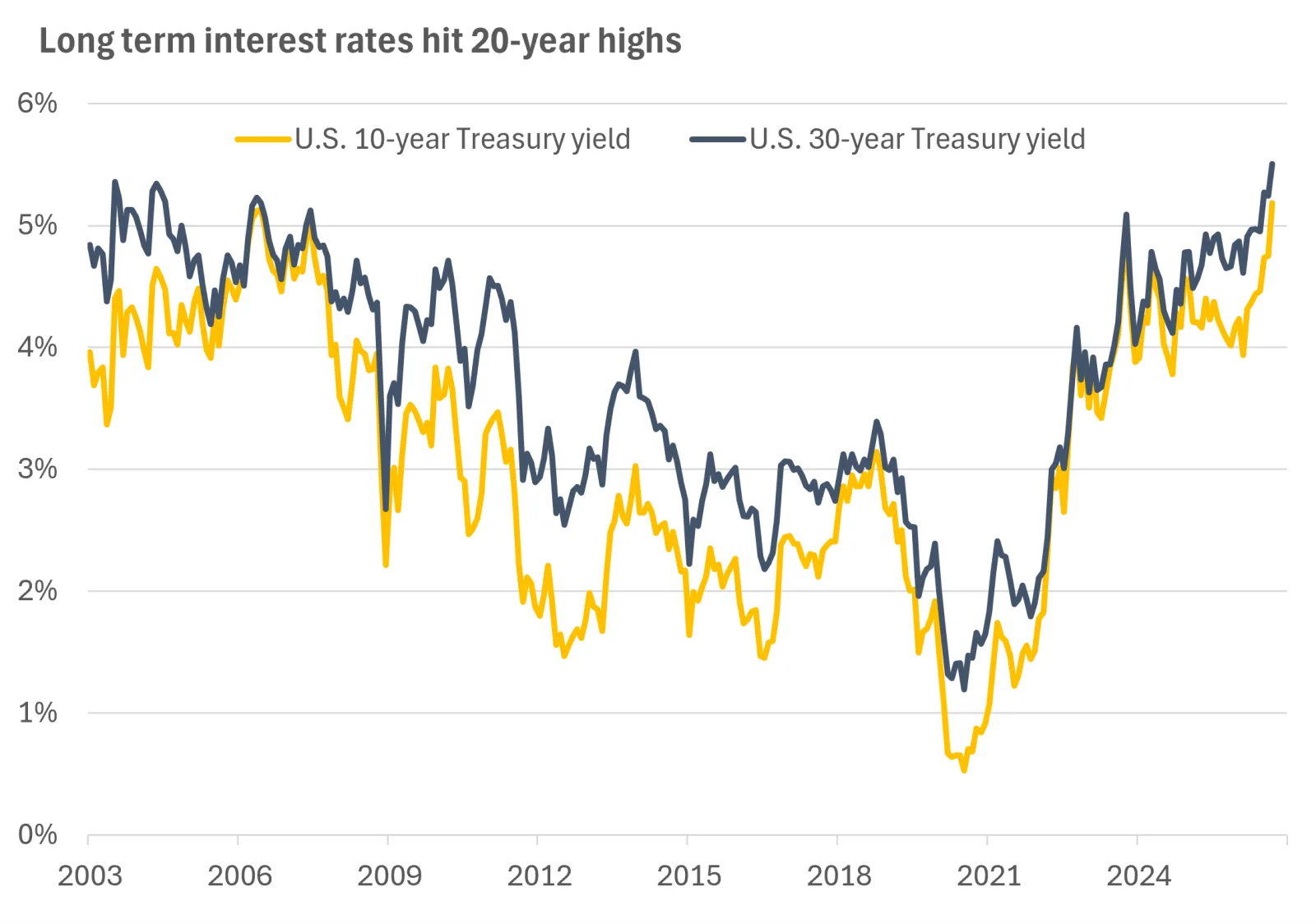
The chart shows the sharp move higher in longer dated U.S. government bond yields in recent months to multi-decade highs. Past performance does not guarantee future results.
The chart shows the sharp move higher in longer dated U.S. government bond yields in recent months to multi-decade highs. Past performance does not guarantee future results.
Equity markets were impressively resilient in the face of this spike. However, scratching beneath the surface, higher rates sparked another rotation in leadership, as large-cap stocks outperform smaller companies and international equities.
Let's dig deeper into the macroeconomic forces underpinning these moves and think about what they might mean for your portfolio.
Inflation a tough nut to crack
Inflation risks continue to weigh on bond markets.
We saw this sensitivity in real time last week amid conflicting headlines around the Middle East. Bellicose rhetoric from the U.S. and Iran at the U.N. meeting pushed crude oil prices higher and sparked a painful sell-off in bond markets. More constructive news around a potential phased reopening in the Strait of Hormuz helped reverse some of this damage, but the 10-year still finished the week 20 basis points higher (0.2%). Bonds will likely remain sensitive to geopolitics until we get a definitive diplomatic solution to this conflict.
However, it is not just oil prices sparking concern over inflation. Core personal consumption expenditures (PCE) inflation – which strips out often volatile food and energy prices – is running at 3.3%, well above the Fed's 2% target. This has sparked fears that the U.S may have a deeper inflation problem.
We suspect some of these pressures will be temporary. Rising goods prices over the past year have been driven by a combination of higher tariff rates – which should generate a one-off effect on inflation – and a narrow increase in certain consumer electronics prices as global microchip prices surge. Meanwhile, services inflation is being boosted by some imputed prices - such as financial services, which tend to rise when markets rally. Excluding these imputed prices core PCE inflation is running at 3%.
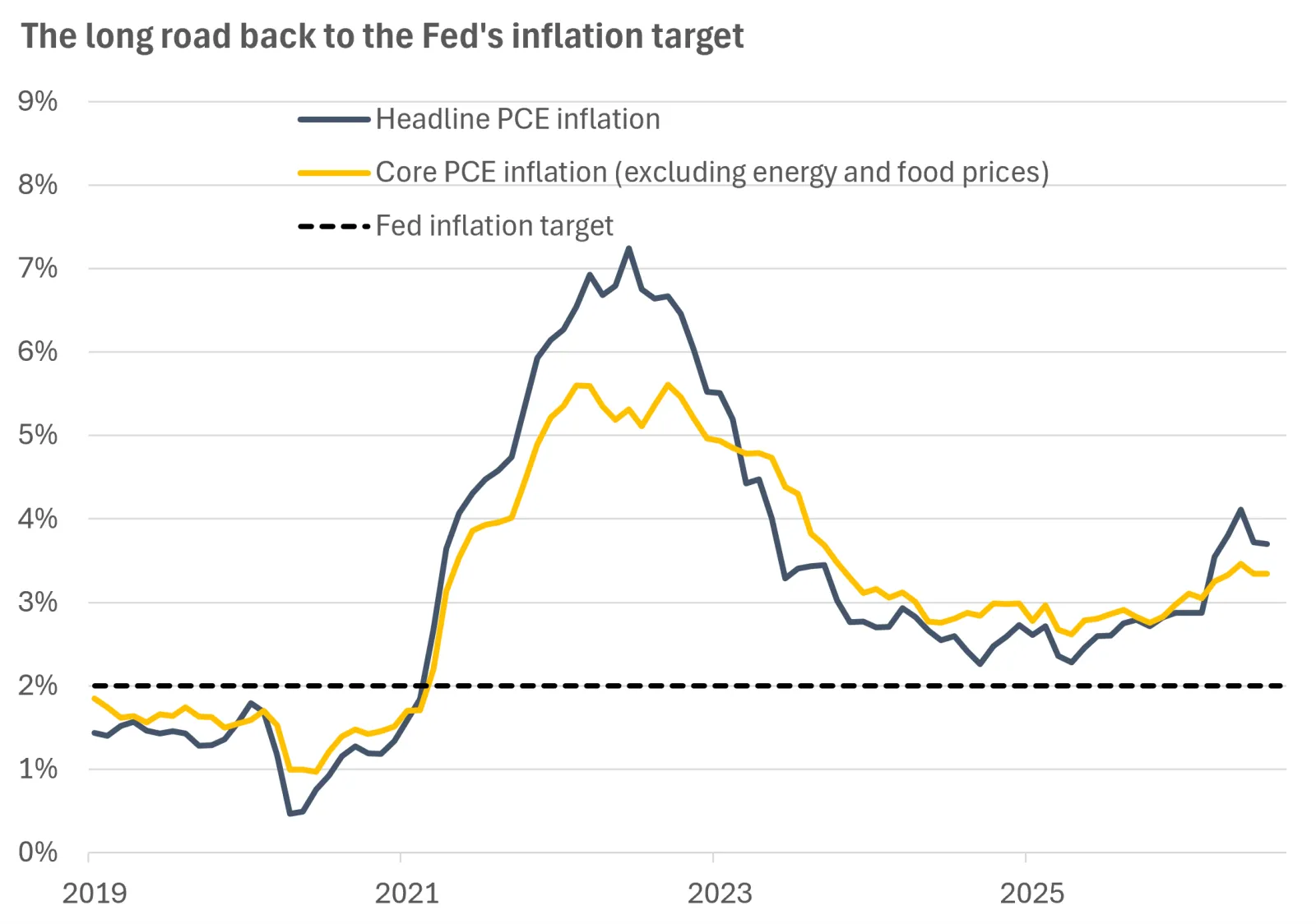
The chart shows that both headline and core inflation have moved further away from the Fed's 2% target this year.
The chart shows that both headline and core inflation have moved further away from the Fed's 2% target this year.
However, while we think a cooling in these temporary drivers should set the stage for slower inflation rates next year, the market (and the Fed) might need to see hard proof of easing price pressures, especially with price growth having run above the Fed's 2% target for nearly six years.
Accelerating growth
We believe strong growth represents a more constructive driver of the bond market sell-off.
Again, there was evidence of this dynamic last week, when a surge in the U.S. (and global) Purchasing Managers Index (PMI) surveys of business sentiment pointed to a further acceleration in activity across the manufacturing and services sectors.
We of course need to be careful in taking too much signal from a single indicator, especially given the PMI's noisy track record, but there has been broader evidence of strengthening activity rates in recent months.
Consumer spending continues to run at robust rates as households use their strong balance sheets to smooth through this year's spike in inflation. Meanwhile, aggressive AI spending is driving a surge in investment, which looks set to persist in coming quarters. Finally, corporate profits are booming, which typically supports hiring and capex spending.
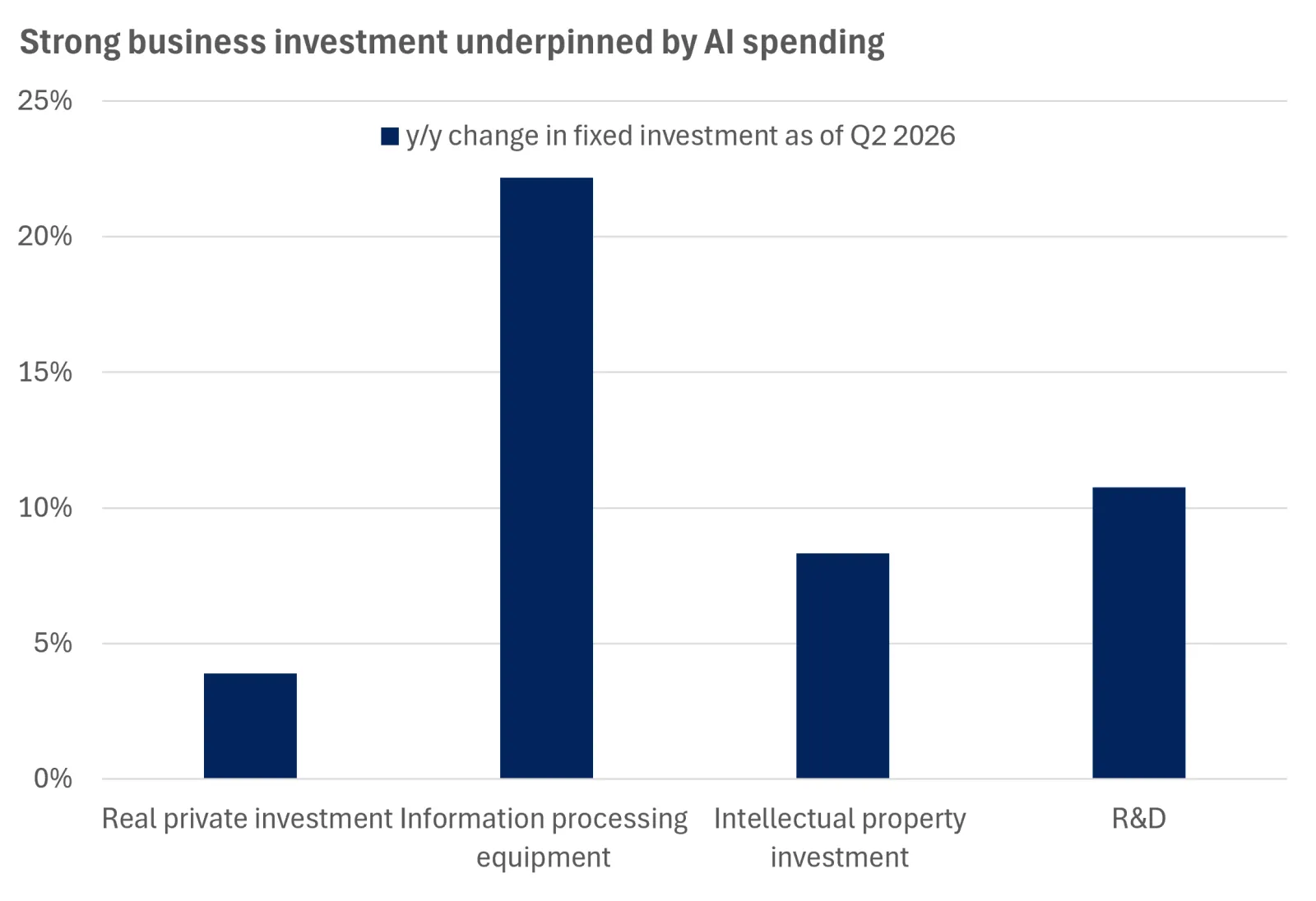
The chart shows that booming AI spending is helping to drive U.S. investment higher.
The chart shows that booming AI spending is helping to drive U.S. investment higher.
We are already seeing these dynamics start to drive a retightening in the labor market, and the Fed will likely be conscious that strong growth could add to its inflation challenges, if left untamed.
A higher-for-longer Fed
The Fed of course has already started to adjust policy in the face of these macroeconomic drivers, lifting interest rates by 25 basis points (0.25%) at its September meeting and signaling at least one more increase from here.
We think of this as a tap on the brakes of the economy, as well as a way to signal credibility in the Fed's inflation battle, as the central bank looks to recalibrate policy to push back on above-target inflation and prevent any overheating. Continuing this adjustment, we think the Fed will hike again this year, maybe even as soon as October, and once or twice more in 2027. Higher interest rates should lean on activity, particularly in interest-rate-sensitive parts of the economy like housing, but we do not expect these to derail broader growth.
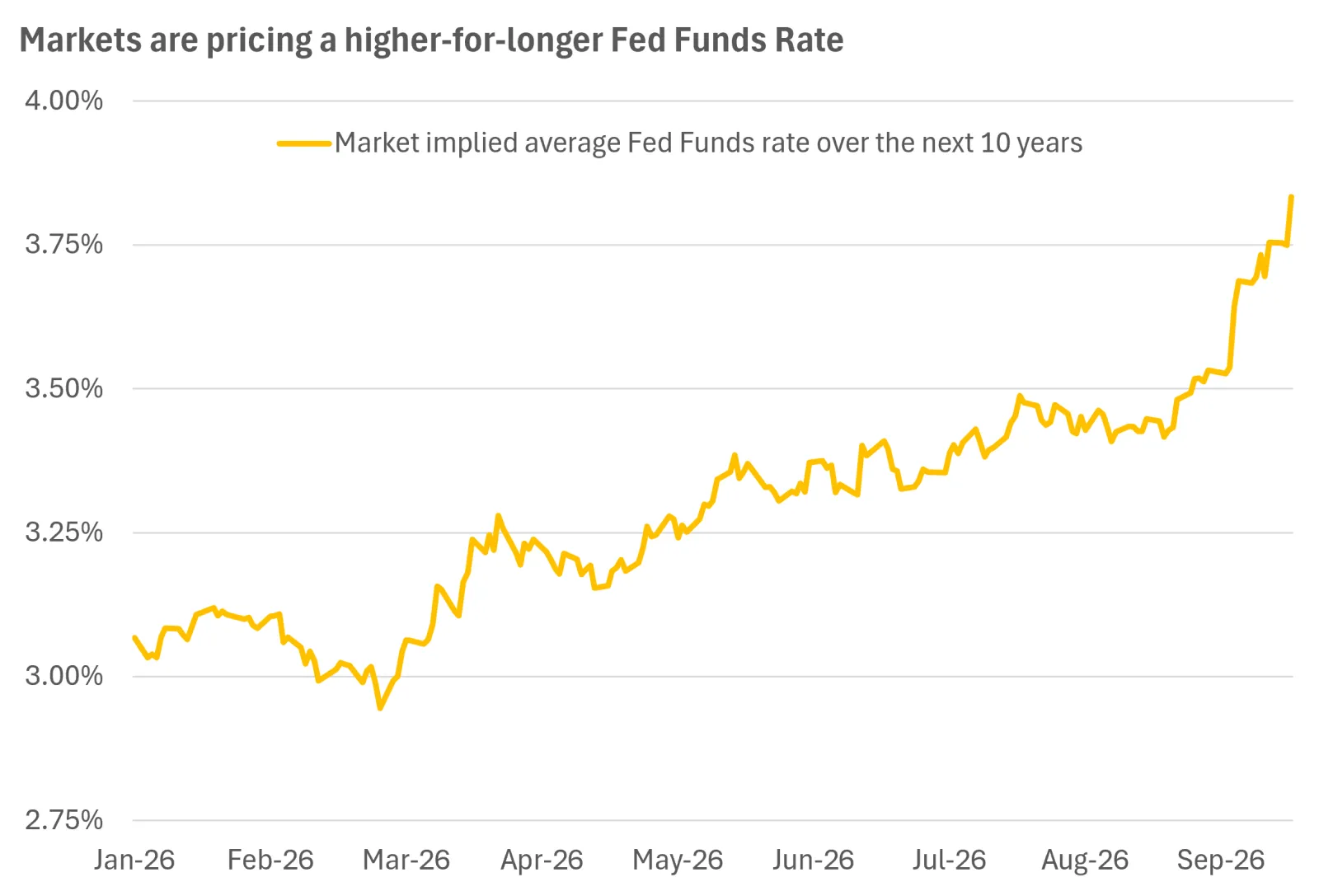
The chart shows that expectations for the average fed funds rate over the next decade have increased markedly this year.
The chart shows that expectations for the average fed funds rate over the next decade have increased markedly this year.
Importantly, markets have not just adjusted expectations for the fed funds rate in the short term. The 10-year Treasury currently points to an average fed funds rate of 3.8% over the next decade, up from 3% at the start of this year. If realized, this would represent a more structural rise in interest rates.
This shift could imply a rise in what economists call the neutral, or equilibrium, interest rate in the U.S. economy, sometimes referred to as r*. This interest rate is determined by a range of macroeconomic forces and represents the level at which Fed policy neither stimulates nor weighs on the economy.
To be transparent, we can't observe where neutral rates sit, and forecasting these is a notoriously tricky business. However, we believe there are plausible reasons why neutral rates might be rising, including extraordinary AI investment, hopes for stronger potential growth rates on the back of this innovation, and large government deficits. All considered, we would not be surprised if we have entered a higher-for-longer era for interest rates, especially when compared to the low-rate environment seen in the 2010s.
What does this all mean for investors?
Bonds have had a tough year, continuing a difficult run for this asset class since the pandemic. Moreover, there is a risk that the adjustment in rates might not be over, in our view, and we could well see further volatility in bond markets.
However, we believe bonds can continue to form an important part of portfolios, providing income for investors and potential diversification in the face of a business cycle downturn. Tactically, we think that short-term yields offer favorable returns in excess of cash, while limiting duration risk in portfolios. Meanwhile, longer-term investors looking for income might find yields of well over 5% or more in U.S. Treasuries over coming decades attractive, while high-yield credit or emerging-market debt offer even higher yields, albeit with more credit risk. Be sure to evaluate these opportunities in the context of your financial goals, risk tolerance, liquidity needs and time horizon.
Higher rates can pose risks to equities as discount rates rise and financial conditions tighten – as we saw in 2022. However, while it would not be a surprise to us to see volatility rise, we suspect it would take a larger recalibration in Fed policy than currently anticipated to derail markets.
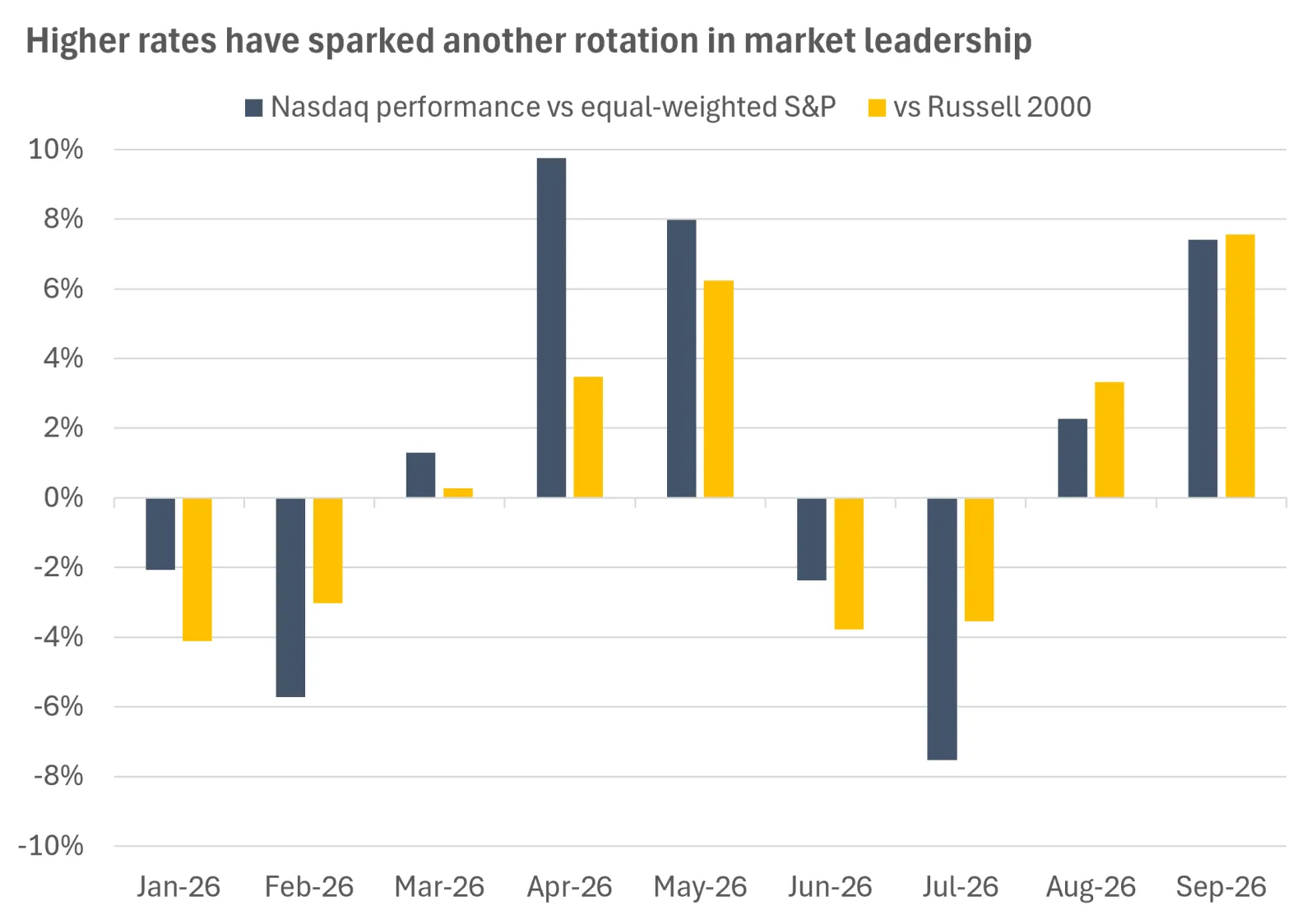
The chart shows the shifts in market leadership this year, with the technology focused Nasdaq outperforming in recent months. Past performance does not guarantee future results. An index is unmanaged, cannot be invested into directly and is not meant to depict an actual investment.
The chart shows the shifts in market leadership this year, with the technology focused Nasdaq outperforming in recent months. Past performance does not guarantee future results. An index is unmanaged, cannot be invested into directly and is not meant to depict an actual investment.
Instead, we believe investors should think carefully around asset allocation in the face of higher rates. Large cap stocks, particularly those in the tech sector, have held up well given strong balance sheets and solid growth profiles, while areas like small-cap stocks have lagged, given they tend to hold more debt and be more sensitive to interest rate moves. Similarly, rising U.S. rates have pushed the dollar higher in recent weeks, weighing on the returns of international equities for U.S. investors.
Speak to your financial advisor to help ensure your portfolio is diversified and well-positioned for higher interest rates.
James McCann
Senior Economist, Investment Strategy
Source for all data in commentary: Bloomberg

James McCann
Senior Economist
Thought Leader In:
- Economic issues impacting the lives of everyday Americans.
- The effects of government spending, taxes and regulation changes on our clients.
- Building diversified portfolios to help investors reach their long-term financial goals.
“The economic, political and policy landscape is shifting dramatically, making it ever more challenging for our clients to navigate their personal finances. In this environment, it's our deep, research-driven insights that can help clients stay on track to reach their financial goals."
James McCann
Senior Economist
Previous weeks' weekly market wraps
9/18: What the Fed's first hike in three years means for investors
9/11: Oil Raised the Question, CPI Delivered the Answer
9/4: Three Datapoints the Fed Is Likely Watching Ahead of the September FOMC Meeting
8/28: A Clearer Path into September
8/21: A roller-coaster week for rates: Separating opportunity from risk
Important Information:
The Weekly Market Update is published every Friday, after market close.
This is for informational purposes only and should not be interpreted as specific investment advice. Investors should make investment decisions based on their unique investment objectives and financial situation. While the information is believed to be accurate, it is not guaranteed and is subject to change without notice.
Investors should understand the risks involved in owning investments, including interest rate risk, credit risk and market risk. The value of investments fluctuates and investors can lose some or all of their principal.
Past performance does not guarantee future results.
Market indexes are unmanaged and cannot be invested into directly and are not meant to depict an actual investment.
Diversification does not guarantee a profit or protect against loss in declining markets.
Systematic investing does not guarantee a profit or protect against loss. Investors should consider their willingness to keep investing when share prices are declining.
Dividends may be increased, decreased or eliminated at any time without notice.
Special risks are inherent in international investing, including those related to currency fluctuations and foreign political and economic events.
Before investing in bonds, you should understand the risks involved, including credit risk and market risk. Bond investments are also subject to interest rate risk such that when interest rates rise, the prices of bonds can decrease, and the investor can lose principal value if the investment is sold prior to maturity.