Key takeaways

  • History offers reassurance - Markets have historically performed well following midterm elections, regardless of which party wins.
  • The party in power typically loses seats - The president's party usually loses congressional seats in midterm elections, yet market performance has historically remained broadly positive across a variety of political outcomes.
  • Interest rates may matter more than politics - Investors are increasingly focused on deficits, Treasury borrowing and Fed policy, making interest rates a more important market driver than election outcomes alone.
  • Gridlock appears to be the most likely outcome - Divided government and legislative gridlock reduce the likelihood of sweeping policy changes and large new fiscal initiatives.

With the 2026 midterm elections approaching, investors are once again asking what politics may mean for markets and whether the elections have the potential to disrupt this year's positive momentum. History suggests that elections often create short-term uncertainty, but they have rarely been the primary driver of long-term market returns. Instead, economic growth, corporate earnings, inflation, and interest rates tend to matter far more. Given this year's backdrop, the more important question may be what the election outcome means for government spending, deficits, and interest rates.

What History Says

1) Muted returns tend to be followed by a strong rebound once uncertainty clears

  • The historical record around midterm elections is reassuring. Markets have often experienced volatility ahead of election day amid higher uncertainty and negative headlines. However, stocks have tended to rally starting about one month before the election and then continue to rise once the results are known as investors gain more clarity about the policy environment, although improving economic and earnings trends have often played an important role as well (for example, the 2002 market bottom following the tech bust, the 2010 recovery from the financial crisis, and the 2022 peak in inflation and growing expectations that the Fed's tightening cycle was nearing an end).
     
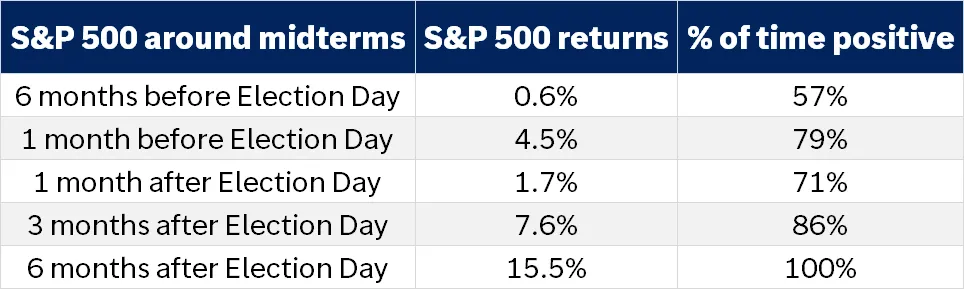
  • Since 1970 there have been 14 midterm elections. The S&P 500 has gained an average of 4.5% during the month leading up to Election Day, with positive returns 79% of the time. Over the subsequent six months, the index has generated an average return of 15.5% and posted gains following all 14 midterm elections. While there is no guarantee that history will repeat itself this election cycle, we believe these results show that investors are usually better served by maintaining a disciplined investment plan than by making major portfolio changes based solely on election forecasts.
 The table shows S&P 500 total returns around the midterm election day since 1970.
Source: FactSet, Edward Jones. Past performance does not guarantee future results. Indexes are unmanaged, cannot be invested into directly and are not meant to depict an actual investment.

2) The party in power tends to lose seats

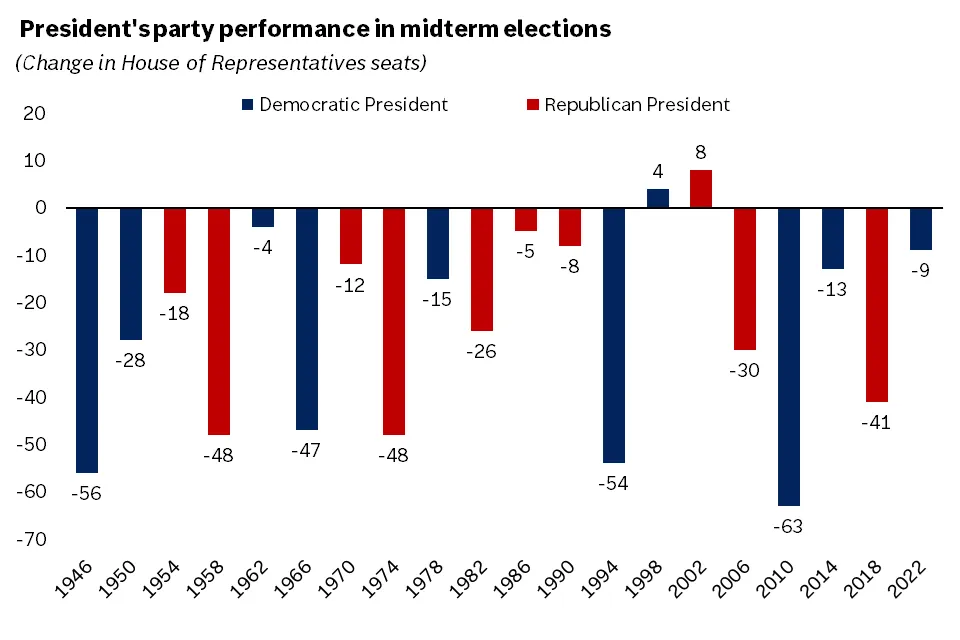
  • History suggests that midterm elections are usually challenging for the party in the White House. Since 1946, the president's party has lost House seats in 18 of 20 midterm elections, with the only exceptions occurring in 1998 (Clinton) and 2002 (George W. Bush), and Senate seats in 15 of 20 midterms. One possible explanation is that midterm elections often become a referendum on the sitting administration, while voters seeking change may be more motivated to turn out.
 The graph shows the change in House seats for the party holding the White House immediately following each midterm election. The president's party has lost seats in 18 of the last 20 midterm elections.
Source: The American Presidency Project, Edward Jones.
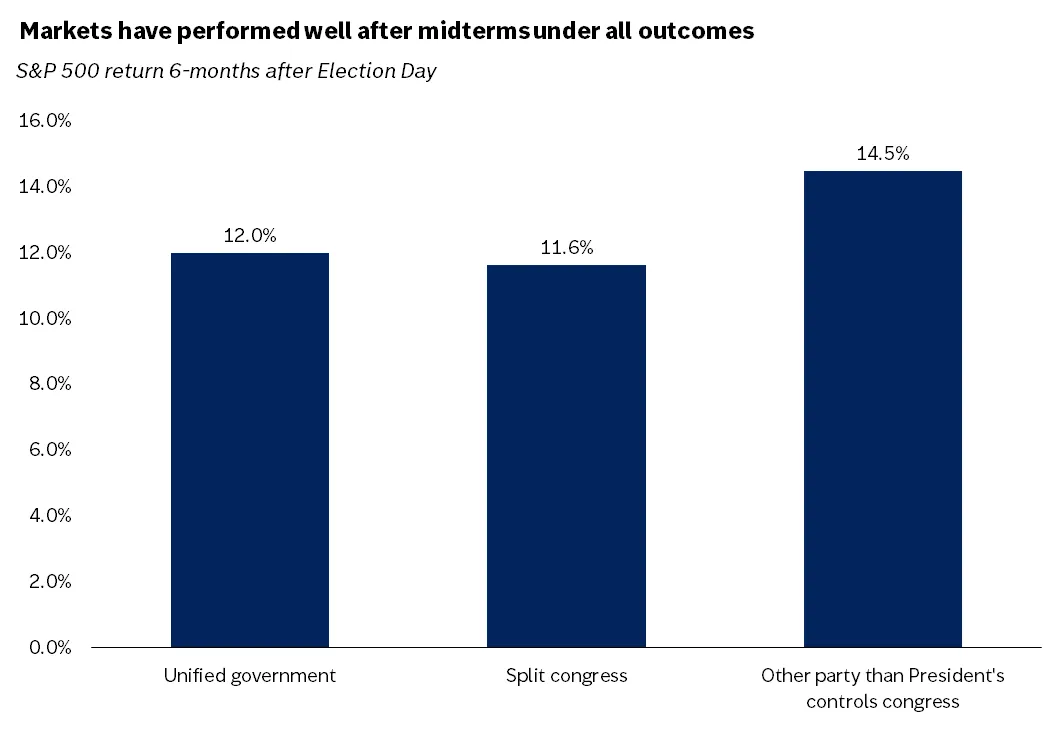
  • While political control has often shifted following midterm elections, market performance has historically been surprisingly consistent. Since 1970, the S&P 500 has generally generated positive returns following midterms regardless of whether the outcome resulted in unified government, a split Congress, or divided government between the White House and Congress. This includes the five instances in which the president's party controlled both the House and Senate heading into a midterm election and subsequently lost at least one chamber, with the S&P 500 averaging approximately 11% over the following six months. We think the broader lesson is that investors may benefit more from focusing on economic fundamentals than attempting to predict election outcomes.
 The graph shows that since 1970 S&P 500 performance has been consistent regardless of whether the outcome of the midterm elections resulted in unified government, a split Congress, or divided government between the White House and Congress.
Source: FactSet, Edward Jones. Past performance does not guarantee future results. Indexes are unmanaged, cannot be invested into directly and are not meant to depict an actual investment.

What's different this time

1) A strong market is entering the election

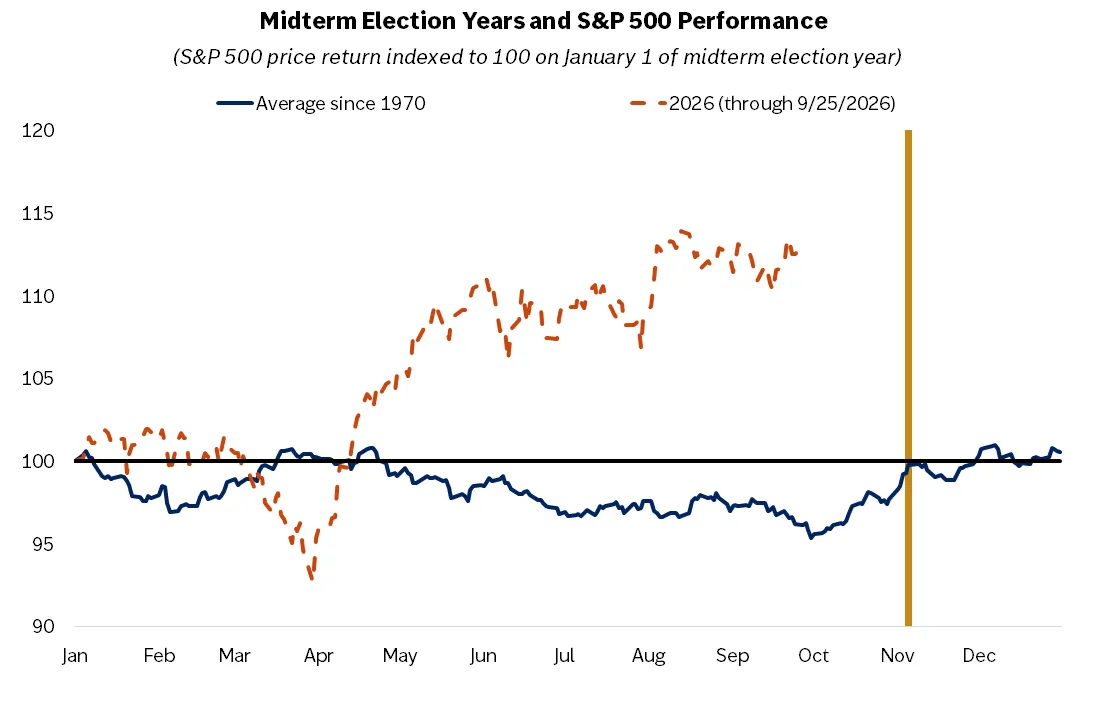
This year the S&P 500 has not followed the typical midterm-year script of weaker returns before election day as policy uncertainty builds. It entered late September up roughly 12% including dividends, well above the 3.6% average full-year return recorded across midterm years since 1970. Also, its March peak-to-trough decline was about 9%, less than half the 19% average midterm-year drawdown. Strong earnings, resilient business investment, and heavy AI-related capital spending have so far outweighed concerns about high energy prices, tariffs, inflation, and interest rates. While strong market performance reflects healthy fundamentals, it may also leave less room for the outsized post-election gains that have often followed weaker midterm years.

 The chart compares the average S&P 500 performance during midterm election years since 1970 with 2026.
Source: FactSet, Edward Jones. Past performance does not guarantee future results. Indexes are unmanaged, cannot be invested into directly and are not meant to depict an actual investment.

2) Interest rates may matter more than election results

Historically, investors often focus on how election outcomes could affect taxes or regulation. This year, markets appear increasingly focused on what congressional control could mean for government spending, deficits, Treasury borrowing, and interest rates. More fiscal spending and Treasury issuance can place upward pressure on bond yields, which in turn can weigh on equity valuations. With yields at multiyear highs driven by a combination of strong growth, persistent inflation, rising energy prices, and high deficits at a time when unemployment is historically low, there appears to be limited appetite for new spending initiatives. Geopolitics and how the Fed's interest rate path unfolds from here will likely remain the dominant drivers of interest rates rather than most legislative proposals.

3) Much of the expected outcome may already be reflected in markets

Election forecasts and prediction markets currently suggest a high likelihood that Democrats will gain at least one chamber of Congress. Republicans hold narrow majorities in both the House and Senate, and losing either chamber would significantly limit their ability to advance major legislative initiatives over the next two years.

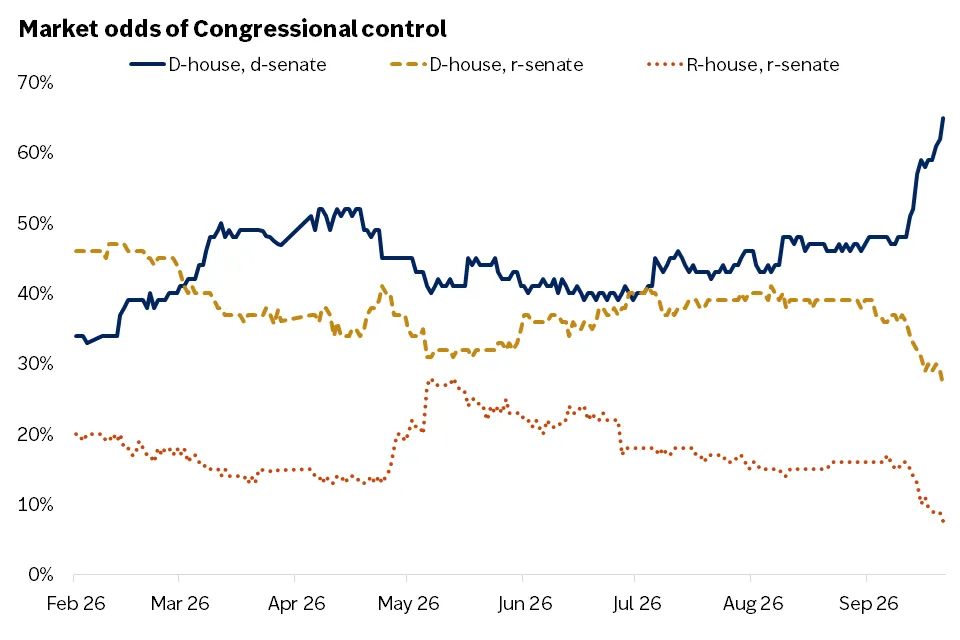
Consistent with the historical tendency for the president's party to lose seats during midterm elections, Democrats have been favored to win the House and are increasingly viewed as having a realistic path to control of the Senate as well. Approximately one month before Election Day, prediction market Kalshi assigns a more than 60% probability to Democrats winning both the House and Senate, up from about 35% in February. It also assigns a 30% probability to a Democratic House with a Republican Senate, leaving less than a 10% chance that Republicans retain control of both chambers.

As with most elections, the largest market moves are often driven by surprises rather than expected outcomes. If the election results align with current expectations, market reactions may be relatively muted because investors have already had time to incorporate those scenarios into asset prices. Conversely, outcomes that differ meaningfully from current expectations could produce a sharper short-term market response as investors reassess the likely policy landscape.

 The graph shows the odds from prediction market Kalshi for the different congressional outcomes.
Source: Bloomberg, Edward Jones

4) Why gridlock may matter more than who wins

While investors appear to be increasingly pricing in some form of divided government, the implications are still worth considering. Even if Democrats were to win both the House and Senate, they would remain well short of the 60 votes typically needed to overcome a filibuster, while President Trump would retain veto authority.

As a result, we think the most likely outcome is a period of legislative gridlock in which large changes to tax policy, spending programs, or regulation become difficult to enact. Historically, major fiscal initiatives have been most common when one party controls both Congress and the White House. By contrast, divided government tends to limit sweeping policy changes and place greater emphasis on economic and corporate fundamentals. While divided government may not prevent incremental spending measures through bipartisan compromise, it is still likely to reduce the odds of a large-scale fiscal expansion relative to unified party control.

From a market perspective, this outcome may reduce policy uncertainty and lessen concerns about substantial new fiscal expansion. To the extent that gridlock constrains future deficits and Treasury issuance relative to a unified-government scenario, it could also remove a source of pressure on long-term interest rates.

5) Executive authority is playing a larger role than in past cycles

One important difference this election cycle, in our view, is the growing role of executive authority. While Congress remains critical for taxes, government spending, appropriations, and debt-limit negotiations, many of the policies affecting markets today can be implemented without new legislation. These include tariffs, foreign policy, immigration enforcement, and portions of the regulatory and energy agenda.

As a result, a change in congressional control may alter the administration's ability to pursue new fiscal initiatives, but it would not necessarily reverse many of the policies currently influencing inflation, supply chains, or energy markets. Even if Congress becomes more gridlocked, executive actions are likely to remain an important driver of outcomes over the next two years.

Investment considerations

While election headlines may generate periods of volatility, a Democratic victory in one or both chambers would likely reinforce a divided-government environment and reduce the odds of significant new legislation over the next two years. As a result, investor attention would likely remain focused on earnings, economic growth, inflation, and interest rates rather than major policy changes.

That does not mean political risks disappear entirely. A divided government could increase the likelihood of contentious negotiations over government funding and the debt ceiling. If Republicans do not address the debt-ceiling issue while they still control Congress, future negotiations could become a source of market volatility, similar to the 2011 standoff that contributed to the downgrade of U.S. sovereign debt. Conversely, Senate oversight of future Federal Reserve appointments could provide investors with greater confidence that the Fed's independence remains intact, as Jerome Powell's term as Board Governor expires in January 2028.

Asset class positioning - From a portfolio perspective, the election outcome alone does not alter our investment positioning. Based on current fundamentals, we continue to favor a combination of mega-cap technology companies and cyclical and value-oriented investments. If inflation remains sticky, we believe large-cap companies with strong balance sheets should remain relatively well positioned. If energy prices ease and inflation pressures moderate, market leadership could broaden into areas such as mid-cap stocks, small-cap stocks, and international equities. Be sure to evaluate these opportunities in the context of your financial goals, risk tolerance, liquidity needs and time horizon.

Sector implications - From a sector perspective, a split-government outcome could create both winners and losers. Managed-care organizations and hospitals could potentially benefit from a compromise around Affordable Care Act (ACA) subsidies, while areas currently counting on substantial deregulation or policy support, including portions of the financial, defense, and cryptocurrency-related sectors, may face a less favorable legislative backdrop.

Bottom line

While election outcomes may influence the policy backdrop, we believe inflation, interest rates, earnings growth, and the durability of the AI-driven capital-spending cycle will have a much greater influence on market returns over the next year. History suggests investors are often rewarded for maintaining a disciplined, long-term approach rather than reacting to election headlines.

For a deeper discussion of the policy and political landscape heading into the midterm elections, see the latest Capital Currents publication from our Policy, Regulatory and Government Relations team.

September 2026 Capital Currents | Monthly Policy & Market Intelligence | Edward Jones

Angelo Kourkafas, CFA
Senior Global Investment Strategist

Sources for all data in commentary: Bloomberg, FactSet

Angelo Kourkafas

Angelo Kourkafas is responsible for analyzing market conditions, assessing economic trends and developing portfolio strategies and recommendations that help investors work toward their long-term financial goals.

He is a contributor to Edward Jones Market Insights and has been featured in The Wall Street Journal, CNBC, FORTUNE magazine, Marketwatch, U.S. News & World Report, The Observer and the Financial Post.

Angelo graduated magna cum laude with a bachelor’s degree in business administration from Athens University of Economics and Business in Greece and received an MBA with concentrations in finance and investments from Minnesota State University.

Read Full Bio

Important Information:

This is for informational purposes only and should not be interpreted as specific investment advice. Investors should make investment decisions based on their unique investment objectives and financial situation. While the information is believed to be accurate, it is not guaranteed and is subject to change without notice. 
Investors should understand the risks involved in owning investments, including interest rate risk, credit risk and market risk. The value of investments fluctuates and investors can lose some or all of their principal. 
Investing in equities involves the risk of loss. The value of an investors shares can fluctuate, and investors can lose money. Small-and mid-cap stocks tend to be more volatile than large company stocks. 
Past performance does not guarantee future results. 
Market indexes are unmanaged and cannot be invested into directly and are not meant to depict an actual investment. 
Diversification does not guarantee a profit or protect against loss in declining markets. 
Dividends may be increased, decreased or eliminated at any time without notice. 
Special risks are inherent in international investing, including those related to currency fluctuations and foreign political and economic events. 
Before investing in bonds, you should understand the risks involved, including credit risk and market risk. Bond investments are also subject to interest rate risk such that when interest rates rise, the prices of bonds can decrease, and the investor can lose principal value if the investment is sold prior to maturity.