Opening an education savings account, saving early and saving often are great ways to help earmark money for your child’s tuition costs.
A 529 Plan, or the variety of other available education savings options, can offer tax benefits, too. Some families worry that saving for college may hurt their chances of receiving financial aid. In reality, 529 plans and many other education savings options are considered parent-owned assets, meaning only a small percentage of the savings (less than 6%) are reflected in the financial aid calculation. The key is to identify which account is right for you and when to start saving, while keeping your other financial goals on track.
How much should I save in a college fund for my kids?
Before diving into what college savings approach is best for you, think about what type of school you want to plan for (private, public, vocational, postgraduate), the associated costs (see the chart below) and how much you want to cover.
Will you pay for:
- All your child’s college expenses?
- Half of everything?
- Tuition but not room and board?
While there isn’t one right answer, you should decide what works best for your family’s personal and financial situation. The table below outlines the cost of attending three types of institutions forecasted 10 and 18 years into the future. Understanding ballpark costs depending on which type of school you want your children to attend can help drive the amount you need to save each month to meet your goals. Your financial advisor can help you determine how much college may cost, as well as how the savings may affect your other goals.
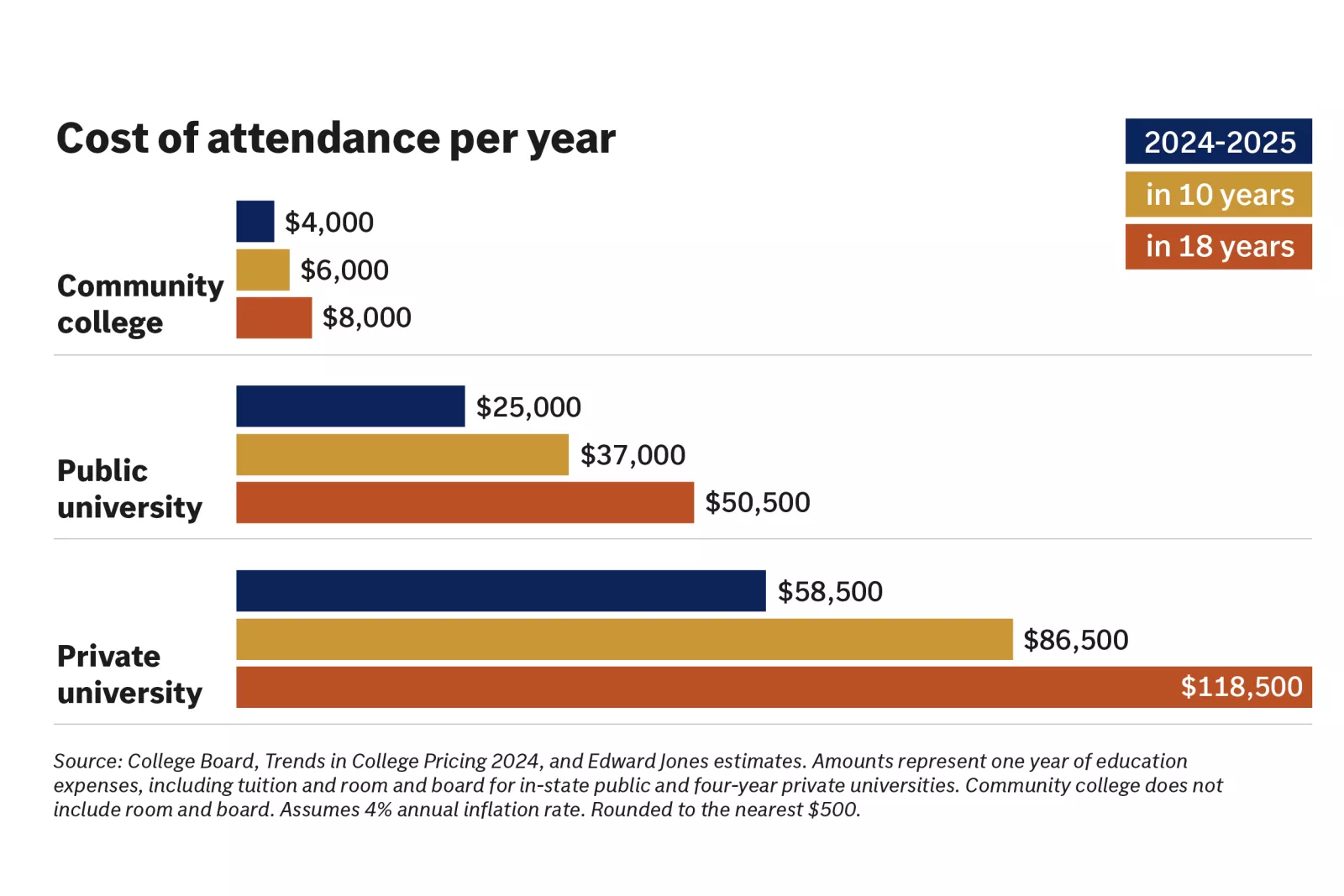
This graph illustrates the yearly cost of attendance for community college, public universities, and private universities for 2024-2025, as well as the forecasted cost in 10 years and 18 years.
• For community college, the yearly cost comes to $4,000 for 2024-2025, $6,000 in 10 years, and $8,000 in 18 years.
• For a public university, the yearly cost comes to $25,000 for 2024-2025, $37,000 in 10 years, and $50,500 in 18 years.
• For a private university, the yearly cost comes to $58,500 for 2024-2025, $86,500 in 10 years, and $118,500 in 18 years.
This graph illustrates the yearly cost of attendance for community college, public universities, and private universities for 2024-2025, as well as the forecasted cost in 10 years and 18 years.
• For community college, the yearly cost comes to $4,000 for 2024-2025, $6,000 in 10 years, and $8,000 in 18 years.
• For a public university, the yearly cost comes to $25,000 for 2024-2025, $37,000 in 10 years, and $50,500 in 18 years.
• For a private university, the yearly cost comes to $58,500 for 2024-2025, $86,500 in 10 years, and $118,500 in 18 years.
If I don’t fully fund my child’s college education, what are other ways to help pay for it?
There are many options for paying for college outside of savings, each with its own set of considerations. Outside of parent contributions and savings, the majority of education funding comes from scholarships, grants and loans. Student income and savings are also meaningful contributors to education funding, including through work-study programs.1
- Scholarships: Scholarships are offered from a variety of sources and don’t have to be repaid. However, many students who qualify will only receive a partial scholarship that won't cover the full cost of college.2
- Grants: Grants generally don’t need to be repaid. While scholarships are often merit-based, grants are more likely to be need-based.
- Federal or private student loans: Loans must be repaid within a certain time frame and incur interest. Over 50% of bachelor’s degree recipients use this option and graduate with student loan debt.3
- Work-study programs: These programs provide part-time jobs for undergraduate and graduate students to help pay for education expenses. How much your student receives in compensation depends on your school and your financial need.
Your financial advisor can show you different ways to save for education and will explain how different ways of investing and borrowing may affect your overall financial strategy.
When do I start a college savings fund for my kids?
Once you have the basics down, you and your financial advisor can talk about how much you need to save and work out a plan to help get you there. Keep in mind, time can be one of your biggest assets, so the earlier you begin saving, the better. Staying on track by earmarking a certain amount each month can make a big difference.
One college savings approach many families adopt is to invest a portion of the money that was previously dedicated to child care expenses into a college savings plan like a 529. This chart shows the differences among three savings strategies:
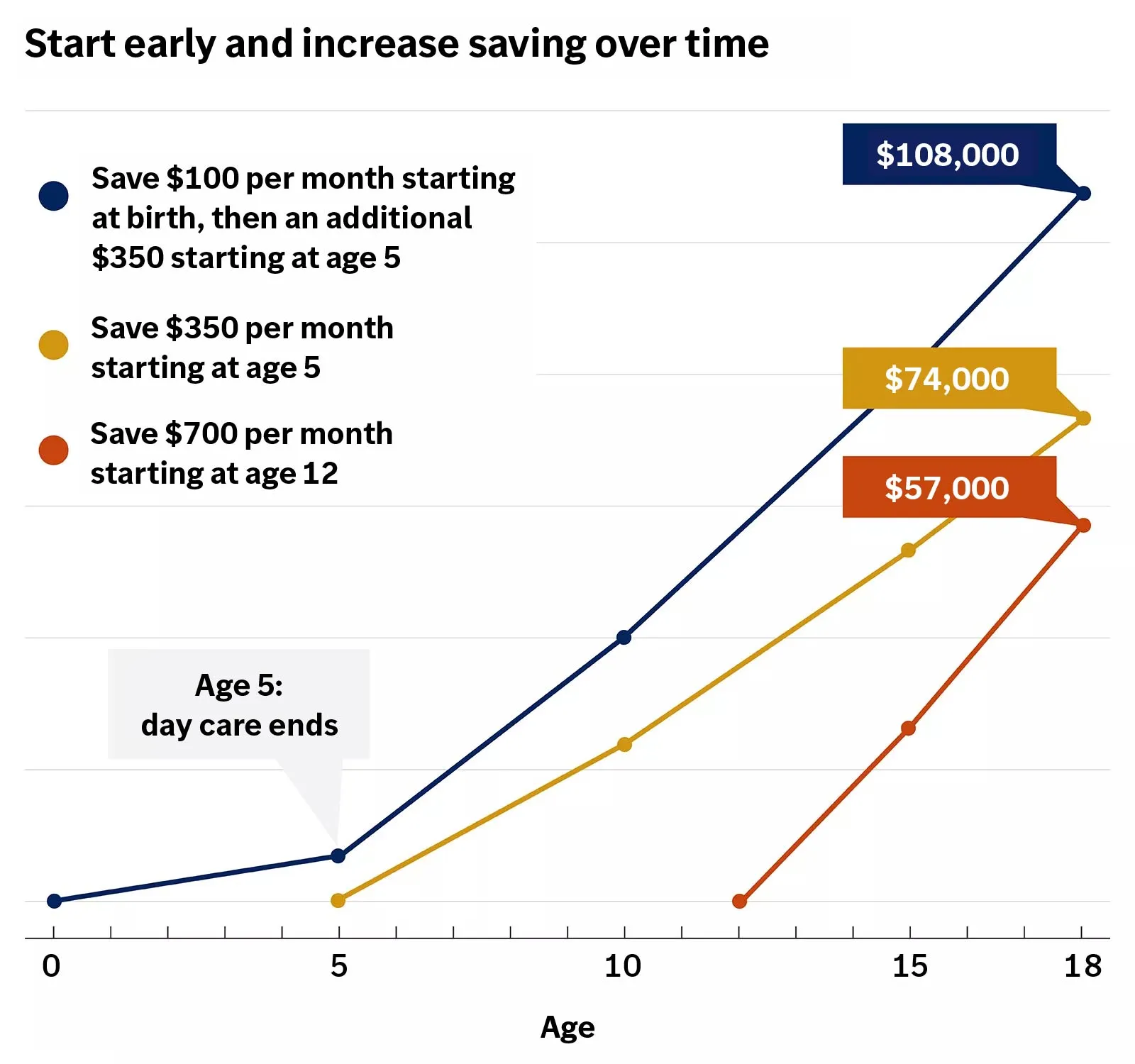
This graph shows how both the amount you save and when you start saving make a real difference.
• The first line shows you’ll accumulate $108,000 if you put aside $100 per month starting at your child’s birth through age 4, then save an additional $350 from childcare savings (for $450 total per month) from age 5 until 18.
• The second line shows you’ll accumulate nearly $74,000 if you put aside a portion of previous childcare costs and save $350 per month starting at age 5 until age 18.
• The third line shows you’ll accumulate $57,000 if you put aside $700 per month for a child from age 12 to age 18.
This graph shows how both the amount you save and when you start saving make a real difference.
• The first line shows you’ll accumulate $108,000 if you put aside $100 per month starting at your child’s birth through age 4, then save an additional $350 from childcare savings (for $450 total per month) from age 5 until 18.
• The second line shows you’ll accumulate nearly $74,000 if you put aside a portion of previous childcare costs and save $350 per month starting at age 5 until age 18.
• The third line shows you’ll accumulate $57,000 if you put aside $700 per month for a child from age 12 to age 18.
Where can I save for my child’s college education?
There are a variety of ways to save for higher education. Common options include:
- 529 savings plan
- Taxable investment accounts
- Roth IRAs
- Savings bonds
- Coverdell education savings account (ESA)
- Custodial accounts (UGMA and UTMA)
Your financial advisor can help determine an appropriate vehicle for your child’s education savings.
Important information:
1 Hanson, Melanie. “How Do People Pay for College?” EducationData.org, April 23, 2022
2 Sallie Mae How America Pays for College 2024
3 College Board, "Trends in College Pricing and Student Aid 2024
Content is provided for educational purposes only and should not be interpreted as specific advice. Investors should make financial decisions based on their unique financial situation. Investing involves risk and investors can lose some of all of their principal.