It seems like there’s always some new rumor going around about Social Security. But due to recent federal layoffs and poor financial projections for the program, they’ve taken on new life. So, let’s discuss what’s behind these myths, whether there’s any truth to them and, most importantly, what you can do about them.
Myth #1: Social Security is going bankrupt
The myth that Social Security is going bankrupt comes up again and again. The concern likely originates from estimates by the Social Security Board of Trustees, which indicate that if no changes are made to the program, Social Security would need to reduce benefits to around 79 cents for each dollar of projected benefits starting in 2033.
While that may sound concerning, it also doesn’t tell the whole story. There are many changes Congress could enact to strengthen the program. For example, Congress could:
- Raise the combined payroll tax,
- Eliminate the cap on earnings subject to the payroll tax, and/or
- Change the full retirement age.
In fact, simply raising the combined payroll tax from 12.4% to 15.73% would fully fund the program through at least 2098, according to the Social Security Board of Trustees. So, while challenges exist, we believe Social Security is and will continue to be a dependable source of income in retirement.
What you can do:
While we don’t believe you’ll need to make changes, here are a few ways you can feel more in control:
- Evaluate where you stand. Work with your financial advisor to incorporate different scenarios into your financial strategy, including one with a benefit reduction, to gain a sense of how it could affect your plan.
- Identify your spending flexibility. Look through your budget and earmark expenses you could reduce in a worst-case scenario. Hopefully you’ll never need it, but you’ll probably feel better knowing you have options.
- Consider delaying Social Security if you haven’t started claiming yet. By delaying Social Security, you can potentially bump up your paycheck and help your loved ones in the event of your untimely passing.
Myth #2: Federal layoffs will affect my Social Security benefits
Recently, the Social Security Administration (SSA) announced plans to reduce its employees by over 10% from 57,000 to 50,000. While these layoffs may negatively impact service quality, to be clear, budget cuts and staff reductions will not reduce your benefit amount.
Even before the SSA announced reductions, wait times to speak with an SSA representative were notoriously long. That’s in part because staffing at the agency has been coming down while at the same time more people are retiring and claiming benefits. As a result, the process to file benefits could get longer, and wait times to talk to a Social Security representative could also increase.
What you can do:
Make a plan before calling or meeting with a Social Security representative to increase the likelihood your questions are answered in a timely fashion. If you need to talk with an SSA agent to receive guidance, make sure you have plenty of time set aside for the call. If you’re visiting an SSA office in person, be sure to make an appointment beforehand and have your documents and questions at the ready.
If you’re signing up for Social Security and are worried about a potential delay in the start of your benefits, consider:
- Starting the application process up to four months ahead of your desired benefit start date,
- Using online resources and tools when possible, and
- Ensuring you have all your documents in order.
Once you start receiving benefits, we think the risk of widespread benefit check delays is low due to the political pressure the government would otherwise face.
Myth #3: Social Security will be sufficient for retirement
While some may think Social Security was designed to provide for all their retirement needs, it’s highly unlikely that it will be enough to fund your dream retirement. That’s because, on average, Social Security only replaces about 40% of your pre-retirement income, according to the SSA. This means you’ll likely be responsible for generating a significant portion of the income you need in retirement. Furthermore, some of the proposed fixes for Social Security — such as increasing the earliest claiming age or the age at which you can claim 100% of your benefits — are likely to increase the amount younger generations will need to save for retirement.
What you can do:
Social Security wasn’t designed to cover all your retirement needs. Make up for what Social Security doesn’t cover by building a larger nest egg with the power of three: time, money and return.
- Time — Whether by starting earlier or by delaying retirement, the longer you save, the more time you’ll have to contribute to, and potentially grow, your retirement account.
- Money — Additional contributions can help build a larger foundation from which your accounts can grow. Consider steadily increasing your contributions as your salary rises and taking advantage of catch-up contributions when you become eligible.
- Return — A higher return can help your retirement funds to grow faster. However, with higher return potential comes higher risk, so make sure to balance your portfolio’s risk and return so you’re not tempted to sell investments at inopportune times.
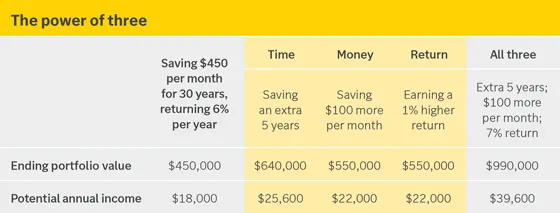
This chart outlines the concept of the "power of three," a strategy to supplement your Social Security income in retirment. It shows how the amount of time you spend saving, the amount of money you invest, and the return potential of those investments all impact the amount you'll have in retirement.
This chart outlines the concept of the "power of three," a strategy to supplement your Social Security income in retirment. It shows how the amount of time you spend saving, the amount of money you invest, and the return potential of those investments all impact the amount you'll have in retirement.
Reach out to your Edward Jones financial advisor
While concerns about Social Security are understandable, we believe Congress will make the appropriate changes for it to remain a dependable source of income in retirement now and in the future.
Your Edward Jones financial advisor can help you better understand your Social Security benefits and design a financial strategy that can help meet your retirement needs.
Opinions stated are as of the date of this newsletter, are for general informational purposes only and are not intended to predict or guarantee the future of Social Security.